Agricultural equipment is not always the first industry people think of for deep hole drilling, but I have done more work for tractor and harvester manufacturers than for almost any other sector. These machines use an enormous number of hydraulic cylinders, and those cylinders need deep, straight bores.
What sets agricultural work apart from, say, aerospace or oil and gas is the volume. Agricultural component manufacturers run high production rates, and the cycle time matters more than getting the last 0.01mm of tolerance.
Hydraulic Cylinders for Tractors and Implements
A large tractor uses 6-12 hydraulic cylinders for steering, implement control, and cab functions. Each cylinder has a barrel that needs a deep hole bore. The typical sizes I see are:
| Application | Bore Diameter | Stroke Length | Barrel Length |
|---|---|---|---|
| Steering cylinder | 40-60mm | 200-400mm | 400-700mm |
| Lift cylinder | 80-120mm | 400-800mm | 600-1200mm |
| Remote implement cylinder | 50-100mm | 300-1000mm | 500-1500mm |
| Suspension cylinder | 60-90mm | 200-500mm | 400-800mm |
Production Gun Drilling Parameters
For the smaller cylinders typical in agricultural equipment, I use gun drilling with these parameters:
| Parameter | 40-60mm bore | 60-100mm bore |
|---|---|---|
| Cutting speed | 80-110 m/min | 75-100 m/min |
| Feed rate | 0.08-0.14 mm/rev | 0.10-0.16 mm/rev |
| Coolant pressure | 400-600 psi | 500-800 psi |
| Cycle time (500mm barrel) | 2-4 minutes | 3-6 minutes |
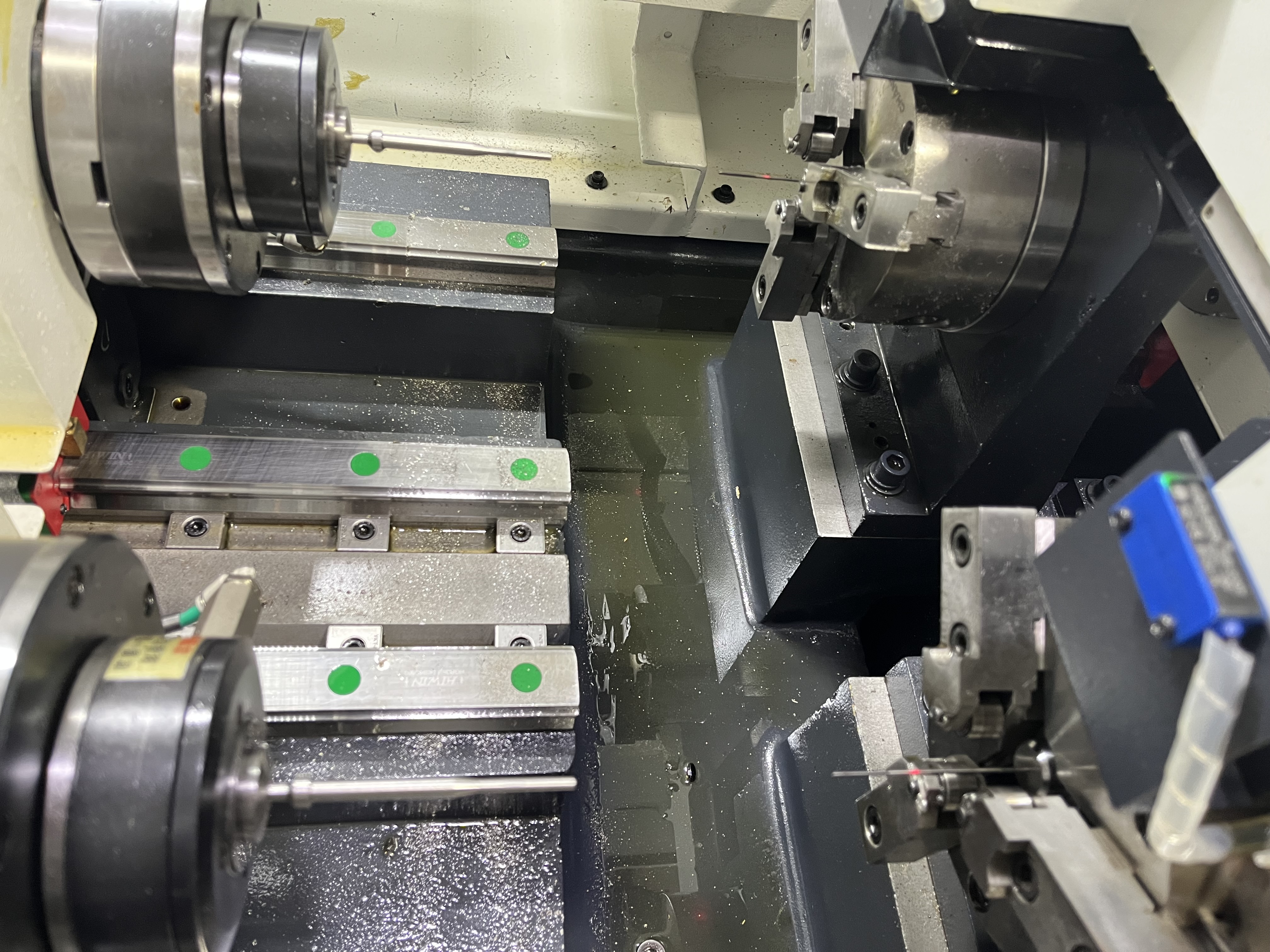
On production runs of 500+ barrels, I use a multi-spindle gun drilling machine. A two-spindle setup cuts the cycle time nearly in half and the capital cost is justified by the volume.
Harvesting Equipment Components
Combine harvesters and forage harvesters have more specialized components. The threshing drum, auger shafts, and cutterbar drives all need drilled holes for lubrication passages and hydraulic lines.
These parts are often in difficult materials. Auger shafts are typically made from 1045 or 4140 steel, but some newer designs use 8620 or 4320 for higher strength.
Harvesting Component Parameters
| Component | Material | Hole Dia | Depth | Speed | Feed |
|---|---|---|---|---|---|
| Threshing drum shaft | 4140 | 12-20mm | 300-600mm | 70-90 m/min | 0.06-0.10 mm/rev |
| Auger shaft | 1045 | 15-25mm | 500-1500mm | 80-100 m/min | 0.08-0.12 mm/rev |
| Cutterbar drive | 8620 | 8-15mm | 200-400mm | 60-80 m/min | 0.05-0.08 mm/rev |
Boom and Sprayer Components
Self-propelled sprayers and boom systems use long tubular booms that can be 20-30 meters wide when deployed. The boom sections are typically aluminum or thin-wall steel tubes. I use thin wall tubing techniques on these.
For sprayer booms, the bores are for hydraulic lines that fold and unfold the boom sections. These are small-diameter bores – 6-15mm – through 3-6mm wall thickness tubing.
Sprayer Boom Drilling Parameters
| Parameter | Aluminum 6061 | Steel Tube |
|---|---|---|
| Cutting speed | 100-140 m/min | 70-90 m/min |
| Feed rate | 0.05-0.10 mm/rev | 0.04-0.08 mm/rev |
| Coolant pressure | 300-500 psi | 500-800 psi |
| Support method | Mandrel | Mandrel |
Wear and Surface Finish Requirements
Agricultural cylinders do not need the mirror finishes that aerospace or medical components do. A surface finish of 1.6-3.2 microns Ra is acceptable for most agricultural cylinders. The seals used in agricultural equipment are typically polyurethane or nitrile rubber, which can tolerate a slightly rougher bore than the PTFE seals used in high-pressure industrial cylinders.
The straightness requirement is also looser – 0.1mm per meter is typical, compared to 0.05mm per meter for aerospace.
Key Takeaways
- Agricultural work is volume-driven – multi-spindle machines pay off at 500+ parts
- Cylinder sizes are smaller than construction equipment – 40-120mm bore typical
- Surface finish of 1.6-3.2 Ra is acceptable for agricultural seals
- Sprayer booms are thin-wall aluminum or steel – use mandrel support
- Lower precision requirements mean faster cycle times are possible
For related equipment, see construction and mining deep hole drilling and valve and pump components.