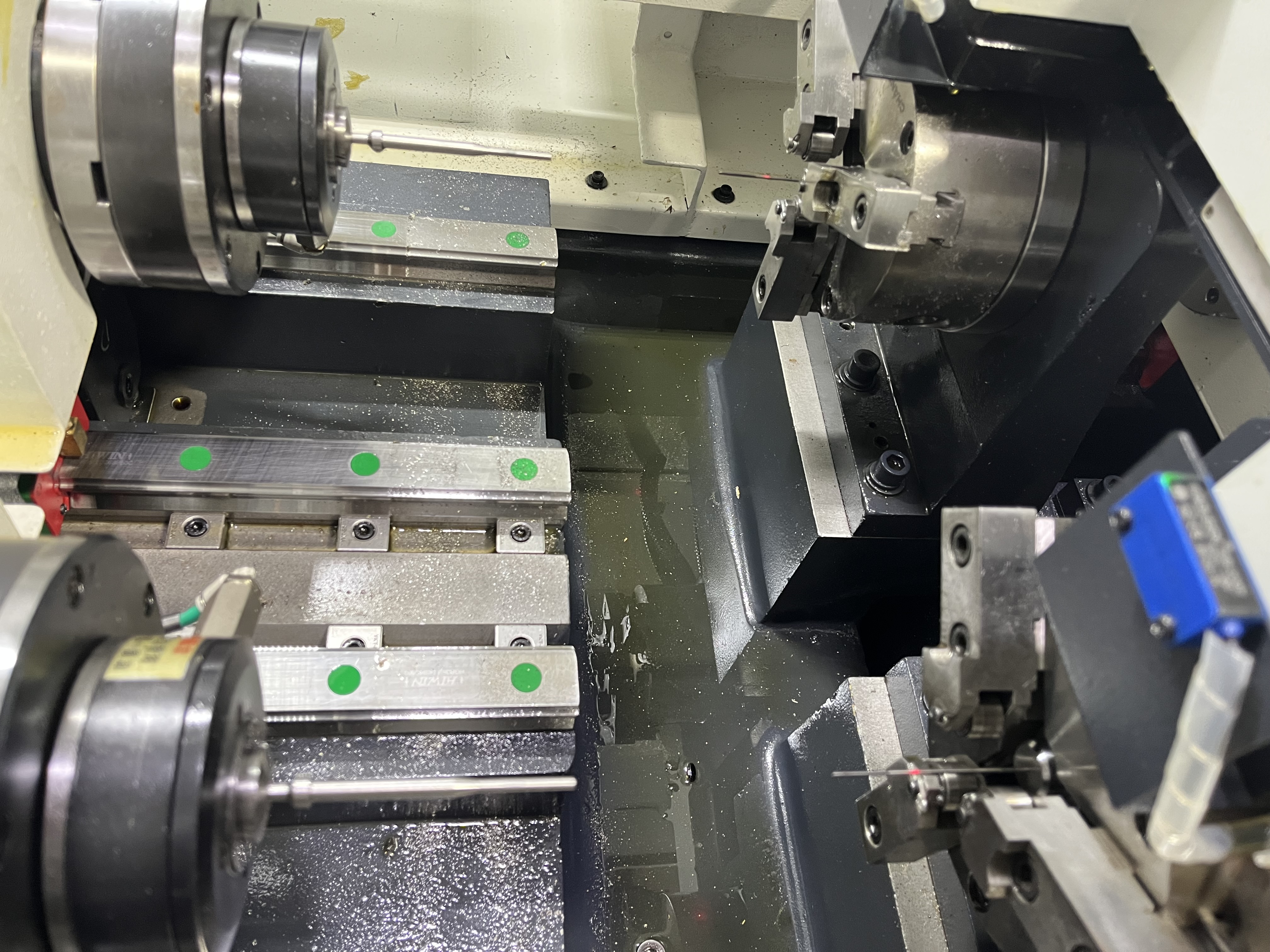
Automotive manufacturing has been the biggest driver of deep hole drilling technology for decades. A modern car engine alone has dozens of deep holes — oil galleys in the block, crank oil passages, connecting rod bores, fuel injector channels. Every one of them is a gun drilling or BTA drilling job. (For the EV side of automotive, I covered motor shafts separately. This one is about the traditional ICE side.)
I’ve worked on automotive lines and job shop work for automotive suppliers. The production volumes change the way you think about the work.
Crankshaft Oil Passages
A crankshaft has oil passages that run from the main bearing journals to the rod journals. These are drilled at an angle — typically 30 to 45 degrees — and they have to intersect precisely inside the casting or forging.
The challenge with crankshafts is the interrupted cut. The drill enters the surface, hits a void inside the casting, then re-enters material on the far side of the oil cavity. That’s hard on gun drills. I’ve found that reducing feed by about 30% through the intersection zone prevents the edge from chipping.
Typical crankshaft drilling parameters:
| Parameter | Value |
|---|---|
| Hole diameter | 4-8mm |
| Depth | 100-300mm |
| Cutting speed | 70-90 m/min |
| Feed rate | 0.02-0.04 mm/rev |
| Coolant pressure | 1000-1500 psi |
Connecting Rods
Connecting rods need a drilled oil passage from the big end to the small end. The hole is usually small — 3-6mm — and runs the full length of the rod, maybe 150-250mm.
The difficulty is that connecting rods are forged, and the forging scale is abrasive. Gun drills wear faster on the first few parts after the rod is machined. I’ve seen tool life drop by half on forged rods compared to bar stock.
| Parameter | Value |
|---|---|
| Hole diameter | 3-6mm |
| Depth | 150-250mm |
| Cutting speed | 60-80 m/min |
| Feed rate | 0.015-0.03 mm/rev |
| Coolant pressure | 1200-1600 psi |
The feed rate is the one I adjust most. On forged rods, I stay at the low end — 0.015 mm/rev — to reduce the shock on the cutting edge when hitting the scale. On bar stock, I can push to 0.03 mm/rev without issues.
For high-volume connecting rod work, I run a slightly higher coolant pressure and change the drill after a set number of parts rather than waiting for it to dull. The consistency matters more on a production line than getting the last possible hole out of a tool.
Fuel Injector Components
Fuel injector bodies have some of the tightest tolerances in automotive deep hole drilling. A common rail injector might have a 1.2mm hole that’s 80mm deep — a 66:1 L/D ratio — with a diameter tolerance of ±0.005mm.
At those diameters, the gun drill is fragile. A 1.2mm drill at 80mm depth is prone to wandering and breakage. I’ve found that the most important factor is the guide bushing condition. If the bushing is worn by more than 0.005mm, the drill will wander before it even enters the part.
For micro-hole injector work, the coolant filtration level matters too. I run 5-micron filtration on these jobs. Anything larger lets particles through that can clog the coolant hole in the drill, and once coolant stops flowing through a 1.2mm drill, the cutting edge fails in seconds.
Transmission Components
Automatic transmissions have valve bodies with dozens of small-diameter deep holes — oil circuits, control passages, vent paths. These are typically drilled in aluminum valve bodies at high speed.
Aluminum is easier to drill than steel, but it’s also easier to damage. The chips are soft and can weld to the drill if coolant isn’t adequate. I run a higher feed in aluminum — 0.08-0.12 mm/rev — to get the chips out fast, and I use an emulsion with high lubricity.
The cycle time matters on transmission valve body lines. I’ve seen shops running 12-spindle gun drilling machines that drill all the holes in a valve body simultaneously. The machine cost is high, but the per-part cost is lower than any other method.
Production Setup for High-Volume Lines
High-volume automotive lines need a different approach to part loading and workholding than what works in a job shop. When you’re running 10,000 crankshafts a month, every second of load time matters.
The setups I’ve seen work best use automated palletized workholding. The operator loads parts onto pallets offline while the machine runs, then a gantry system swaps the pallet into position. The machine never waits for a part. I’ve worked on lines where the pallet change takes under 30 seconds, compared to 3-5 minutes for manual setup on a conventional machine.
Chip management is another factor that job shops underestimate. On a high-volume line, the BTA or gun drilling machine generates chips continuously. I’ve seen lines with chip conveyors running under the machine that carry chips to a central collection system. Without that, the operator spends more time clearing chips than running parts.
I also rely on tool monitoring more aggressively on production lines. Aerospace work uses tool change intervals based on part count with a safety margin — the same principle applies here. A torque monitoring system catches a dull tool before it breaks, which prevents machine downtime and scrapped parts.
What Automotive Teaches You
The main thing I’ve learned from automotive work is that consistency beats maximum performance. On a job shop run of 50 parts, you can adjust parameters for each batch. On an automotive line running 10,000 parts a month, the parameters need to be set so that the process stays stable without anyone touching it.
That changes how you pick cutting data. I run slightly conservative parameters on production lines — 10-15% below what the tool can take — because a stable process that runs without operator intervention is worth more than 5% faster cycle time.
Key Takeaways
- Automotive deep hole drilling spans a wide range: micro-holes for fuel injectors (1.2mm) to large oil passages in crankshafts (4-8mm).
- Interrupted cuts on crankshafts and forged connecting rods require reducing feed by 30-50% through intersection zones to protect the cutting edge.
- Fuel injector work at 66:1 L/D demands near-perfect guide bushings and 5-micron coolant filtration to prevent drill wander and clogging.
- High-volume production lines benefit from automated palletized loading and chip conveyor systems to maximize spindle utilization.
- On production lines, run parameters 10-15% below the tool’s maximum to keep the process stable without operator intervention.