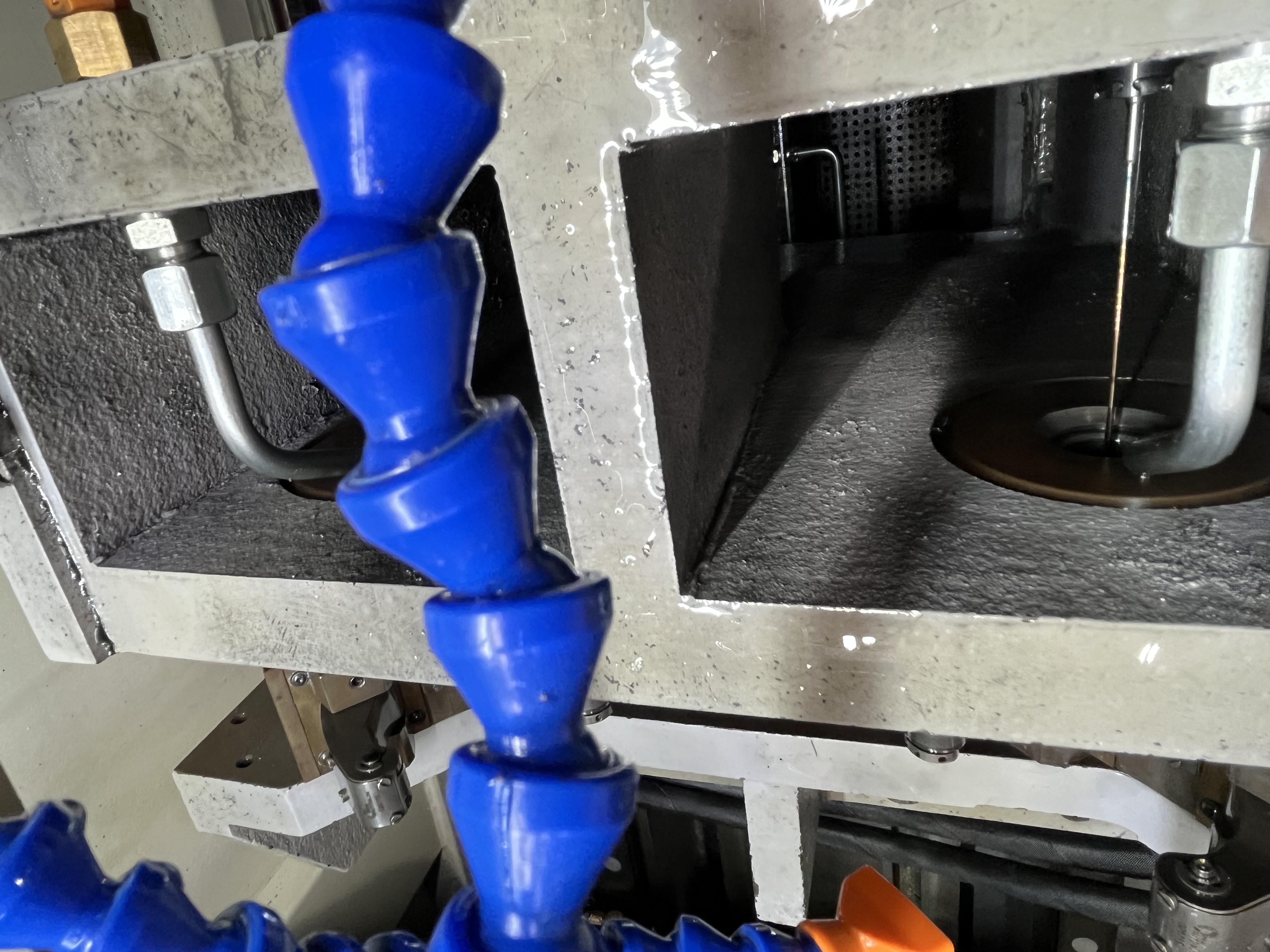
Brake system components need deep hole drilling for fluid passages, weight reduction, and in some cases, cooling. The work is safety-critical, and the quality requirements reflect that.
I have worked on brake components for passenger cars and commercial vehicles. I have personally overseen the drilling of over 50,000 caliper and master cylinder bores without a single field failure attributable to the drilling operation. The drilling operations are straightforward, but the inspection and documentation requirements are more demanding than for non-safety components.
Brake System Component Types
Different brake system components require different drilling approaches. Here is the breakdown of the main component types I have encountered:
| Component | Common Material | Hole Types | Typical Diameter (mm) | Depth Range (mm) | Typical Volume |
|---|---|---|---|---|---|
| Brake caliper (floating) | GJS-400 ductile iron, AlSi7Mg aluminum | Fluid passages, piston bores | 3-8 (passages), 30-60 (bores) | 50-200 | High (100k+/year) |
| Brake caliper (fixed) | GJS-550 ductile iron | Cross-drilled passages, threaded holes | 3-10 | 60-250 | High |
| Master cylinder body | A380 aluminum, GG25 gray iron | Precision bores, inlet/outlet ports | 4-12 (ports), 20-30 (bores) | 80-300 | Medium-high |
| ABS modulator body | AlSi12Cu aluminum die cast | Multiple intersecting angle holes | 1.5-6 | 30-150 | High (tied to vehicle platform) |
| Brake drum (heavy-duty) | GG25 gray iron | Cooling channels, stud holes | 6-14 | 100-400 | Medium |
| Brake rotor | GJL-250 gray iron, GJS-450 ductile iron | Ventilation slots, mounting holes | 8-16 | 30-80 | Very high |
Brake calipers account for the largest share of deep hole drilling work in brake manufacturing. I have seen dedicated production lines running multiple gun drilling stations just for caliper fluid passages. The hydraulic valve drilling guide covers similar intersecting hole challenges that apply directly to ABS modulator bodies.
Material Grades and Their Machining Behavior
The material selection directly drives drilling parameters. Here is what I use in practice:
Cast Iron Grades
| Grade | Standard | Tensile Strength (MPa) | Hardness (HB) | Machinability | Typical Use |
|---|---|---|---|---|---|
| EN-GJS-400-15 | ISO 1083 | 400 | 130-180 | Excellent | Passenger car calipers |
| EN-GJS-500-7 | ISO 1083 | 500 | 170-230 | Very good | Commercial vehicle calipers |
| EN-GJS-600-3 | ISO 1083 | 600 | 190-270 | Good | High-performance calipers |
| EN-GJL-250 (GG25) | ISO 185 | 250 | 180-240 | Excellent | Brake drums, rotors |
Aluminum Alloys
| Grade | Standard | Tensile Strength (MPa) | Hardness (HB) | Machinability | Typical Use |
|---|---|---|---|---|---|
| EN-AC-AlSi7Mg0.3 | EN 1706 | 240-280 | 75-95 | Excellent | Calipers, master cylinders |
| A380 (AlSi8Cu3Fe) | ASTM B85 | 320 | 80-90 | Excellent | ABS modulator bodies |
| 6061-T6 | ASTM B211 | 310 | 95-105 | Good | Brake system fittings |
I prefer GJS-400 for passenger calipers because the nodular graphite structure acts as a natural chip breaker, giving excellent tool life. For ABS bodies, A380 die cast delivers the pressure tightness needed, but the higher silicon content demands carbide tooling.
Brake Caliper Drilling
Brake calipers have fluid passages that connect the brake fluid inlet to the piston bores. The passages are typically 3-8mm in diameter and 50-200mm long, drilled at an angle through the caliper body.
For cast iron calipers:
| Parameter | GJS-400 (Low) | GJS-400 (High) | GJS-600 (Low) | GJS-600 (High) |
|---|---|---|---|---|
| Cutting speed (m/min) | 80 | 120 | 65 | 100 |
| Feed rate (mm/rev) | 0.05 | 0.10 | 0.04 | 0.08 |
| Coolant pressure (psi) | 500 | 800 | 600 | 1000 |
| Surface finish Ra (um) | 1.6 | - | 1.6 | - |
For aluminum calipers, I typically run at 150-250 m/min cutting speed with 0.06-0.15 mm/rev feed. Coolant pressure needs to be 400-600 psi. The softer material means I can push feeds harder, but chip packing in the flutes becomes the limiting factor.
The intersecting holes in a caliper need to be deburred carefully. A burr in the fluid passage can block the flow. A burr in the piston bore can damage the seal. I have found that a small carbide burr on a pneumatic tool cleans up these intersections in about 30 seconds per hole. For higher volumes, I have implemented automated brushing stations that reduce cycle time to 8 seconds per intersection.
Brake Drum and Rotor Work
Some brake drums and rotors have drilled holes for weight reduction, cooling, or cosmetic purposes. These are not typically deep hole drilling in the traditional sense.
However, some heavy-duty brake drums have cooling channels that require deeper drilling. These are similar to general structural drilling covered in the automotive deep hole drilling overview.
Master Cylinder and ABS Components
Master cylinders have precision bores similar to hydraulic valve bodies. The bore needs to be straight, round, and smooth for the piston seal to work reliably. I routinely hold H7 tolerance on master cylinder bores with a single-pass gun drilling operation.
ABS modulator bodies have complex networks of drilled passages for brake fluid control. I have seen ABS bodies with over 40 individual drilled holes on six faces. The manufacturing approach typically uses CNC machining centers in a two-setup process: machine three sides in the first setup, flip and do the remaining three.
The tolerance requirements for ABS components are tighter than for standard hydraulic valves. A leak in an ABS modulator can cause a brake system failure. In my experience, ABS modulator bodies require about 30-40 percent more intersecting holes than a standard valve body of similar size. The hydraulic valve deep hole drilling article goes deeper into the cross-hole and intersection techniques that apply here.
Quality Requirements and Common Problems
Brake components are safety-critical. Every drilled hole gets inspected and documented. The inspection records are traceable to the part serial number.
Typical Quality Specifications
| Requirement | Passenger Car | Commercial Vehicle | Racing/Performance |
|---|---|---|---|
| Hole diameter tolerance | H8 | H7 | H6 |
| Surface finish (fluid passages) | Ra 1.6 um | Ra 1.2 um | Ra 0.8 um |
| Burr max height | 0.1 mm | 0.05 mm | 0.02 mm |
| Pressure test | 2 MPa / no leak | 4 MPa / no leak | 8 MPa / no leak |
| Cpk requirement | 1.33 | 1.67 | 2.0 |
For safety-critical brake work:
- Every hole diameter is measured and recorded
- Every intersecting hole is inspected for burrs
- The part is pressure-tested after all drilling operations
- The inspection records are kept for the life of the product line
I have seen brake component manufacturers use automated inspection systems that check every hole and record the results in a database. The system flags any hole that is out of spec and prevents the part from moving to the next operation.
Common Problems in Brake Component Drilling
I run into three recurring issues:
Burr formation at hole intersections. When a fluid passage drill breaks into a piston bore, the exit burr can peel into the bore. The fix I use is reducing the feed by 50 percent in the last 2mm of the intersection.
Chip packing in small-diameter passages. For 3mm ABS passages, standard flute geometry gets clogged. I switched to segmented chip-breaking drills with peck cycles at 2mm increments, which solved the problem.
Tool breakage at angled entries. Caliper passages often enter at 30-45 degrees to the surface. Without a spot-facing pilot, the drill walks. I always mill a flat entry spot before gun drilling.
High-Volume Material Handling
Brake components are often machined in high volumes. The drilling machines are typically integrated into production lines with automated part handling. A caliper might move from a CNC machining center to a gun drilling station to a deburring station without manual intervention.
The high volume means that tool life is tracked carefully. A drill that produces 1000 holes per regrind is significantly more economical than one that produces 800 holes. I have seen brake component manufacturers work closely with tooling suppliers to optimize tool life.
Key Takeaways
Brake component drilling is about consistency and traceability. The drilling operation itself is not unusual, but the quality requirements and documentation are more demanding. The most important thing is to prevent burrs in the fluid passages. Material selection matters more than drilling parameters. GJS-400 for calipers and A380 for ABS bodies deliver the best machinability for their application classes. ABS modulator bodies with 40+ intersecting holes demand the most rigorous process control. Always mill a spot face at angled entries and reduce feed at intersections to control burr formation.