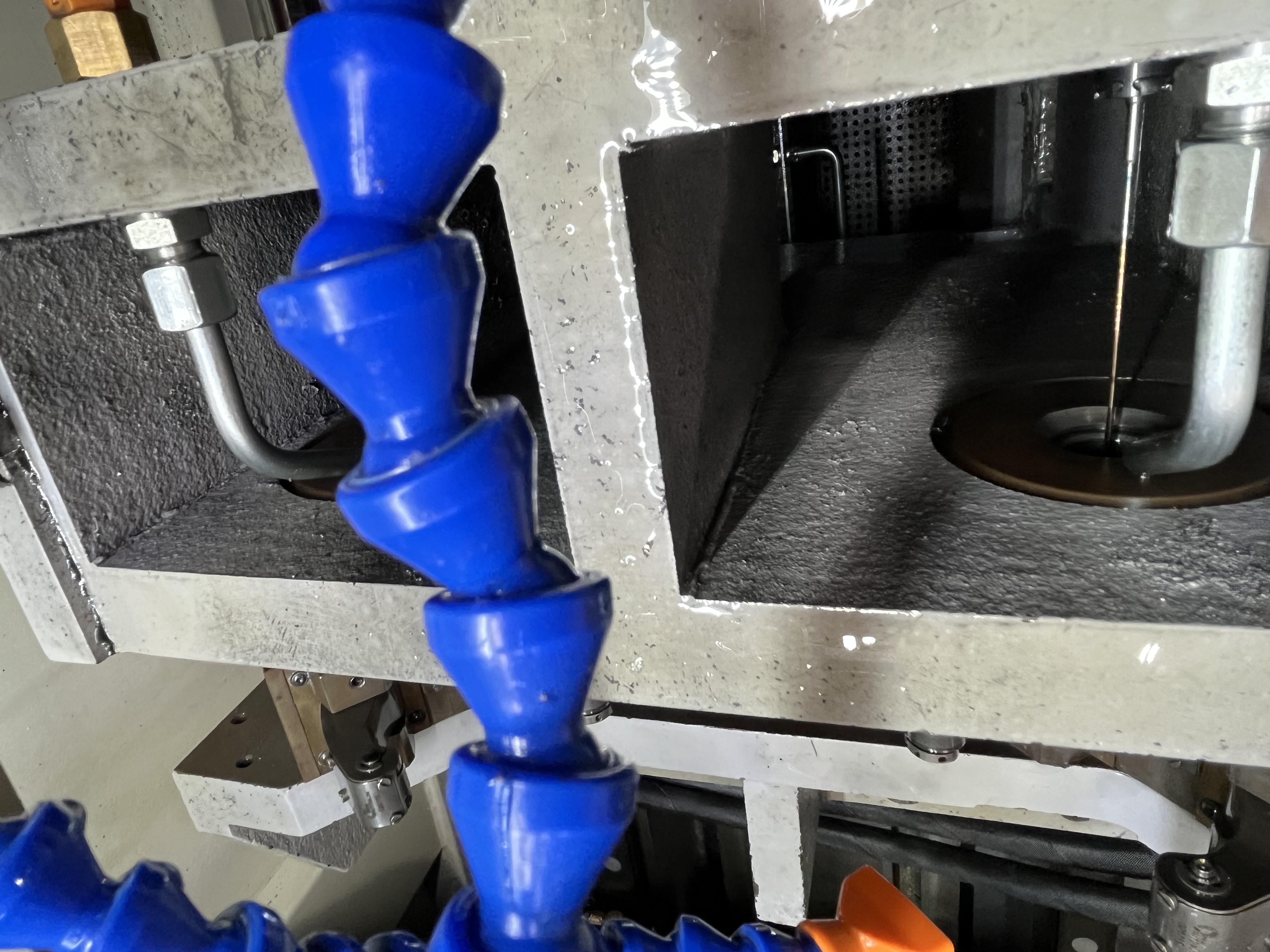
Castings are different from wrought material. The grain structure is not uniform, there can be porosity, and the surface has a tough scale layer. I have drilled plenty of cast iron and steel castings over the years, and I have learned that treating them like wrought bar stock is a fast way to break a drill.
The main differences from wrought material are the entry surface and the internal consistency. Here is what I have learned from drilling thousands of holes in castings.
Casting Types and Their Drillability
| Casting Type | Common Grades | Hardness Range | Drillability | Key Challenge |
|---|---|---|---|---|
| Gray cast iron | ASTM A48 Class 20-40 | 140-220 HB | Excellent | Abrasive scale, graphite dust |
| Ductile (nodular) cast iron | ASTM A536 60-40-18 | 170-280 HB | Good | Harder than gray iron, lower speeds |
| Malleable cast iron | ASTM A47 32510 | 110-260 HB | Good | Variable hardness through cross-section |
| Compacted graphite iron (CGI) | ASTM A842 | 180-280 HB | Fair | Very abrasive, high cutting forces |
| Steel castings (low carbon) | ASTM A27 60-30 | 120-180 HB | Fair to Good | Thick scale, hard spots, porosity |
| Steel castings (alloy) | ASTM A148 90-60 | 200-350 HB | Fair | Heavy scale, inconsistent hardness, inclusions |
| Stainless steel castings | CF8, CF8M, CA15 | 150-300 HB | Poor | Work hardening, stringy chips, porosity |
| Aluminum castings | A356, 319, 380 | 60-110 HB | Good to Poor depending on porosity | Porosity is the main issue |
Gray cast iron is the easiest material I have ever drilled. The graphite content acts as a natural lubricant, and the chip formation is excellent — short, broken chips that evacuate easily. Ductile iron is harder and more abrasive. Steel castings are the ones that keep me up at night.
The Casting Scale
Every casting has a hard scale on the surface from the casting process. The scale is abrasive and dulls drills fast. For cast iron, the scale is relatively thin — 1 to 2 mm. For steel castings, it can be 3 to 5 mm or thicker, especially on heavy-section castings.
I always machine the entry surface before gun drilling. I take a 3 mm pass over the entry face for cast iron and a 4 to 5 mm pass for steel castings. This gets through the scale and gives the drill a clean, perpendicular surface to start on. I cover this in more detail in my article on spot facing before deep hole drilling.
If I cannot machine the entry face, I use a stub drill at 3x diameter to create a pilot hole, then follow with the long drill. The pilot hole needs to be deep enough to guide the drill through the scale layer.
Porosity
Porosity is the single biggest problem when deep hole drilling castings. Small voids from trapped gas form during solidification. When the drill hits a void, the cutting forces drop to nearly zero. When it re-enters solid material, the drill grabs and the shock load can chip the cutting edge or snap the drill.
I reduce feed by about 20 percent when drilling castings that are prone to porosity. The lower feed reduces the shock when the drill hits a void. I also use a tougher carbide grade — C2 instead of C3 — to give the edge more impact resistance.
The porosity problem gets worse with section thickness. Heavy casting sections cool slower, which gives gas bubbles more time to form and migrate. Thin-wall castings generally have less porosity because they solidify faster.
Hard Spots
Hard spots in castings come from several sources. In cast iron, chilled areas form when the molten metal cools too fast against the mold wall, producing white iron instead of gray iron. White iron is extremely hard — 45 to 55 HRC — and will destroy a carbide drill in seconds.
In steel castings, hard spots can come from segregation of alloying elements during solidification. I have hit spots in alloy steel castings that measured 50 HRC in a part that was supposed to be 25 HRC.
When I suspect hard spots, I reduce feed by 30 to 40 percent and listen to the sound of the cut. A change in pitch usually means the drill has hit a harder zone. If the sound changes, I stop and check the chip color. Blue chips mean the temperature is spiking from the hard spot. If you are dealing with consistent hard spot issues, my article on material hard spots in deep hole drilling covers the diagnostic approach I use.
Non-Metallic Inclusions
Sand inclusions from the casting mold can get trapped inside the casting. These are hard, abrasive particles that wear the drill edge unevenly. I have seen a single sand inclusion wipe out an entire cutting edge in one pass. The symptom is a sudden jump in surface roughness halfway through the hole.
Recommended Parameter Adjustments for Castings
Here are my starting parameters for deep hole drilling different casting types. I adjust based on the actual material condition:
| Casting Type | Cutting Speed (m/min) | Feed (mm/rev) | Coolant Pressure (bar) | Notes |
|---|---|---|---|---|
| Gray cast iron | 80-120 | 0.06-0.12 | 35-55 | Start mid-range, increase feed |
| Ductile cast iron | 60-90 | 0.05-0.10 | 40-60 | Reduce speed 20% vs gray iron |
| Steel castings (low carbon) | 50-70 | 0.04-0.08 | 50-70 | Reduce feed 20% if porosity expected |
| Steel castings (alloy) | 35-55 | 0.03-0.06 | 60-80 | Start conservative, verify first hole |
| Stainless steel castings | 25-40 | 0.02-0.05 | 60-80 | Use chip breaker geometry |
| Aluminum castings | 100-180 | 0.08-0.15 | 25-40 | Watch for porosity at depth |
| CGI | 50-70 | 0.04-0.08 | 50-70 | Very abrasive, check tool wear frequently |
The general rule I follow is to drop both speed and feed by 20 to 30 percent compared to wrought material of the same grade, then open up parameters after drilling the first five holes and verifying tool condition.
Inspection Requirements for Castings
I check these things on every casting batch before drilling:
- Hardness check — Three spots minimum per casting, spread across the section. Note any variation above 20 HB.
- Surface condition — Look for scale thickness, sand inclusions, and surface porosity.
- Dimensional check — Castings can have draft angles and parting line mismatch that affect drill entry.
- Ultrasonic test — For critical applications, I ask for ultrasonic inspection to map internal porosity zones before drilling.
After drilling, I inspect the holes for:
- Surface finish irregularities that might indicate porosity zones
- Tool wear patterns that suggest hard spots
- Burr condition at exit — castings often produce larger exit burrs than wrought material
Key Takeaways
Castings are unpredictable compared to wrought material. The grain structure, hardness, and internal consistency vary within a single casting, let alone across a batch. I always start with conservative parameters and open up after verifying the material is consistent. Machining the entry surface before drilling eliminates the most common entry problem. Feed reduction during drilling helps manage porosity shock loading. And hardness checking every casting in the batch catches hard spots before they break a drill. A bad casting can ruin a drill in seconds — verifing the material before you commit to the cut is the only reliable prevention.