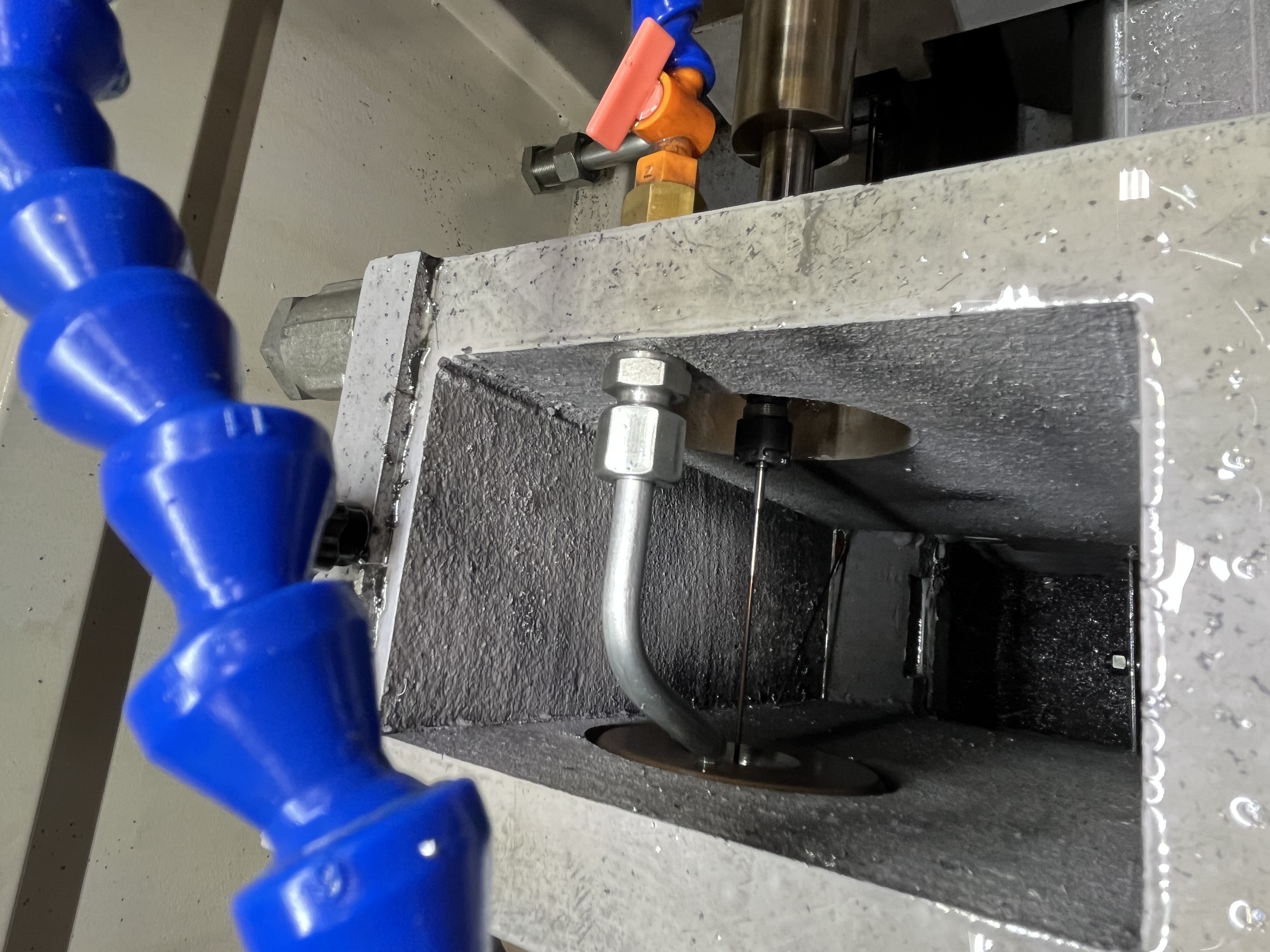
Some of the most demanding deep hole drilling jobs involve drilling a small-diameter hole through several meters of steel with near-perfect straightness. The classic application is gun barrel drilling — the process that gun drilling is named after. Defense applications remain the most stringent driver of long tube drilling standards today, from rifle barrels to artillery components and missile guidance housings.
The challenge is straightness. A 5mm hole through 2 meters of steel at a 100:1 L/D ratio needs to be straight to within a few hundredths of a millimeter per meter. If the hole drifts, the wall thickness changes, and the part is scrap. For defense-grade components, the stakes are even higher because barrel straightness directly affects projectile accuracy.
Defense Applications and Military Specifications
I have worked on defense contracts that required compliance with MIL-STD-130N for identification marking and MIL-HDBK-727 for drilled hole tolerances. The defense sector has specific requirements that go beyond commercial deep hole drilling standards. Here are the key defense applications I have encountered and the specifications that govern them.
| Defense Component | Typical Material | Depth Range | Straightness Requirement | Governing Spec |
|---|---|---|---|---|
| Rifle barrels | 4140/4150 steel, stainless | 500-1000mm | 0.05mm per meter | MIL-HDBK-727 |
| Artillery tubes | High-strength alloy steel | 2-8 meters | 0.08mm per meter | Individual program spec |
| Missile guidance housings | Aluminum, titanium alloys | 200-500mm | 0.025mm per meter | MIL-STD-130N |
| Ordnance components | 4340, 300M steel | 100-600mm | 0.05mm per meter | MIL-DTL specific |
| Hydraulic actuators (military) | 17-4PH, 15-5PH stainless | 300-1200mm | 0.04mm per meter | MIL-SPEC hydraulic |
| Naval propeller shafts | Monel, Inconel, high-strength steel | 1-6 meters | 0.1mm per meter | ABS/Naval standards |
MIL-HDBK-727 provides design guidance that explicitly addresses deep hole drilling as a cost factor. The handbook notes that cost increases significantly when the length-to-diameter ratio exceeds 3:1. For defense contracts, I always budget high for L/D ratios above 20:1 because the rejection rate at inspection is higher.
The defense industry typically requires drift tolerance of 0.001 to 0.002 inches per inch of depth — approximately 0.04 to 0.08mm per 25mm. I have held 0.001 inches per inch on production runs of rifle barrels by using counter-rotation and maintaining tight material hardness specifications.
The Process
The standard method for long tube drilling is gun drilling with a rotating workpiece and counter-rotating tool. The counter-rotation cancels out the tendency of the drill to wander off center. For defense applications, I absolutely require counter-rotation — I will not run a defense barrel without it.
I’ve run this on dedicated gun drilling machines with a headstock that rotates the workpiece and a tool spindle that rotates in the opposite direction. The workpiece rotation speed is typically lower than the tool speed — maybe 50-200 rpm for the workpiece versus 3000-5000 rpm for the tool.
The counter-rotation gives noticeably better straightness than rotating the tool alone. I’ve measured straightness of 0.05mm per meter with counter-rotation versus 0.15mm per meter with tool-only rotation on the same machine. On a 2-meter rifle barrel, that difference means the difference between passing MIL-HDBK-727 tolerances and scrapping the part.
Material Considerations
The material for long tube work is usually a high-strength alloy steel like 4140 or 4150, heat-treated to a uniform hardness. For defense components, I also work with 4340, 300M, 17-4PH stainless, and occasionally titanium alloys for missile components. Consistency matters more than absolute hardness. If the material varies in hardness along the length, the drill will steer toward the softer side.
I’ve seen this happen: a tube that was supposedly uniform had a hard spot near one end, and the drill drifted by 0.2mm passing through it. After re-heat-treating the tube for better uniformity, the next attempt drilled straight through.
For long tube work, I recommend specifying a hardness range of no more than 5 HRC across the length. Anything wider risks deviation. For defense contracts, I push for a 3 HRC maximum spread. Defense material certifications typically include the hardness traverse data, which I review before accepting the material for production.
Drill Support
At depths of 1.5 meters or more, the gun drill needs support along its length to prevent it from buckling under feed pressure. The support comes from the drill tubes — long steel tubes that connect the drill head to the machine spindle.
The drill tube is supported by steady rests along its length. A 2-meter drilling depth might need 3 or 4 steady rests on the drill tube alone. The steady rests are usually carbide-faced to handle the high surface speed of the rotating tube. For defense applications with deep L/D ratios, I add an extra steady rest beyond what I would use for commercial work.
Pressure head at the entry point seals the coolant into the bore and keeps the drill aligned. A worn pressure head seal causes coolant leaks that rob pressure from the cutting edge. In defense production, I replace pressure head seals at 75% of the manufacturer’s recommended interval because a single coolant pressure drop during a critical bore can scrap an expensive forging.
Straightness Verification
The only reliable way to check straightness in a long deep hole is with a test bar — a precision-ground bar that fits the hole diameter. The bar is inserted into the drilled hole and the gap between the bar and the hole wall is measured at regular intervals.
The test bar method gives a direct reading of straightness over the full length. I check at 200mm intervals and record the measurements. If the deviation exceeds 0.1mm per meter at any point, I adjust the machine alignment before drilling the next part. For defense work, I document every measurement in a traceable report that accompanies the part through the manufacturing process.
Parameters for Long Tube Drilling
For a 5mm hole through 2 meters of 4140 steel:
| Parameter | Value |
|---|---|
| Cutting speed | 60-80 m/min |
| Feed rate | 0.020-0.035 mm/rev |
| Coolant pressure | 1800-2500 psi |
| Workpiece rotation | 80-150 rpm (counter to tool) |
| Surface finish target | Ra 0.4-0.8 μm |
| Straightness target | 0.05mm per meter |
The coolant pressure at the high end is needed to clear chips over the full 2-meter length. At the start of the hole, 1800 psi might be enough. By the time the drill is at 1.5 meters depth, I often need to increase it to 2500 psi to keep the chips moving. I monitor the pressure continuously during production drilling because a gradual pressure increase tells me the drill is wearing.
The Hardest Part
The most difficult part of long tube drilling is the entry. The first 5mm of drilling determines the straightness of the entire hole. If the drill starts straight, it tends to stay straight. If it starts off by 0.05mm, the error propagates and gets worse with depth.
I take extra care with the entry — checking alignment, verifying the guide bushing condition, and running a test with a short pilot drill before committing to the full depth. An extra 10 minutes on the entry saves hours of drilling a hole that’s straight. For defense applications, I add a test piece to the front of every production lot. I drill the test piece first, verify straightness, and only then release the production batch for processing.
For more on the process behind gun drilling, see the ejector drilling troubleshooting guide and the BTA drilling explained comparison.
Key Takeaways
- Defense deep hole drilling applications require MIL-STD compliance including MIL-HDBK-727 for tolerances and MIL-STD-130N for identification marking.
- Counter-rotation is essential for defense-grade barrel straightness — I have measured 0.05mm per meter with counter-rotation versus 0.15mm per meter without it.
- Defense components use materials like 4140, 4340, 300M, 17-4PH, and titanium alloys with a hardness spread of 3 HRC maximum for critical bores.
- Straightness verification with a precision test bar at 200mm intervals is the only reliable method, and defense work requires documented traceable measurements.
- The entry determines the hole trajectory — a 5mm pilot depth sets the path for the entire bore, and extra entry setup time prevents scrap.
- Pressure head seals fail faster on defense work due to higher depth ratios; I replace them at 75% of the manufacturer’s interval as a preventive measure.