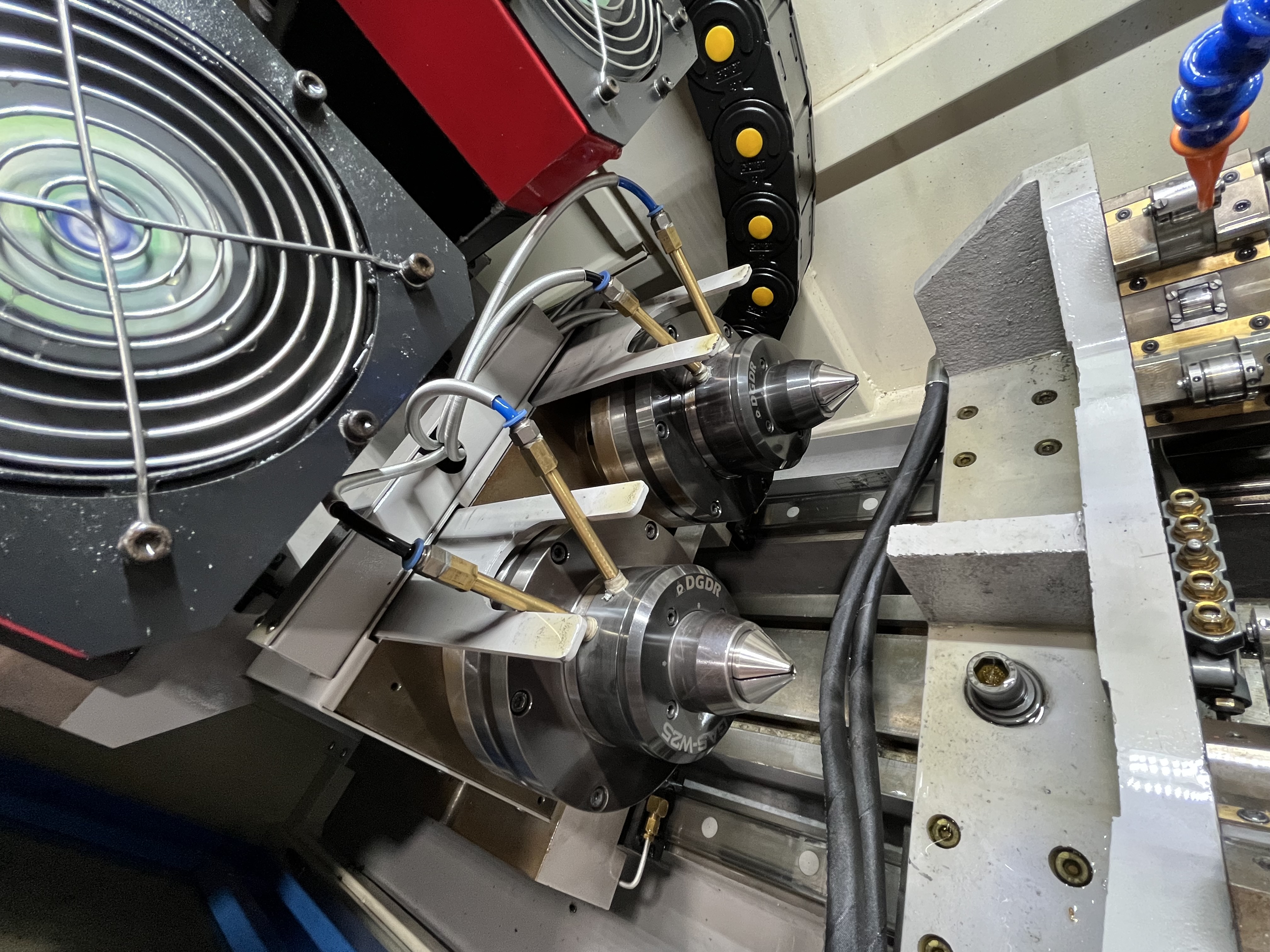
Large generator rotors have cooling holes drilled through the winding slots to allow hydrogen or air to circulate and remove heat. The holes are typically 8-15mm diameter, drilled lengthwise through the rotor forging. In my experience, a blocked cooling hole is one of the most common causes of generator rotor failure, so the quality of these holes matters more than most people realize.
Rotor Forging Materials and Cooling Hole Layout
The rotor material is usually a high-strength steel forging like 25CrMo4 or similar. The rotor can be 6-10 meters long with cooling holes running the full length. The position tolerance for the holes is typically within 0.5mm of the design coordinate.
Here are the typical rotor sizes and cooling hole configurations I have worked on:
| Rotor Length (m) | Rotor Diameter (mm) | Number of Holes | Hole Diameter (mm) | Cooling Medium |
|---|---|---|---|---|
| 6 | 800-1000 | 12-16 | 8-10 | Hydrogen |
| 8 | 1000-1200 | 16-24 | 10-12 | Hydrogen |
| 10 | 1200-1400 | 24-32 | 12-15 | Hydrogen |
| 6-7 | 600-900 | 8-12 | 8-10 | Air |
The hole pattern is not random. The cooling holes are positioned between the winding slots in the rotor body. Each slot has one or two cooling holes running parallel to it. The holes must stay within the forging envelope and not break into the winding slots.
Drilling Process Selection: Gun Drilling vs. BTA
For a 12mm cooling hole through a steel rotor forging, these are the parameters I use:
| Parameter | Gun Drilling | BTA Drilling |
|---|---|---|
| Cutting speed | 60-80 m/min | 70-90 m/min |
| Feed rate | 0.04-0.07 mm/rev | 0.06-0.10 mm/rev |
| Coolant pressure | 1000-1500 psi | 400-600 psi |
| Coolant flow rate | 30-50 L/min | 100-180 L/min |
| Hole straightness | 0.3mm/m typical | 0.2mm/m typical |
| Max practical depth | 4 meters | 10+ meters |
The main challenge I have encountered is the length. A 6-meter hole requires a gun drill that is over 6 meters long, which is difficult to handle and prone to wandering. I use a BTA drilling process for holes over 4 meters because the drill tube is more rigid.
I have established a decision rule for which process to use:
- Under 3 meters: Gun drilling is faster and more economical
- 3-4 meters: Either process works; I choose based on available machines
- Over 4 meters: BTA drilling is mandatory for straightness and tool life
- Over 8 meters: BTA with a pilot hole and reaming pass is required
Rotor Rotation and Hole Positioning
The rotor rotates during drilling to keep the hole concentric with the rotor axis. I rotate the rotor at 30-80 RPM with the tool advancing horizontally. The rotation speed depends on the rotor diameter:
| Rotor Diameter (mm) | Rotation Speed (RPM) | Surface Speed (m/min) |
|---|---|---|
| 800 | 80 | 201 |
| 1000 | 60 | 188 |
| 1200 | 50 | 188 |
| 1400 | 30 | 132 |
The position tolerance is the critical spec. Each cooling hole must be in its exact position relative to the winding slot. I check the first hole position with a CMM before drilling the rest. If the first hole is within 0.3mm of the design coordinate, the rest will be consistent.
I have found that starting the hole accurately is the most important step for position control. I spot-drill every hole with a stub drill before the full-length gun drill or BTA head enters. The spot depth is 2-3 times the hole diameter, and I check the spot position with an optical comparator before committing to the full pass.
Borescope Inspection and Quality Assurance
After drilling, I check every cooling hole with a borescope. Any blockage or burr in a cooling hole can restrict gas flow and cause the rotor to overheat during operation.
My borescope inspection procedure includes:
- Visual inspection of the full hole length for burrs, chips, or scale
- Measurement of hole diameter at 1-meter intervals using a bore gauge
- Verification of hole straightness using a laser alignment tool
- Air flow testing to confirm unobstructed passage
I have found that the most common defect is a burr at the hole exit where the drill breaks through. This happens because the tool exits into an open slot rather than solid material. The burr can partially block the cooling flow. I deburr every exit point with a carbide deburring tool and verify with the borescope again.
Key Takeaways
- For cooling holes over 4 meters long, BTA drilling produces better straightness than gun drilling
- Rotor rotation is essential for concentricity, but the RPM must be matched to the rotor diameter to avoid vibration
- Starting accuracy determines the entire hole position — invest time in the spot drilling step
- Borescope every hole and flow-test every channel; a single blocked hole can cause a rotor failure that costs millions to repair
- Deburr every exit point carefully — these burrs are the most common defect I have found in production