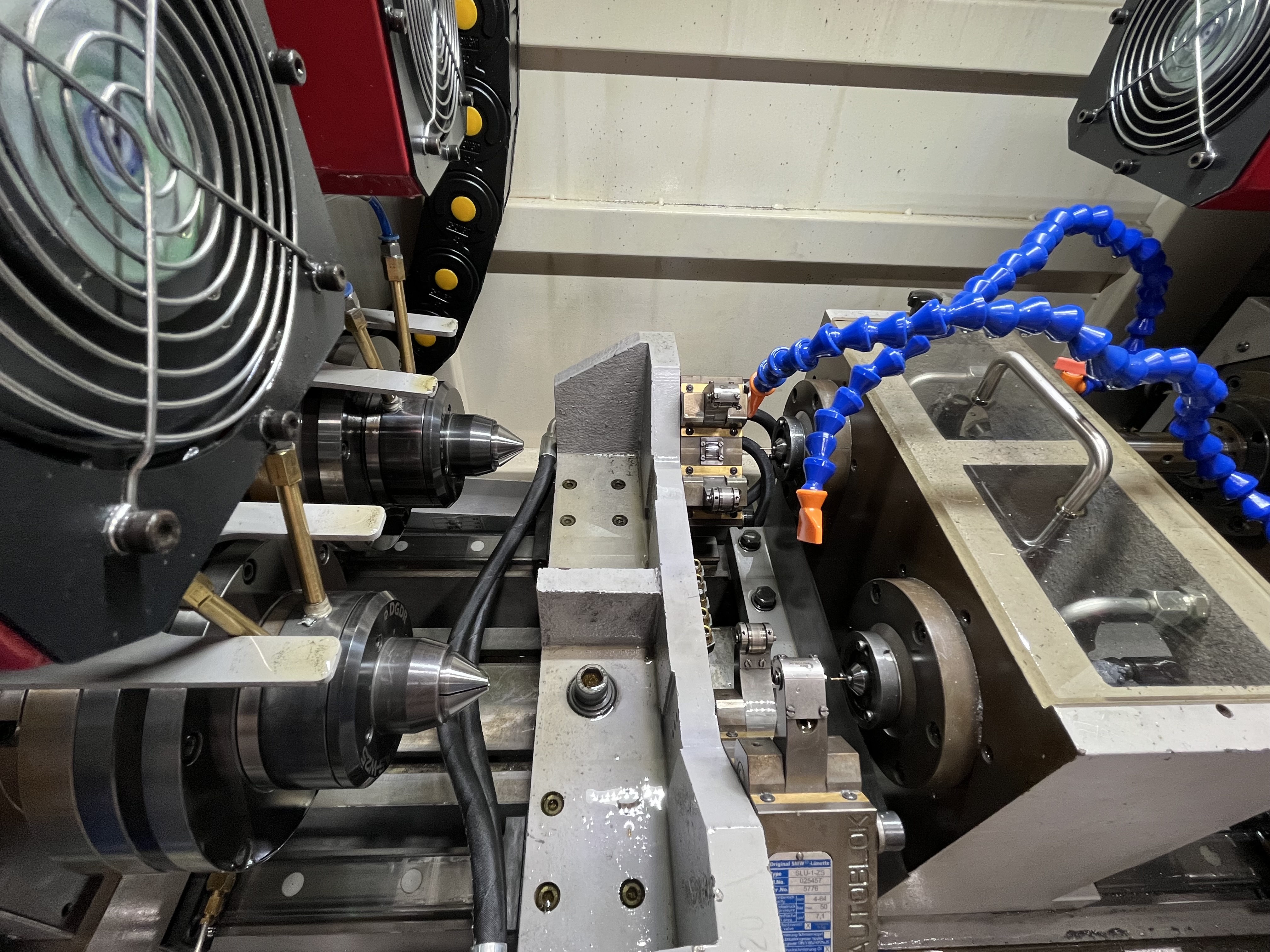
HVAC and refrigeration might not be the first industry you associate with deep hole drilling, but it uses a surprising volume of drilled components. Compressor shafts, connecting rods, heat exchanger tube sheets, and valve bodies all need precision bores.
I have drilled components for commercial HVAC chillers, industrial refrigeration systems, and residential heat pumps. The volume is high and the tolerances are moderate compared to aerospace or medical work. The compressor components share similarities with automotive deep hole drilling in terms of production volume and material types.
Compressor Crankshaft Drilling
Refrigeration compressors use crankshafts that need oil passage bores. The oil bore runs through the center of the crankshaft and delivers lubricating oil to the connecting rod bearings.
For a typical refrigeration compressor crankshaft:
| Parameter | Value |
|---|---|
| Shaft length | 200-600mm |
| Bore diameter | 6-15mm |
| Material | Ductile iron or steel |
| Cutting speed | 60-80 m/min |
| Feed rate | 0.04-0.08 mm/rev |
| Coolant pressure | 1000-1500 psi |
| Process | Gun drilling |
The oil bore in a compressor crankshaft often has intersecting cross-holes that feed oil to each crank journal. The intersection point is where the main bore and the cross-hole meet. I have found that deburring the intersection is critical. If a burr breaks off during compressor operation, it circulates through the lubrication system and can damage bearings.
For deburring, I use a combination of:
- Electrochemical deburring for cross-hole intersections
- Mechanical brush deburring for accessible edges
- High-pressure flushing to remove loose particles
Connecting Rod Drilling
Compressor connecting rods need a small oil passage from the big end bearing to the small end bearing. This passage is typically 2-5mm diameter through 100-200mm of material.
Connecting rod drilling is challenging because of the part geometry. The connecting rod is not a simple cylinder — it has a complex shape with the big end and small end at different angles. The oil passage must follow a specific path between the two bearing surfaces.
I have drilled angled oil passages in connecting rods using a CNC gun drilling machine with multi-axis positioning. The machine rotates the part to align the drill with the passage angle.
For connecting rod oil passages:
| Parameter | Value |
|---|---|
| Passage diameter | 2-5mm |
| Length | 100-250mm |
| Angle relative to rod axis | 10-45 degrees |
| Cutting speed | 40-60 m/min |
| Feed rate | 0.015-0.035 mm/rev |
The small diameter and angled entry make connecting rod drilling one of the more difficult operations in HVAC work. The drill enters the part at an angle, which creates uneven cutting forces at the start. I use a spot drill to create a flat entry surface before the gun drill enters.
Heat Exchanger Tube Sheets
Heat exchangers in HVAC chillers use tube sheets similar to shell and tube heat exchangers in chemical processing. The tube sheets hold the refrigerant tubes in place and separate the refrigerant side from the water side.
For an HVAC chiller tube sheet:
| Parameter | Value |
|---|---|
| Thickness | 20-80mm |
| Hole diameter | 10-25mm |
| Number of holes | 100-1000 |
| Material | Carbon steel or copper alloy |
| Hole tolerance | H9 or H10 fit |
| Drilling process | Gun drilling or peck drilling |
HVAC tube sheets have lower precision requirements than chemical processing tube sheets. The hole tolerance is typically H9 (0.052mm for a 15mm hole) compared to H7 (0.018mm) for some chemical applications.
The materials are different too. HVAC tube sheets are often carbon steel or copper alloys rather than stainless steel. Copper alloys drill differently than steel — they produce stringy chips that can wrap around the drill.
For copper alloy tube sheets:
| Parameter | Value |
|---|---|
| Cutting speed | 80-120 m/min |
| Feed rate | 0.08-0.15 mm/rev |
| Coolant pressure | 400-600 psi |
The higher cutting speed for copper alloys takes advantage of their good thermal conductivity. The chips come off easily, and the coolant pressure can be lower than for steel because copper alloys do not work-harden.
Expansion Valve and Control Valve Bodies
Refrigeration expansion valves and control valves have drilled passages for refrigerant flow. These valve bodies are typically made from brass, bronze, or stainless steel.
The drilled passages in valve bodies are usually short (50-150mm) but require tight tolerances for proper valve operation. The bore diameter and position must be accurate to ensure the valve moves freely without leaking.
For valve body drilling in brass:
| Parameter | Value |
|---|---|
| Bore diameter | 5-25mm |
| Length | 50-150mm |
| Cutting speed | 100-150 m/min |
| Feed rate | 0.08-0.20 mm/rev |
| Tolerance | H7 or better |
Brass drills beautifully at high cutting speeds. The chips come off as small particles, and tool life is excellent. I have drilled thousands of brass valve bodies on a single gun drill without resharpening.
Production Efficiency
HVAC components are often produced in high volumes. The drilling processes must be efficient to keep costs competitive.
I have set up automated gun drilling cells for HVAC production:
- Automatic part loading from a conveyor
- CNC positioning for multiple holes per part
- Automatic tool wear monitoring
- In-process gauging with feedback to the machine
The cycle time for a typical compressor crankshaft oil bore is 30-90 seconds. At that rate, a single gun drilling machine can produce 1000-2000 parts per shift.
Key Takeaways
- Refrigeration compressor crankshaft oil bores need careful deburring at cross-hole intersections to prevent bearing damage
- Connecting rod oil passages at 10-45 degree angles require spot drilling before gun drill entry
- HVAC tube sheets in copper alloys run at 80-120 m/min cutting speed with 400-600 psi coolant
- Valve body drilling in brass achieves excellent tool life with 100-150 m/min cutting speed
- Automated gun drilling cells for HVAC production achieve 1000-2000 parts per shift per machine