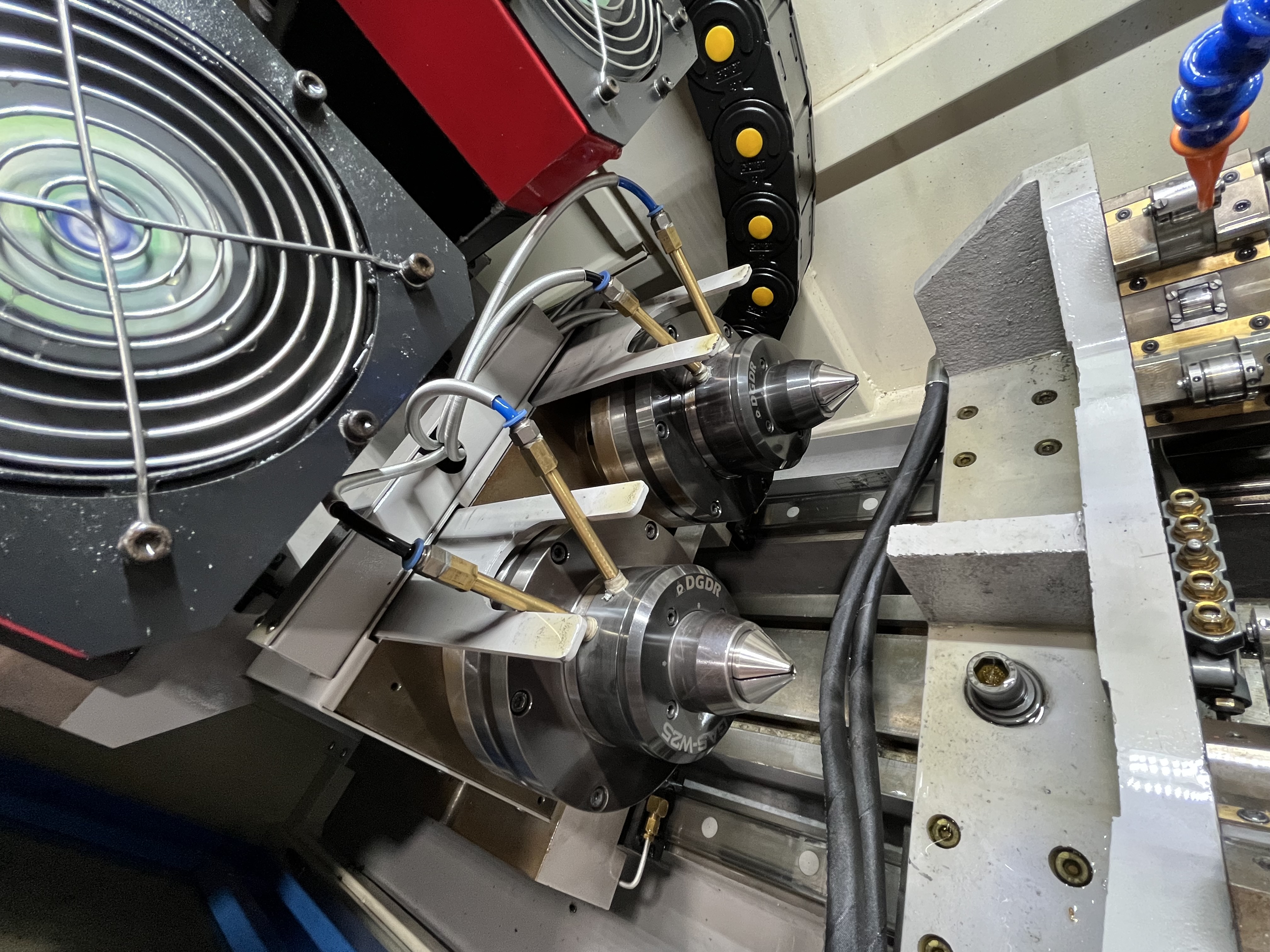
Long cylinders — anything over 2 meters — are a different class of work from shorter parts. The setup and support requirements are more demanding, and the consequences of a mistake are larger.
I’ve drilled cylinders up to 6 meters long for hydraulic and industrial applications. The principles for setting up long work are the same regardless of the specific part.
Support Spacing
The most important decision when setting up a long cylinder is the support spacing. A cylinder that sags under its own weight produces a bore that’s not straight.
I use the following support spacing:
| Cylinder Length | Minimum Supports | Spacing |
|---|---|---|
| Up to 2 meters | 2 steady rests | 1 meter |
| 2-4 meters | 3-4 steady rests | 1 meter |
| 4-6 meters | 5-6 steady rests | 1 meter |
| Over 6 meters | 7+ steady rests | 0.75-1 meter |
The steady rests are positioned evenly along the cylinder length. I adjust the spacing if the cylinder has flanges or other features that affect its stiffness.
Alignment Procedure
Aligning a long cylinder takes time but saves problems later. My procedure:
- Level the machine bed
- Mount the cylinder in the steady rests
- Check alignment at the headstock end with a dial indicator
- Check alignment at each steady rest position
- Adjust steady rests until the cylinder is within 0.05mm TIR at all points
- Recheck after tightening all restraints
The alignment check takes about an hour on a 4-meter cylinder. I’ve seen shops skip this step and spend days trying to fix the resulting bore problems.
Thin Walls
Long cylinders often have thin walls relative to their diameter. A 200mm diameter cylinder with 10mm wall thickness has a thin wall that can deflect under cutting forces.
The deflection causes the bore to be larger at the center than at the ends. The cylinder wall flexes away from the cutting tool as it moves toward the center.
To minimize this effect, I reduce the feed rate by about 20% when drilling thin-walled cylinders. The lower feed reduces the cutting forces and the resulting deflection.
Coolant Return
On long BTA drilling jobs, coolant return is a consideration. The coolant flows forward between the drill tube and the bore wall, then returns through the center of the drill tube carrying the chips.
On a 4-meter cylinder, the coolant travels 8 meters round trip. The pressure drop along that path is significant. I calculate the expected pressure drop and make sure the pump can deliver adequate pressure at the far end.
If the return coolant temperature rises more than 10 degrees from entry to exit, the chip evacuation is affected. I monitor the return temperature and increase flow if needed.
Workpiece Rotation
For long cylinders, I prefer workpiece rotation over tool rotation. Rotating the cylinder keeps the bore concentric and reduces the tendency of the drill to wander.
The rotation speed depends on the cylinder diameter and weight. A 4-meter cylinder weighing 500kg should rotate at 50-100 RPM maximum. Higher speeds cause vibration that affects the bore quality.
Common Problems with Long Cylinders
The most common problems I’ve encountered:
- Bore drift. The drill wanders off center over the length. Usually caused by misalignment or uneven material hardness.
- Chatter at mid-span. The cylinder vibrates at its natural frequency. Adding a steady rest at the midpoint usually fixes this.
- Oversized bore at entry. The drill deflects during entry. Using a guide bushing closer to the workpiece helps.
- Tapered bore. The bore is larger at one end than the other. Often caused by the machine flexing under load.
Inspection
Long cylinders are inspected after drilling for:
- Diameter at both ends and mid-length
- Straightness over the full length
- Surface finish
- Wall thickness (minimum and maximum)
I check the wall thickness at both ends before drilling the full length. If the wall is uneven by more than 1mm at the entry, I correct the alignment before going deeper.
Material Handling and Rigging
Moving a 4-meter cylinder around the shop requires planning. I’ve seen more parts damaged during handling than during drilling. A cylinder swinging from a crane can hit a machine bed, or worse, drop on someone’s foot.
My material handling guidelines for long cylinders:
| Cylinder Length | Lifting Method | Sling Spacing |
|---|---|---|
| Up to 2 meters | Single sling, centered | Centered |
| 2-4 meters | Two slings, spreader bar | 1/3 length from each end |
| 4-6 meters | Three slings, spreader bar | Ends and center |
| Over 6 meters | Four slings, multiple spreader bars | Every 1.5-2 meters |
For cylinders over 3 meters, I use a spreader bar instead of a single hook. The spreader bar keeps the slings vertical and prevents the cylinder from tilting during the lift. A tilting cylinder can slide out of the slings.
I also use protective sleeves over the slings where they contact the cylinder. A bare wire rope sling will scratch a finished OD, and those scratches become stress risers on the finished part.
For fixturing, I use nylon-tipped set screws in the steady rests instead of steel. The nylon tips protect the cylinder surface and still provide enough grip to hold the part. I’ve switched to nylon tips on all my long-cylinder setups and haven’t had a slippage issue since.
For more on BTA tooling and coolant flow for large diameter work, see BTA deep hole drilling.
Key Takeaways
- Support spacing of 1 meter or less between steady rests is critical for bore straightness on cylinders over 2 meters.
- Alignment takes an hour but saves days of problem-solving on long parts.
- Thin-walled cylinders need feed rate reduced by approximately 20% to control deflection.
- Coolant pressure drop over long BTA return paths must be calculated — not guessed.
- Material handling with spreader bars and protective slings prevents part damage before drilling starts.
- Nylon-tipped set screws in steady rests protect the cylinder surface without sacrificing grip.