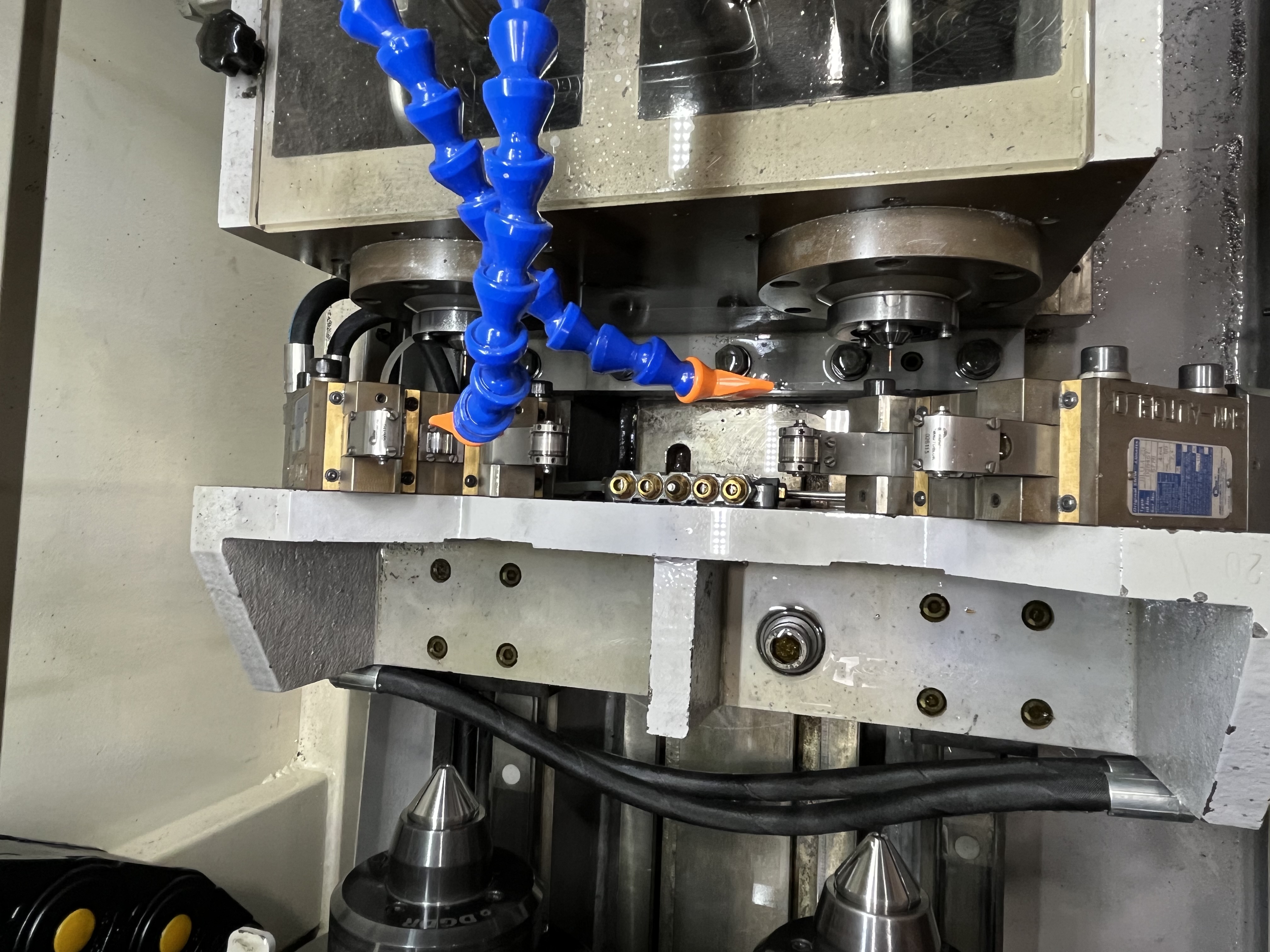
Cast iron parts often need gun drilled holes for fluid passages or weight reduction. The machining allowance — how much material to leave for finishing — depends on the casting quality and the tolerance requirement. I have drilled thousands of holes in gray iron, ductile iron, and compacted graphite iron, and the allowance decision is different for each grade.
Cast iron drills differently than steel. The graphite content acts as a lubricant, so tool life is good. But cast iron can have hard spots from uneven cooling, and the surface has a tough scale layer. The graphite also affects the surface finish — the as-drilled finish is naturally smoother than in steel because the graphite flakes act as chip breakers and lubricate the cutting edge.
For gun drilling cast iron, I machine the entry surface before drilling to remove the scale. A 2mm pass over the entry face is usually enough. If the casting has heavy scale from sand casting, I take 3mm. The scale is a mixture of sand, oxide, and partially burned mold material. It is abrasive and will wear the gun drill bushing in addition to dulling the drill edge.
Cast Iron Grade Differences That Affect Allowance
Gray iron (class 30, class 40, class 50) is the most common grade I drill. The graphite is in flake form, which makes the material brittle and produces short, powdery chips. The as-drilled surface finish on gray iron is excellent — I typically measure Ra 0.8-1.6um with a good gun drill. The machining allowance for gray iron can be on the low end because the material cuts cleanly and does not push back.
Ductile iron (60-40-18, 65-45-12, 80-55-06) has nodular graphite that gives it ductility. The material is tougher than gray iron and produces longer chips. The as-drilled finish is still good at Ra 1.2-2.0um, but the hole can close up slightly behind the drill due to material springback. I account for this by targeting 0.02-0.03mm over the nominal size at the drill.
Compacted graphite iron (CGI) is the hardest to drill of the three. The graphite structure is vermicular — somewhere between flake and nodular. CGI has higher strength than gray iron but lower thermal conductivity, which means more heat builds up at the cutting edge. I reduce cutting speed by 10-15% compared to gray iron and increase coolant pressure by 200 psi.
| Cast Iron Grade | Typical Hardness (HB) | As-Drilled Ra | Springback | Recommended Allowance for Reaming |
|---|---|---|---|---|
| Gray Iron Class 30 | 180-220 | 0.8-1.2um | None | 0.3-0.4mm |
| Gray Iron Class 40 | 200-240 | 1.0-1.5um | None | 0.3-0.4mm |
| Ductile 60-40-18 | 170-210 | 1.2-1.8um | 0.02-0.03mm | 0.4-0.5mm |
| Ductile 80-55-06 | 210-260 | 1.5-2.0um | 0.02-0.03mm | 0.4-0.5mm |
| CGI | 190-240 | 1.5-2.0um | 0.01-0.02mm | 0.4-0.5mm |
Parameter Selection and Its Effect on Allowance
The drilling parameters affect the as-drilled size and the amount of stock needed for finishing. I have run tests comparing surface finish and diameter consistency across different feeds and speeds.
For the drilling parameters:
- Cutting speed: 80-120 m/min
- Feed rate: 0.06-0.12 mm/rev
- Coolant pressure: 500-800 psi
- Coolant type: Water-soluble oil at 6-8% concentration
At the lower end of the feed range (0.06 mm/rev), the surface finish improves but the drill can chatter if the setup lacks rigidity. At the upper end (0.12 mm/rev), the surface finish degrades but the chip formation improves and the drill runs more smoothly. I use 0.08-0.10 mm/rev for most cast iron work.
Cutting speed affects the heat generated at the cutting edge. Cast iron does not conduct heat well — most of the heat goes into the chip, but some transfers to the drill. At 120 m/min, I see increased drill wear at the outer corner. At 80 m/min, the tool life doubles but the surface finish is slightly rougher.
| Cutting Speed (m/min) | Feed (mm/rev) | As-Drilled Diameter | Surface Finish Ra | Tool Life (meters) |
|---|---|---|---|---|
| 80 | 0.08 | Nominal +0.01mm | 1.6-2.0um | 80-100 |
| 100 | 0.08 | Nominal +0.02mm | 1.2-1.6um | 60-80 |
| 120 | 0.08 | Nominal +0.03mm | 0.8-1.2um | 40-60 |
| 100 | 0.06 | Nominal +0.01mm | 0.8-1.2um | 70-90 |
| 100 | 0.12 | Nominal +0.03mm | 1.6-2.5um | 50-70 |
I use 100 m/min and 0.08 mm/rev as my standard for gray iron. This gives a good balance of tool life, surface finish, and diameter consistency.
Determining the Machining Allowance
The as-drilled surface finish in cast iron is naturally good due to the graphite. I typically get Ra 0.8-1.6um. The diameter tolerance is typically IT9-IT10 as-drilled.
The machining allowance depends on the final requirement. For a hole that will be reamed to final size, I leave 0.3-0.5mm stock. The reamer needs enough material to cut cleanly but not so much that it loads up and breaks. For a hole that will be honed, I leave 0.15-0.25mm. Honing removes material fast in cast iron because the graphite aids the cutting action.
For reaming, the allowance also depends on the reamer type. A carbide reamer can handle 0.3-0.4mm stock on gray iron. An HSS reamer needs 0.15-0.25mm — too much stock will cause the reamer to chatter. I match the allowance to the reamer.
| Finishing Method | Gray Iron Allowance | Ductile Iron Allowance | CGI Allowance |
|---|---|---|---|
| Carbide reaming | 0.3-0.4mm | 0.4-0.5mm | 0.4-0.5mm |
| HSS reaming | 0.15-0.25mm | 0.2-0.3mm | 0.2-0.3mm |
| Honing | 0.15-0.2mm | 0.2-0.25mm | 0.2-0.25mm |
| Boring | 0.5-0.8mm | 0.5-0.8mm | 0.5-0.8mm |
| Roller burnishing | 0.05-0.1mm | 0.05-0.1mm | Not recommended |
Dealing with Porosity and Hard Spots
The main issue with cast iron is porosity. If the casting has subsurface porosity, the drill can hit a void and the cutting forces change suddenly. I listen for changes in the cutting sound and watch the spindle load. A sudden drop in load means the drill has hit a void.
When the drill hits a void, the surface finish in that area degrades. If the void is large enough, the as-drilled size can be 0.1mm or more over nominal because the drill is not cutting on the void side. In that case, the machining allowance I planned is not enough — the finishing pass does not clean up the oversized area.
I also use chip shape to judge the casting quality. Cast iron produces fine, powdery chips. If the chips suddenly become larger or stringier, the material has changed and I investigate. Stringy chips in cast iron mean the drill has hit a hard spot or the material has changed to a different grade.
Hard spots are localized areas where the iron cooled faster than the surrounding material, forming a carbide structure. These spots can be 50-60 HRC — harder than the gun drill. When I hit a hard spot, I hear a high-pitched squeal and the spindle load spikes. I stop the feed immediately and withdraw the drill to check the edge. If the edge is still sharp, I resume with feed reduced by 50% through the hard spot.
Key Takeaways
- Gray iron drills the best of the cast iron family. Use the lowest machining allowance and highest cutting speeds for gray iron applications.
- Ductile iron has springback. Target 0.02-0.03mm over nominal at the drill to compensate for the hole closing up.
- CGI needs slower speeds and higher coolant pressure. The low thermal conductivity builds up heat at the cutting edge.
- Machining allowance for reaming depends on the reamer type. Carbide reamers take 0.3-0.4mm stock. HSS reamers need 0.15-0.25mm.
- I adjust the allowance downward for honing — the graphite in cast iron makes honing very efficient at stock removal.
- Porosity and hard spots are the two risks that can blow through the allowance. Watch the chip shape and listen for changes in the cutting sound.
- Always machine the entry surface to remove casting scale. The scale will dull the drill bushing and the drill edge if you do not remove it first.