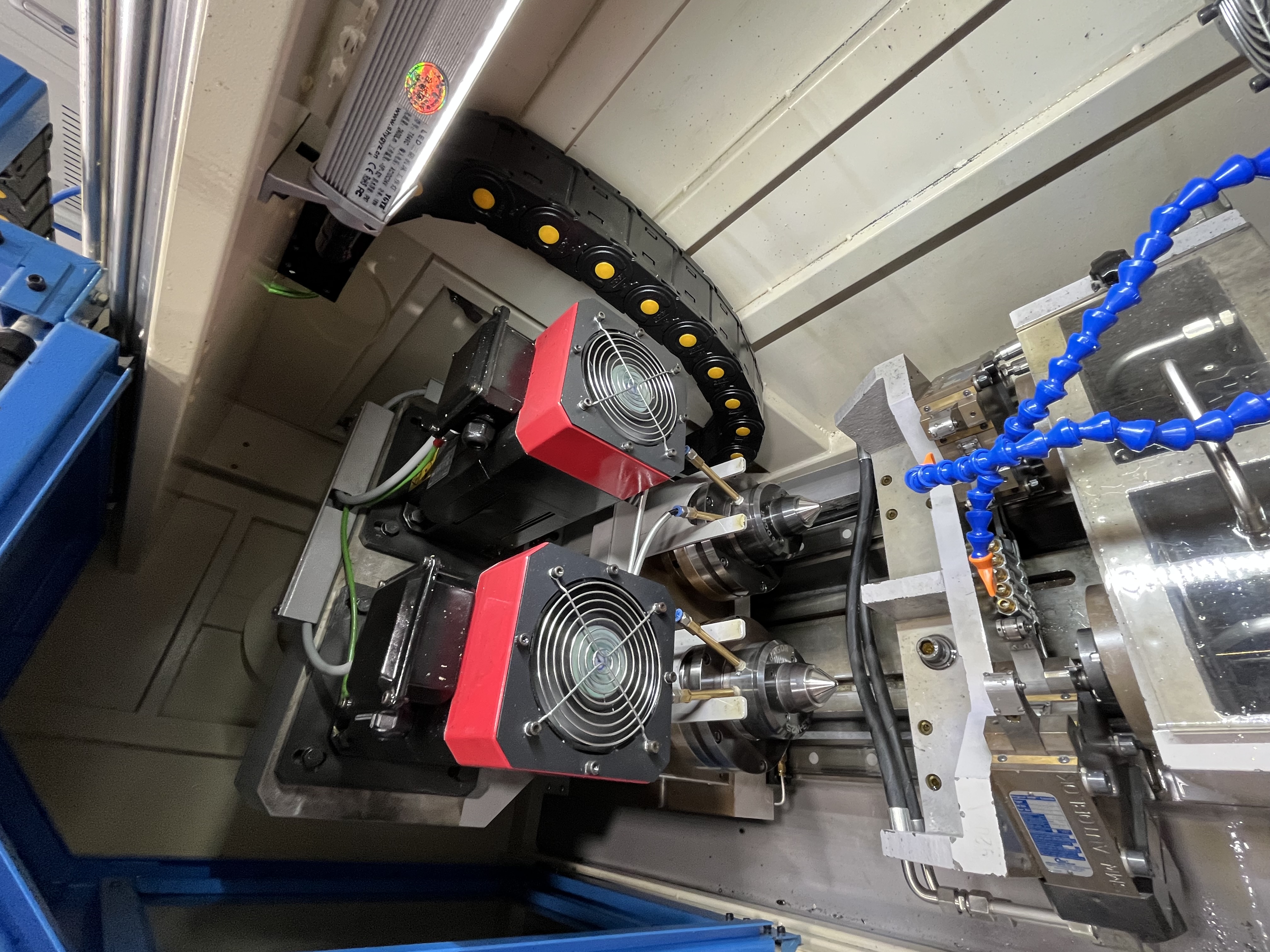
I’ve drilled a lot of mold cooling channels. Injection molds, blow molds, extrusion dies — they all need holes for water to flow through, and those holes need to be straight, smooth, and exactly where the print says. (It’s a different challenge from drilling long shafts — with molds, the angles and material hardness are what get you.)
The standard approach is gun drilling, and for good reason. A gun drill can put a hole through a block of H13 that’s straight to within 0.1mm per meter and leave a surface finish that doesn’t need any cleanup. You can’t do that with a twist drill.
What Makes Mold Work Different
Mold steels are harder than structural steel, and they’re not always consistent through the block. H13 at 45 HRC drills differently than P20 at 30 HRC. I’ve had jobs where the same parameters worked fine on one block and caused chatter on the next block from the same supplier.
The other thing is that cooling channels are rarely straight-in shots. Most molds need angled holes — 15 degrees, 30 degrees, sometimes compound angles. That means you need a machine with a tilting head or a rotary table, and the setup has to account for the angle change.
Parameters I Use for Mold Steels
For H13 or equivalent tool steel, here’s my starting point:
| Parameter | Value |
|---|---|
| Cutting speed | 55-65 m/min |
| Feed rate | 0.04-0.08 mm/rev |
| Coolant pressure | 1200-1800 psi |
| Coolant type | Oil, not emulsion |
I run oil instead of emulsion on mold steels. The lubrication is better, and the surface finish comes out noticeably cleaner. The downside is cost and cleanup, but for a job that needs to pass inspection, it’s worth it.
The Angle Problem
An angled cooling channel introduces problems you don’t see on straight holes. The drill enters at an angle, which means the tip loads unevenly during the first few millimeters. If the entry isn’t spotted correctly, the drill will walk.
I always center-drill angled cooling channels with a short, rigid spot drill before switching to the gun drill. The spot needs to be at least as deep as the gun drill tip length. I’ve had jobs where a shallow spot caused the gun drill to deflect at entry, and the channel came out 0.5mm off position at the far end.
Pecking and Chip Control
Deep cooling channels — over 500mm — need pecking. I use a retract of 50-80mm every time the drill advances 10 times its diameter. For an 8mm drill, that’s a peck of 80mm with a full retract to clear chips.
The chip shape tells you everything. Short, broken segments about 4-6mm long are ideal. Powder means the feed is too low. Long strings mean it’s too high. If chips come out as fine dust on a mold steel job, I check the coolant pressure first — it’s usually a psi problem, not a feed problem.
When Things Go Wrong
The most common problem on mold cooling channels is drill wandering at the entry. The fix is almost always in the spotting. A wider spot with a 120-degree included angle gives the gun drill a better start than a tight 90-degree spot.
The second most common problem is surface finish at depth. On a 600mm channel, sometimes the first 400mm looks great and the last 200mm shows feed marks. That’s the drill wearing. Mold steels are abrasive, and gun drills lose their edge faster than operators expect. I change tools based on footage, not feel.
Quick Reference
| Hole Diameter | Max Depth | Feed (H13) | Pressure |
|---|---|---|---|
| 6-8mm | 600mm | 0.04 mm/rev | 1500-1800 psi |
| 8-12mm | 800mm | 0.06 mm/rev | 1200-1500 psi |
| 12-20mm | 1200mm | 0.08 mm/rev | 1000-1200 psi |
The numbers shift with material and machine, but this gets you close.
Material Considerations for Different Mold Steels
Not all mold steels drill the same way. P20 at 30 HRC is forgiving — I can push feed rates higher and get good chip formation without much worry. H13 at 45 HRC needs slower speeds and more attention to coolant pressure. S7 at 50+ HRC is the hardest of the common mold steels and demands the most careful approach.
Here is what I have settled on for each:
| Material | Hardness | Cutting Speed | Feed Rate | Coolant Pressure |
|---|---|---|---|---|
| P20 | 30-36 HRC | 70-85 m/min | 0.06-0.10 mm/rev | 1000-1400 psi |
| H13 | 42-48 HRC | 55-65 m/min | 0.04-0.08 mm/rev | 1200-1800 psi |
| S7 | 48-56 HRC | 40-55 m/min | 0.03-0.05 mm/rev | 1500-2000 psi |
I have learned the hard way that treating S7 like H13 will cost you drills. The higher carbide content in S7 wears the tool edge faster, and the chip formation is more brittle. Running S7 too fast produces micro-chipping on the drill tip that shows up as a rough surface finish 300mm into the hole.
Key Takeaways
- Spot drilling is the single most important step for angled cooling channels. A shallow spot guarantees problems at depth.
- Match your parameters to the specific mold steel, not a generic tool steel range. P20, H13, and S7 need different approaches.
- Oil coolant is worth the extra cost and cleanup for mold steels that need to pass surface finish inspection.
- Change gun drills on footage, not when they break. Mold steels wear tools faster than operators expect.
- Watch chip shape as the primary indicator of correct parameters. Powder, strings, or discolored chips all tell you something needs adjusting.