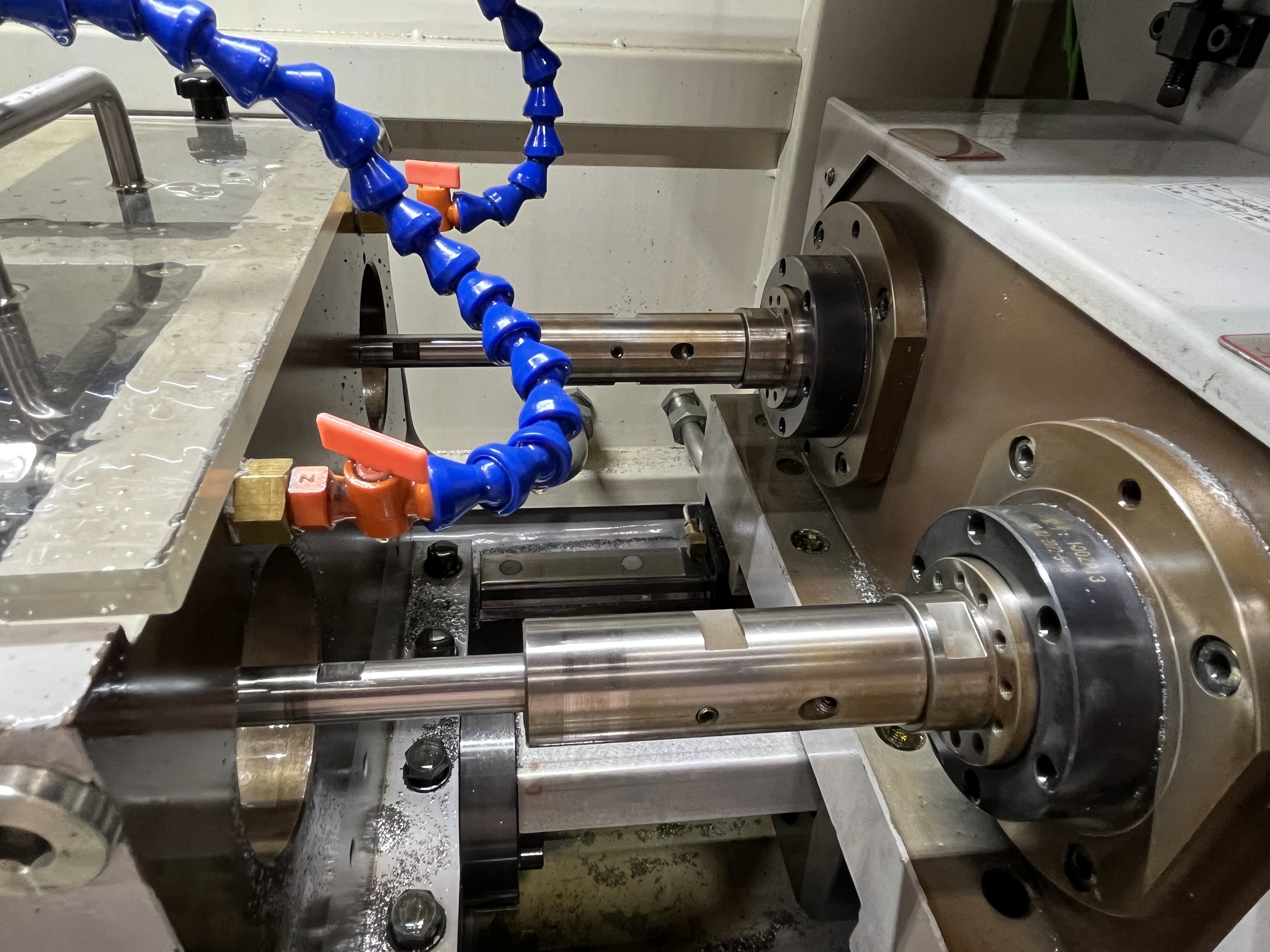
Oil and gas deep hole drilling is a world of big parts and tough materials. Drill collars two meters long with a 50mm bore through the center. Valve bodies the size of a washing machine. Heat exchangers with tube sheets that need hundreds of holes drilled in a precise pattern.
I’ve worked on oilfield components on and off for years. The work has its own pace and its own set of problems.
The Parts You See Most
The most common oilfield deep hole drilling jobs I’ve seen:
Drill collars. These are thick-walled tubes that sit above the drill bit in a drilling string. They need a through-bore of 50-100mm, and they can be 10 meters long. The material is usually 4145H or similar high-strength alloy steel.
The challenge is length. A 10-meter drill collar sags under its own weight unless it’s supported properly. I use six or seven steady rests on a 10-meter job, spaced evenly along the length. The alignment check takes an hour, but the bore needs to be straight over the full length.
Valve bodies. Gate valves and ball valves for oilfield service have large bores that need to be concentric with the valve seat. The material is often stainless steel or a corrosion-resistant alloy. These aren’t deep holes by drill collar standards — typically 200-600mm — but the diameter can be 200mm or more, which means BTA drilling.
The difficulty with valve bodies is the interrupted cut. The bore often passes through a cavity where the gate or ball sits. When the tool breaks through into that cavity and then re-enters material on the far side, it takes a shock. I reduce feed by 40% through the cavity zone to protect the cutting edges.
Heat exchanger tube sheets. These are thick plates with hundreds of holes drilled in a grid pattern. The holes need to be accurately positioned so the tubes fit through them. The plate might be 100mm thick with 500 holes of 20mm diameter.
The challenge is productivity. Drilling 500 holes one at a time takes too long. Multi-spindle drilling is the standard approach. I’ve run four-spindle BTA heads on tube sheet work, drilling four holes at once. The cycle time drops to a quarter of single-spindle, and the hole spacing stays consistent because all four spindles move together.
Large Diameter BTA Parameters
For a 100mm bore in 4145H alloy steel:
| Parameter | Value |
|---|---|
| Cutting speed | 60-80 m/min |
| Feed rate | 0.12-0.20 mm/rev |
| Coolant pressure | 250-400 psi |
| Coolant flow | 400-600 L/min |
Note the coolant flow — at these diameters, flow rate matters more than pressure. A 100mm BTA head needs enough volume to fill the bore and carry chips back through the tool. If the flow drops below 400 L/min, chips settle in the bottom of the bore and pack up.
Thread Connections
Oilfield components usually have threaded connections — API or premium threads. The thread needs to be concentric with the bore, or the connection won’t seal. I’ve seen joints fail in the field because the thread wasn’t concentric with the bore by a few thousandths.
The fix is boring the thread diameter in the same setup as the final bore pass. If the part has to move to a different machine for threading, the alignment can shift. I prefer to finish-bore and thread in one setup if the machine allows it.
Subsea Components and Safety Considerations
Subsea oilfield equipment takes the requirements a step further. Components like blowout preventers (BOPs), subsea valve bodies, and riser connectors operate under extreme pressure in deep water. A failure isn’t a warranty claim — it’s an environmental disaster.
The deep hole drilling work on subsea components focuses on through-bores for valve gates and connector passages. The materials are typically duplex stainless steel or Inconel 625 clad, both of which are tougher to drill than standard oilfield alloys.
For duplex stainless steel, I’ve found the parameters need to be more conservative than 4145H:
| Parameter | Value |
|---|---|
| Cutting speed | 50-65 m/min |
| Feed rate | 0.10-0.16 mm/rev |
| Coolant pressure | 350-500 psi |
| Coolant type | Oil, high lubricity |
The main risk with duplex is work-hardening. If the tool dwells or the feed drops too low, the surface work-hardens and the next pass struggles to cut. I’ve seen this ruin a BOP bore that cost tens of thousands to produce. The fix is the same as with aerospace Inconel — keep the tool moving, no peck retracts in the middle of the bore, and monitor the spindle load for any sign of increasing resistance.
Hydrostatic testing is standard for subsea components. Every pressure-containing part gets tested to 1.5x its rated working pressure. I’ve had parts fail hydrostatic testing because of a subsurface crack that wasn’t visible on the machined surface, which is why I always run ultrasonic wall thickness inspection on subsea work before the part leaves the machine.
Inspection and Certification
Oil and gas work comes with more documentation than any other industry I’ve worked in. Every critical dimension gets recorded, every heat number gets tracked, and every part gets a serial number.
The inspection methods I’ve used on oilfield work:
- Magnetic particle inspection for surface cracks
- Ultrasonic testing for wall thickness
- Hydrostatic testing for pressure integrity
- Dimensional inspection with CMM for hole position and diameter
The documentation can take as long as the machining. I’ve spent an hour filling out inspection reports for a part that took three hours to machine.
Key Takeaways
Oil and gas work is steady. The volumes aren’t as high as automotive, but the parts are larger and the value per part is higher. The biggest adjustment from other industries is the scale — a 10-meter drill collar doesn’t fit on a standard machine, and it doesn’t handle like a normal part. The setup is everything, and rushing the setup will cost you a scrapped part that took two weeks of material lead time to get.
Key Takeaways
- Oilfield deep hole drilling handles the largest workpieces in the trade — drill collars up to 10 meters with 50-100mm bores through 4145H alloy steel.
- Thread concentricity with the bore is critical for API connections; finish-bore and thread in the same setup whenever possible.
- Subsea components add another layer of difficulty with duplex stainless and Inconel-clad materials that work-harden aggressively — keep the tool moving at all times.
- Hydrostatic testing and ultrasonic wall thickness inspection are mandatory for pressure-containing oilfield parts.
- Invest time in setup on long parts: multiple steady rests, careful alignment, and patience on the first pass prevent scrapping a part with weeks of material lead time.