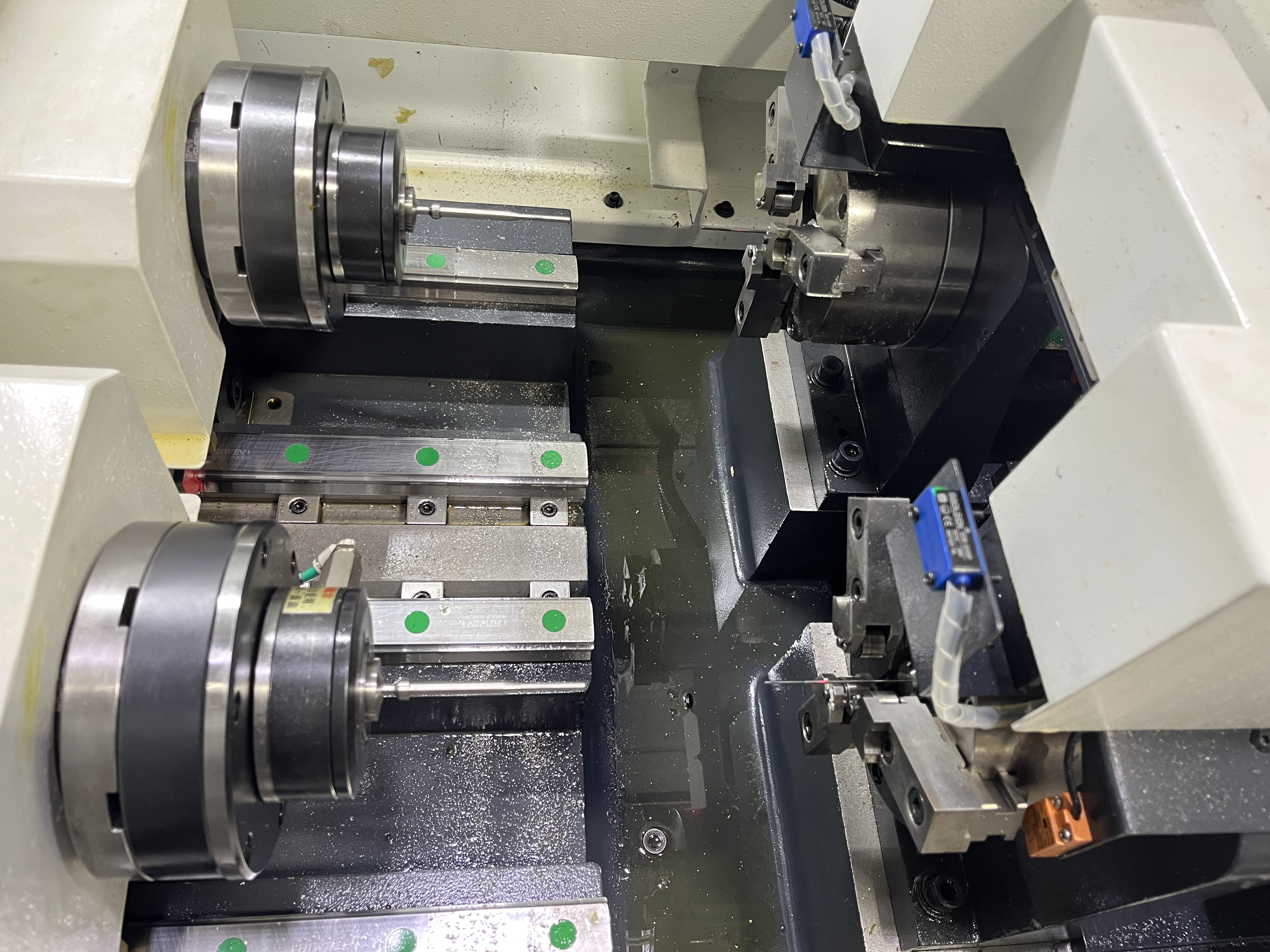
I’ve worked with a fair range of deep hole drilling machines in automotive settings — single-spindle job shop machines, multi-spindle production lines, and everything in between. Each type has its place. The question is matching the machine to the production volume and the part complexity.
Automotive parts have specific requirements that set them apart from general deep hole drilling. The volumes are higher, the tolerances are tighter, and the cost per part matters more. I have seen a 0.01 mm difference in hole position scrap an entire batch of transmission valve bodies.
Low Volume: Job Shop Machines
For volumes under 1000 parts a month — prototype work, service parts, or low-volume production — a standard single-spindle CNC gun drill is the right call.
These machines are flexible. You can change tools, adjust programs, and switch between part types quickly. The downside is cycle time. A single-spindle machine drilling an oil passage in a connecting rod might take 30 seconds per hole, which is fine for 200 parts a day but not for 2000.
What I look for in a job shop machine:
- Quick-change guide bushings (saves 10 minutes per tool change)
- A good chip conveyor (automotive work makes a lot of chips — cast iron and steel chips fill a bin fast)
- Coolant filtration to 20 microns or better
- A control that stores at least 50 programs for quick changeover between part numbers
Mid Volume: Dual-Spindle and Flexible Cells
In the 1000-5000 parts per month range, dual-spindle machines start to make sense. You’re drilling two parts at once, which halves the cycle time without doubling the floor space. I’ve seen dual-spindle machines achieve 75% cost reduction per part compared to single-spindle on the same job.
I’ve also run flexible cells where one machine handles multiple operations — drilling, tapping, and chamfering in a single setup. The advantage is reduced handling. The parts go in once and come out finished. This cuts labor cost and eliminates the position errors that happen when parts move between machines.
The trade-off is that setup changes take longer. If you’re running a family of parts with similar hole patterns, it works well. If every job is different, the flexibility of single-spindle machines serves you better.
High Volume: Multi-Spindle Production Lines
Above 5000 parts per month, you’re looking at dedicated multi-spindle machines. I’ve seen 4-spindle and 6-spindle gun drilling machines on transmission lines that drill all the holes in a valve body simultaneously. Some production cells use 8-spindle or even 24-spindle configurations for high-density hole patterns.
The upfront cost is high — a 6-spindle machine can cost several times what a single-spindle costs. But the per-part cost is lower than any other method at those volumes. For a part that needs 6 deep holes, a 6-spindle machine drills them all in the same cycle time that a single-spindle machine takes for one hole.
Automation is a bigger factor at this level. I’ve seen lines with gantry loaders that feed parts from a conveyor into the machine and out the other side. The operator just loads a pallet of blanks and checks the finished parts. Internal process automation — automatic tool changers, in-process gauging, tool life management — is often more impactful than part-handling automation because it keeps the spindle cutting.
Machine Type Comparison by Automotive Application
| Application | Recommended Machine Type | Typical Spindle Count | Cycle Time Target | Automation Level |
|---|---|---|---|---|
| Connecting rod oil holes | Single-spindle or dual-spindle | 1-2 | 15-30 sec/part | Manual to semi-auto |
| Transmission valve body | Multi-spindle dedicated | 4-8 | 20-45 sec/part | Full automation with gantry |
| Engine block oil galleries | Multi-spindle with BTA | 4-6 | 30-60 sec/block | Robot load/unload |
| Brake caliper piston bores | Dual-spindle with auto-loader | 2 | 20-35 sec/part | Semi-auto |
| Fuel injector bodies | Single-spindle precision | 1 | 10-20 sec/part | Manual with auto-cycle |
| Axle shafts | Dual-spindle or dedicated | 2-4 | 25-50 sec/shaft | Semi-auto to full auto |
| Hydraulic valve spools | Single-spindle or dual-spindle | 1-2 | 15-30 sec/part | Manual |
| EV motor shafts | Dedicated multi-spindle | 4-6 | 20-40 sec/shaft | Full automation |
Cycle Time Targets by Volume
Cycle time drives everything in automotive deep hole drilling. I calculate the required cycle time from the monthly volume, available production hours, and machine uptime. Typical automotive production runs 20 hours per day across two shifts, with 85% machine uptime as a realistic target.
| Monthly Volume | Available Minutes/Month | Required Cycle Time per Part | Machine Configuration |
|---|---|---|---|
| 1,000 | 20,400 (20 hrs/day, 85% uptime) | 20.4 min/part | Single-spindle, manual load |
| 5,000 | 20,400 | 4.1 min/part | Dual-spindle, semi-auto |
| 10,000 | 20,400 | 2.0 min/part | Multi-spindle (4-6), automated |
| 50,000 | 20,400 | 0.4 min/part | Multi-spindle (8+), full automation |
| 100,000 | 20,400 | 0.2 min/part | Dedicated line, multi-station |
Automation Integration
When I spec a machine for automotive production, I think about automation from the start. A machine that is not automation-ready will need to be replaced when volumes grow. I look for these features:
- Automatic door with interlock for robot access
- Programmable chuck pressure for different part sizes
- Part-present sensors on the fixture
- Through-spindle coolant with automatic pressure adjustment
- Remote diagnostics for networked production monitoring
I also plan for tool life management. In automotive production, unplanned tool changes shut down the line. I use tool load monitoring to predict when a drill needs replacement and schedule the change during a break. See my tool load monitoring guide for threshold settings and pattern recognition.
The One Thing I Always Check
No matter the machine type, I always check the coolant system first. Automotive deep hole drilling runs at high duty cycles — the machine might be running 20 hours a day. The coolant system needs to handle that.
I look for:
- A chiller to keep coolant temperature stable (thermal drift kills accuracy — I’ve seen 15-degree swings cause 0.03 mm diameter variation)
- Filtration to 10 microns or better for automotive-grade work
- Enough pump capacity for the longest hole at the highest pressure
- A coolant maintenance schedule that’s actually followed — not posted on the wall and ignored
I’ve seen a $500,000 machine produce scrap because the coolant temperature swung 15 degrees over a shift. The chiller paid for itself in a week.
For more on machine selection factors, see my machine selection ROI framework and the comparison of dedicated vs standard machines.
Key Takeaways
- Match machine type to monthly volume — single-spindle under 1,000, multi-spindle above 5,000
- Multi-spindle machines reduce per-part cost by up to 75% at high volumes
- Internal process automation (tool monitoring, auto-gauging) matters more than part handling
- Plan for automation from the start — a machine without automation interfaces will limit growth
- The coolant system is the most critical subsystem — chiller, filtration, and maintenance matter most
- Calculate required cycle time from volume, available hours, and 85% uptime target