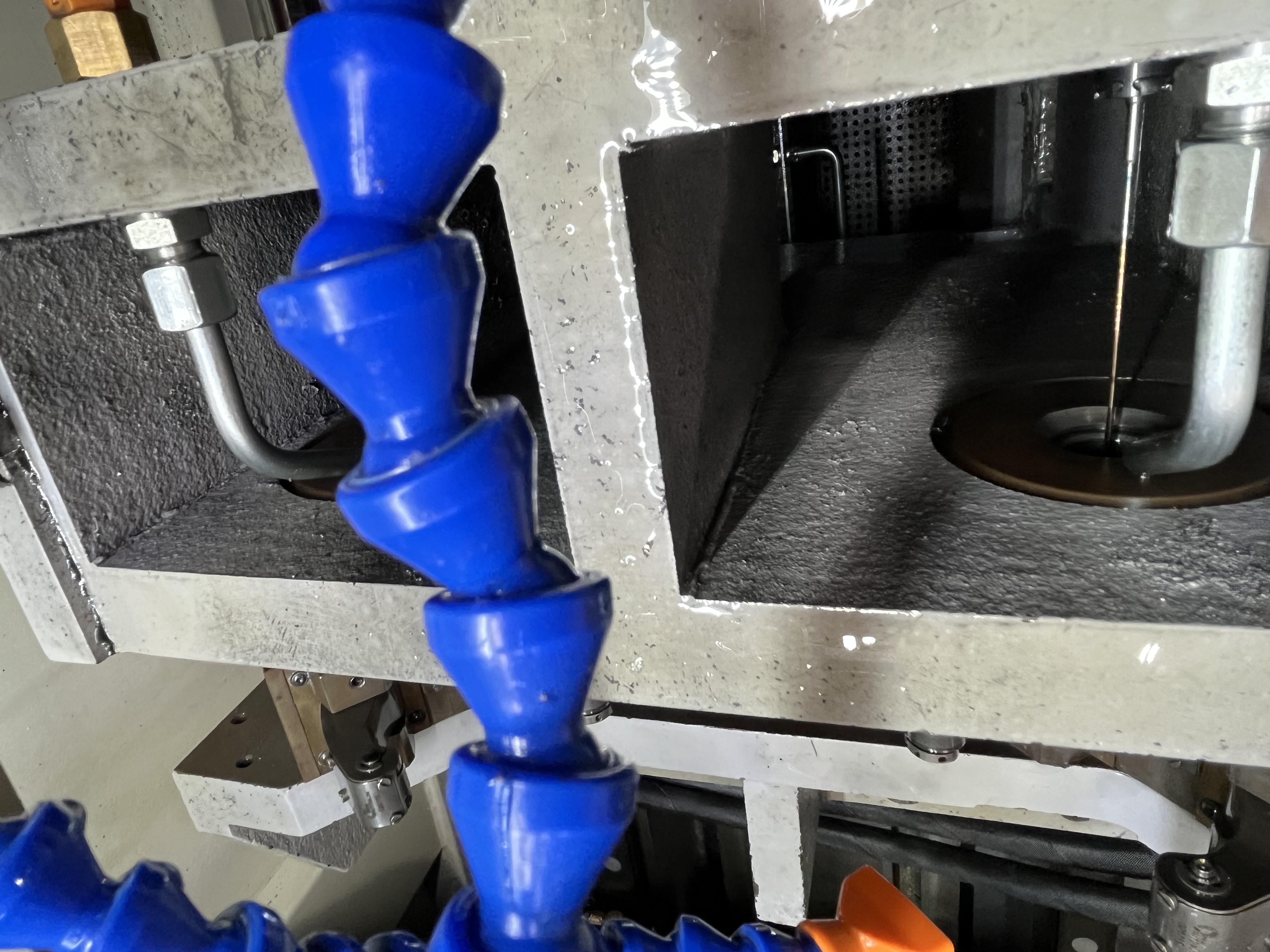
Semiconductor equipment might be the most demanding application for deep hole drilling outside of the medical industry. The components that go into wafer fabrication machines must meet extreme tolerances for cleanliness, dimensional accuracy, and material compatibility.
I have drilled components for chemical vapor deposition chambers, physical vapor deposition systems, and wafer handling robots. The materials are almost always specialty grades of stainless steel, titanium, or aluminum, and every part must be contaminant-free. The precision requirements overlap with medical implant deep hole drilling in terms of cleanliness and tolerance, though the materials differ.
Material Requirements
Semiconductor equipment components must not introduce any contamination into the fabrication environment. This means the materials and the drilling process must be clean enough for cleanroom use.
The most common materials I have drilled for semiconductor equipment:
| Material | Application | Cleanliness Grade | Drilling Challenge |
|---|---|---|---|
| 316L stainless (electropolished) | Chamber components | Class 1 cleanroom | Chip adhesion to surface |
| Ti-6Al-4V titanium | Wafer handling parts | Class 10 cleanroom | Low thermal conductivity |
| 6061-T6 aluminum | Gas delivery components | Class 10 cleanroom | Built-up edge on tool |
| Hastelloy C-22 | Corrosion-resistant parts | Class 100 cleanroom | Work hardening |
The cleanliness grade drives everything about how the part is handled. A Class 1 cleanroom component cannot have any oils, particles, or residues on the surface. Even the coolant used for drilling must be completely removed after machining.
Coolant and Cleanliness
The coolant system for semiconductor component drilling is a closed-loop system that filters to 5 microns or finer. The coolant must be compatible with the cleanroom environment.
I use high-purity synthetic coolant for semiconductor work. Standard emulsified oils leave a residue that is difficult to remove. The synthetic coolant evaporates cleanly and does not leave a film on the part surface.
After drilling, every part goes through a cleaning process:
- Initial degreasing in ultrasonic bath
- Deionized water rinse
- Alcohol rinse for spot-free drying
- Cleanroom packaging in sealed bags
I have had parts rejected because a single particle was found on the bore surface during inspection. The inspection is done under magnification in a cleanroom environment.
Precision Bores for Gas Delivery
Gas delivery systems in semiconductor manufacturing need precision bores for the gas lines that feed process gases into the deposition chamber. These bores must be smooth to prevent gas stagnation and particle accumulation.
For gas delivery components in 316L electropolished stainless steel:
| Parameter | Value |
|---|---|
| Bore diameter | 6-25mm |
| Length | 100-600mm |
| Cutting speed | 50-70 m/min |
| Feed rate | 0.04-0.08 mm/rev |
| Coolant pressure | 800-1200 psi |
| Surface finish target | Ra 0.8 um |
The surface finish is critical. A rough bore creates dead zones where process gases can stagnate and react with residual moisture. I have seen Ra 0.8um specified for gas delivery bores, and some customers spec Ra 0.4um or better.
To achieve Ra 0.4um, I run a second pass with a reamer or burnishing tool after gun drilling. The burnishing pass work-hardens the surface and closes any micro-porosity that might trap contaminants.
Titanium Wafer Handling Components
Titanium is common in wafer handling components because of its low outgassing and high strength-to-weight ratio. But titanium is difficult to drill because of its low thermal conductivity and reactive nature.
For Ti-6Al-4V wafer handling components:
| Parameter | Value |
|---|---|
| Cutting speed | 25-40 m/min |
| Feed rate | 0.025-0.050 mm/rev |
| Coolant pressure | 1500-2000 psi |
| Coolant type | High-pressure oil |
Titanium requires high coolant pressure to clear chips and control heat. If the coolant pressure drops below 1500 psi, the chips pack up in the flute and the drill seizes. I have lost more gun drills in titanium than in any other material.
The coolant must also be chlorine-free. Chlorinated coolants can cause stress corrosion cracking in titanium at elevated temperatures. I use sulphur-free, chlorine-free oil specifically formulated for titanium machining.
Chamber Cooling Channel Drilling
Deposition chambers often have cooling channels drilled through the chamber walls. These channels carry cooling water to maintain the chamber temperature during the deposition process.
The challenge is drilling long, curved channels through thick chamber walls. I have drilled cooling channels that are 8mm diameter through 400mm of 316L stainless steel, following a curved path to maximize cooling coverage.
For curved cooling channels, I use gun drilling with a specially ground drill that has an offset tip. The offset causes the drill to follow a curved path. The curvature is controlled by the amount of offset and the feed rate.
Curved channel drilling parameters:
| Parameter | Value |
|---|---|
| Bore diameter | 6-12mm |
| Channel length | 200-600mm |
| Curvature radius | 500-2000mm |
| Cutting speed | 40-60 m/min |
| Feed rate | 0.03-0.06 mm/rev |
The curvature radius must be within 500mm minimum. Any tighter and the drill binds in the bore. I check the actual curvature by running a test in a witness block before drilling the production part.
Inspection Standards
Semiconductor component inspection goes beyond dimensional checks. Every part must pass:
- Dimensional inspection of bore diameter and position
- Surface finish measurement with profilometer
- Borescope inspection at 50x magnification
- Particle count test (rinse and filter)
- Material certification verification
The particle count test is unique to semiconductor work. The bore is flushed with clean deionized water, and the water is filtered through a membrane. The particles trapped on the membrane are counted under a microscope. The acceptable particle count is typically specified in the customer’s cleanliness standard.
Key Takeaways
- Semiconductor equipment components require Class 1 cleanroom cleanliness with synthetic coolants that leave no residue
- Gas delivery bores in 316L stainless need Ra 0.4-0.8um finish to prevent gas stagnation
- Titanium wafer handling parts require 1500+ psi chlorine-free coolant to prevent chip packing and stress corrosion
- Curved cooling channels in chamber walls use offset-tip gun drills with 500mm minimum curvature radius
- Particle count testing after drilling is unique to semiconductor work and can reject parts for single particle contamination