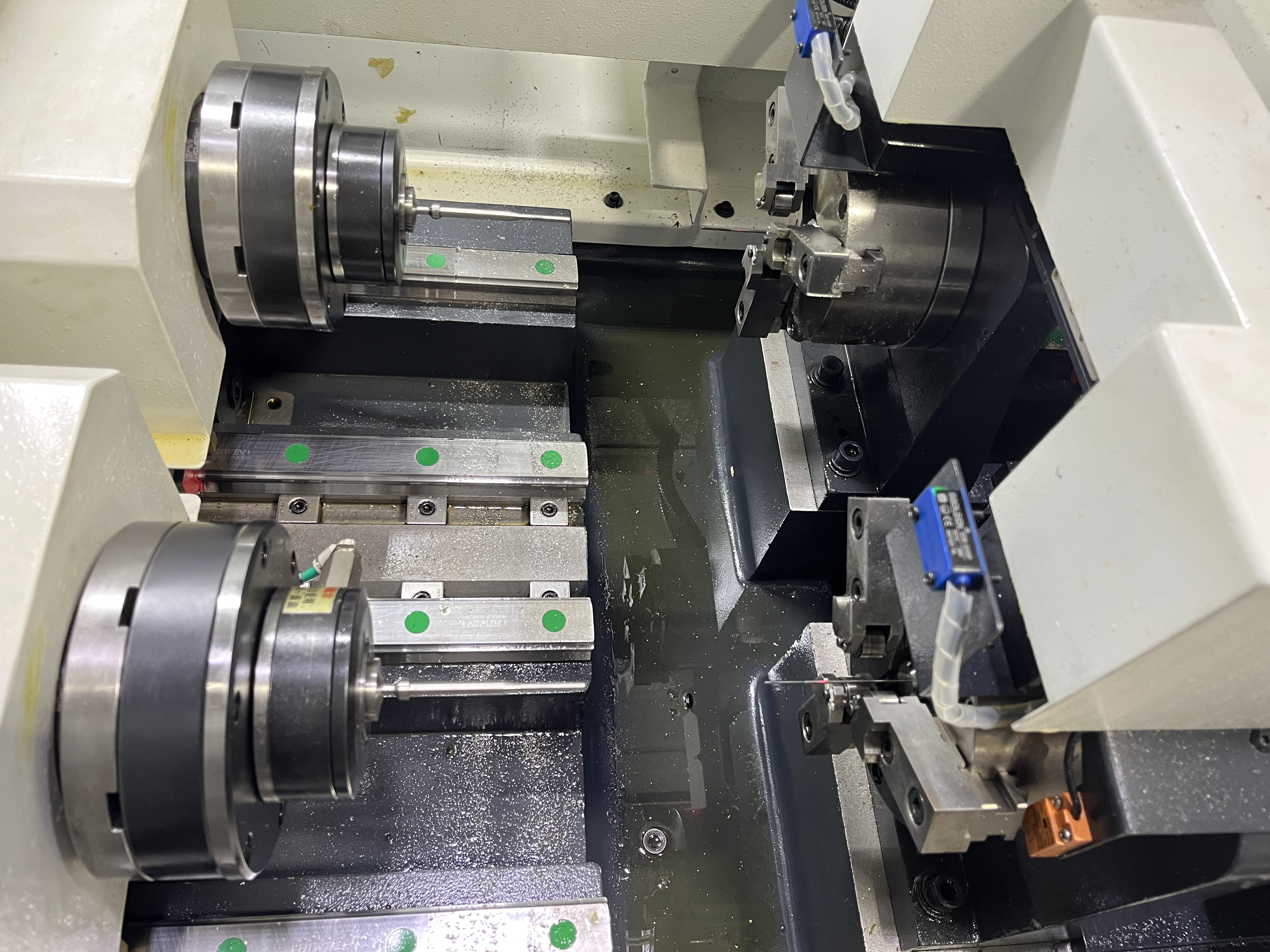
Textile machinery is not the first industry that comes to mind for deep hole drilling, but it uses more drilled components than you would expect. Rollers, spindles, and guide shafts all need through-holes for heating, cooling, or weight reduction.
I have worked on textile machinery components from machine builders in Europe and Asia. The work is similar to general long shaft drilling but with some specific requirements driven by the high-speed, continuous operation of textile production lines. See also textile heated roller drilling and textile spindle shafts gun drilling for component-specific details.
Roller Drilling
Textile machinery rollers are long, thin-walled tubes that rotate at high speeds. A typical roller might be 2 meters long with a wall thickness of 5-10mm. The through-hole is usually 30-60mm diameter depending on the roller size.
The main challenge is the thin wall. A 5mm wall thickness does not leave much room for error on straightness. If the bore drifts by 2mm in a 5mm wall, the roller is scrap.
For textile rollers, I run these parameters:
| Parameter | Value |
|---|---|
| Cutting speed | 80-100 m/min |
| Feed rate | 0.08-0.14 mm/rev |
| Coolant pressure | 600-1000 psi |
| Process | BTA or gun drilling depending on diameter |
| Surface finish target | Ra 1.6 um |
The material is usually mild steel or stainless steel. Stainless rollers are common in textile finishing where corrosion resistance from dyes and chemicals matters.
I have also drilled heated rollers that need a smooth bore surface for efficient heat transfer. The heating medium flows through the bore in contact with the roller wall. A rough bore surface has less contact area and transfers heat less efficiently. For heated rollers, I target Ra 1.6um or better in the as-drilled condition.
Spindle Drilling
Textile spindles are smaller diameter shafts that rotate at very high speeds. I have seen spindles running at 10,000 RPM or more in some textile applications. The through-hole might be 10-20mm in a 30-50mm diameter shaft, 500-1000mm long.
The straightness requirement is tighter than for rollers. A spindle that is out of balance at 10,000 RPM causes vibration that affects the textile quality. The vibration shows up as uneven yarn tension or fabric defects.
For spindles, I use gun drilling with counter-rotation:
| Parameter | Value |
|---|---|
| Bore diameter | 10-20mm |
| Length | 500-1000mm |
| Cutting speed | 60-80 m/min |
| Feed rate | 0.03-0.06 mm/rev |
| Coolant pressure | 1000-1500 psi |
| Straightness achieved | 0.1mm per meter |
Counter-rotation produces the straightest holes, which translates to better balance at high RPM. I have compared counter-rotation against tool-only rotation on textile spindles and the difference is measurable: 0.08mm per meter with counter-rotation versus 0.18mm per meter without.
Weight Reduction
Some textile rollers are drilled primarily for weight reduction, not for heating. A solid steel roller that is 2 meters long and 100mm in diameter weighs about 120 kilograms. Drilling a 60mm through-hole reduces the weight by about 45 kilograms.
The weight reduction improves the machine response time. A lighter roller accelerates faster and puts less load on the bearings. In high-speed textile machinery, every kilogram of rotating weight counts.
I have calculated the weight savings for common roller sizes:
| Roller OD | Roller Length | Bore Diameter | Solid Weight | Drilled Weight | Savings |
|---|---|---|---|---|---|
| 80mm | 2000mm | 50mm | 79 kg | 48 kg | 31 kg |
| 100mm | 2000mm | 60mm | 123 kg | 79 kg | 44 kg |
| 120mm | 2500mm | 80mm | 222 kg | 139 kg | 83 kg |
The savings are substantial. On a machine with 20 rollers, the total weight reduction can be over 800 kg.
Heated Roller Requirements
Heated rollers in textile machinery have additional requirements beyond standard rollers. The bore surface finish affects the heat transfer coefficient. I have run tests showing that a roller with Ra 1.6um bore finish transfers heat 15-20% more efficiently than a roller with Ra 6.3um finish.
The heating medium is usually thermal oil or steam. For oil-heated rollers, the bore must be clean and free of chips or debris that could contaminate the oil system. I flush each roller bore with filtered oil after drilling to remove any remaining particles.
Comparison to General Shaft Work
Textile machinery work is similar to general shaft drilling but with thinner walls and often higher surface finish requirements. The same setup principles apply: multiple steady rests, careful alignment, and proper coolant pressure.
The main difference I have noticed is that textile components are often made from different materials than hydraulic or automotive components. Stainless steel is more common, and some components use specialized grades that need adjusted parameters. I have also seen more use of lightweight materials like aluminum for high-speed textile spindles.
Key Takeaways
- Textile rollers with 5mm wall thickness leave no margin for straightness error beyond 2mm
- Spindles at 10,000+ RPM need counter-rotation gun drilling for straightness under 0.1mm per meter
- Drilling a 60mm through-bore in a 100mm roller saves 45 kg of rotating weight per roller
- Heated rollers with Ra 1.6um bore finish transfer heat 15-20% more efficiently than rough bores
- Stainless steel is more common in textile machinery than in hydraulic or automotive applications