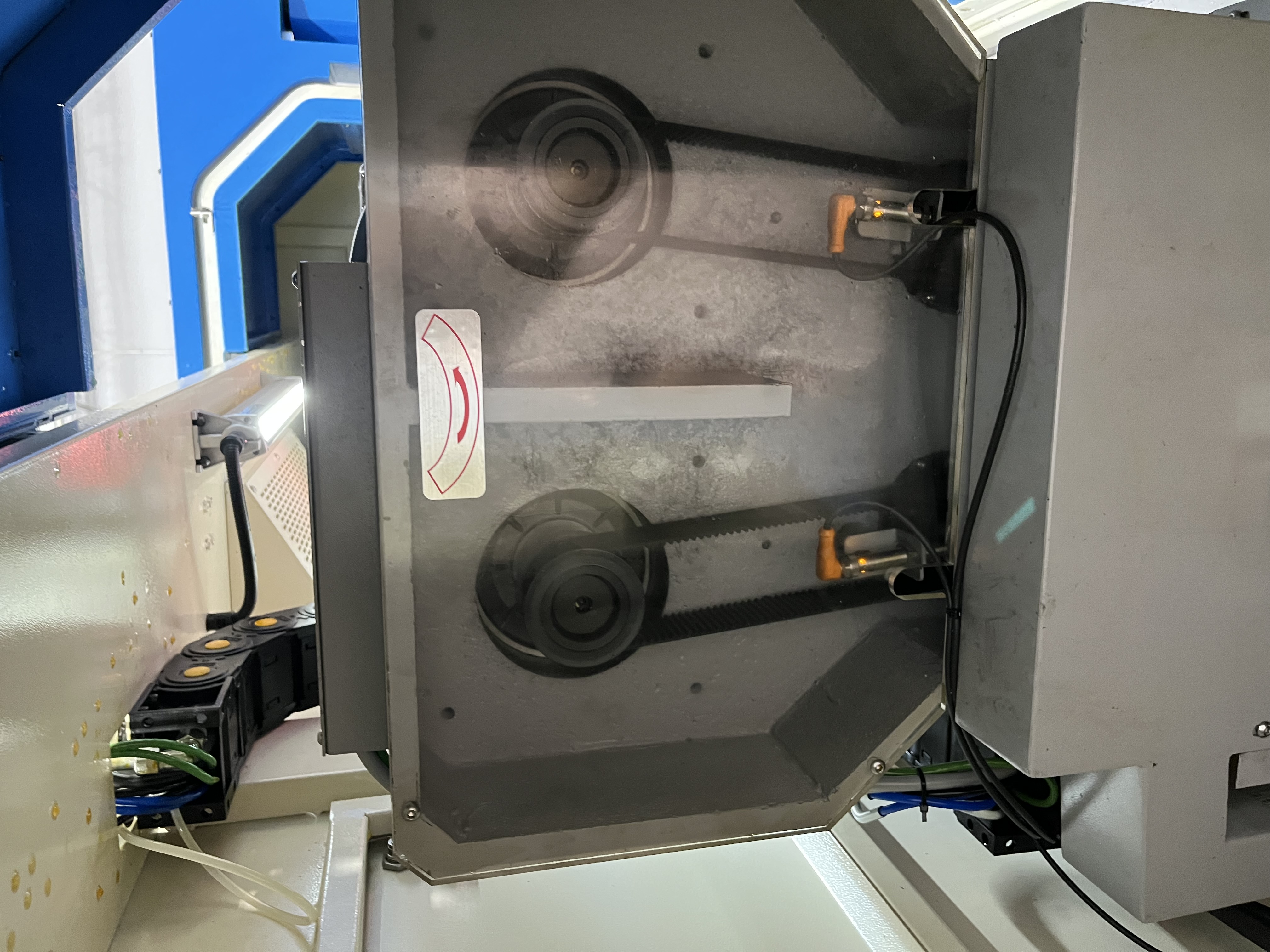
The ball screw drives the feed axis on a deep hole drilling machine. It converts motor rotation into linear movement of the spindle carrier or workpiece. A worn ball screw causes inconsistent feed rate and poor hole quality. I have replaced enough ball screws to know that preventive maintenance is far cheaper than dealing with a failure during production.
Ball Screw Inspection and Condition Assessment
I check ball screw condition by measuring the backlash annually. Backlash is the play between the ball nut and the screw, and it indicates wear in the recirculating ball tracks. The measurement procedure is straightforward but requires careful technique to get consistent readings.
| Ball Screw Condition | Backlash Measurement | Recommended Action | Estimated Remaining Life |
|---|---|---|---|
| Excellent (new) | Under 0.02 mm | No action needed | 10,000+ hours |
| Good | 0.02 - 0.05 mm | Monitor quarterly | 5,000 - 10,000 hours |
| Acceptable | 0.05 - 0.08 mm | Plan replacement within 6 months | 2,000 - 5,000 hours |
| Marginal | 0.08 - 0.10 mm | Order replacement, schedule change | Under 2,000 hours |
| Failed | Over 0.10 mm | Replace immediately | 0 hours |
To measure backlash, I mount a dial indicator against the spindle carrier or machine slide. I move the axis forward by 5mm using the CNC control, then switch the control to manual mode. I push the slide forward by hand and zero the indicator. Then I push the slide backward by hand and read the indicator. The reading is the total backlash in the system.
I repeat the measurement at three positions along the ball screw travel: near the motor end, at mid-travel, and at the far end. The readings should be similar at all three positions. If the backlash is higher at one end, the ball screw has uneven wear and needs replacement sooner.
Acceptable backlash for a deep hole drilling machine is under 0.05mm. Above 0.10mm, the ball screw needs adjustment or replacement. Some ball screws have a double-nut preload adjustment that can reduce backlash by tightening the preload. Others are single-nut designs that need replacement when the backlash exceeds the limit.
Lubrication Schedule and Methods
Proper lubrication extends ball screw life significantly. Here is the schedule I follow:
| Interval | Task | Lubricant Type | Method |
|---|---|---|---|
| Daily | Automatic oiler check | ISO VG 32 slideway oil | Verify flow at ball nut |
| Weekly | Grease ball screw | NLGI Grade 2 lithium grease | Manual application |
| Monthly | Clean and re-grease | NLGI Grade 2 lithium grease | Remove old grease, reapply |
| Every 6 months | Full grease replacement | NLGI Grade 2 lithium grease | Flush old grease completely |
| Annually | Check wiper seals | Replace if worn | Visual inspection |
The oil should be ISO VG 32 to 68 slideway oil. I have checked the lubrication flow at the ball nut by disconnecting the line and measuring the oil output over one lubrication cycle. The ball nut should receive 0.1 to 0.2 cubic centimeters per cycle. If the volume is lower, there is a blockage in the line or the metering valve is clogged.
The deep hole drilling machine maintenance guide covers the broader machine maintenance schedule that complements the ball screw care routine.
Wear Limits and Replacement Criteria
I track several parameters to determine when a ball screw needs replacement:
| Parameter | Normal Range | Warning Level | Replace At |
|---|---|---|---|
| Backlash | 0.02-0.05mm | 0.05-0.08mm | 0.10mm |
| Feed rate variation | Below 5% | 5-10% | Over 10% |
| Noise level | Quiet operation | Audible rumbling | Grinding or clicking |
| Surface temperature | Ambient +5 C | Ambient +10 C | Ambient +20 C |
| Visual inspection | Smooth raceway | Minor pitting | Scoring or spalling |
Ball screw damage can occur from coolant contamination more often than from normal wear. Coolant that leaks past the ball screw wiper seals washes out the grease and causes abrasive wear. I check the ball screw wiper seals monthly and replace them if coolant is getting past.
The wiper seals at each end of the ball nut are the first line of defense against coolant. I replace the wiper seals annually as preventive maintenance. The seal kit costs about 50 to 100 USD and takes an hour to install. A contaminated ball screw costs 2,000 to 5,000 USD to replace.
Preventive Replacement Schedule
I replace ball screws preventively based on operating hours rather than waiting for failure. The replacement interval depends on the machine utilization and the cutting conditions. High-thrust drilling creates more load on the ball screw and accelerates wear.
| Application | Typical Thrust Load | Preventive Replacement Interval | Cost of Replacement |
|---|---|---|---|
| Light gun drilling (under 10mm dia) | 500 - 1500 N | 15,000 - 20,000 hours | $1,500 - $3,000 |
| Medium gun drilling (10-25mm dia) | 1500 - 5000 N | 10,000 - 15,000 hours | $2,000 - $4,000 |
| BTA drilling (over 25mm dia) | 5000 - 20000 N | 5,000 - 10,000 hours | $3,000 - $5,000 |
| High-production (3+ shifts) | Variable | 5,000 - 8,000 hours | $2,000 - $5,000 |
I track the operating hours for each machine and schedule ball screw replacement when the machine approaches the replacement interval. The replacement is scheduled during a planned maintenance shutdown so it does not affect production unexpectedly.
The cost of a preventive replacement is 2,000 to 5,000 USD for the ball screw assembly plus 8 to 16 hours of labor. The cost of an unexpected failure is much higher. A ball screw that fails during production can damage the ball nut housing, the motor coupling, and the way covers. I have seen an unexpected ball screw failure cause 15,000 USD in damage and three weeks of downtime.
Alignment Procedure
After replacing a ball screw, I check the alignment between the ball screw axis and the guide way axis. The ball screw must be parallel to the guide way within 0.02mm per meter. A misaligned ball screw creates side loads on the ball nut that reduce its life.
The alignment procedure:
- Mount a dial indicator on the ball nut housing
- Position the indicator tip against the guide way reference surface
- Move the slide along the full travel (1 meter minimum)
- Read the indicator at both ends: the difference must be under 0.02mm
- Adjust the mounting bracket positions if needed
I align the ball screw by adjusting the mounting brackets at each end. The adjustment involves loosening the bracket bolts and shifting the bracket position until the alignment is within spec.
The motor coupling alignment is equally important. The motor shaft and the ball screw shaft must be aligned within 0.05mm to prevent coupling wear and vibration. I use a laser alignment tool for this step because it is faster and more accurate than feeler gauges.
Key Takeaways
- I measure ball screw backlash annually at three positions along the travel; acceptable backlash is under 0.05mm, and replacement is needed above 0.10mm.
- Ball screw lubrication should deliver 0.1 to 0.2 cubic centimeters of ISO VG 32-68 oil per cycle, verified by measuring flow at the ball nut.
- Coolant contamination through worn wiper seals is the most common cause of premature ball screw failure. I replace wiper seals annually at a cost of 50 to 100 USD.
- Preventive ball screw replacement intervals range from 5,000 hours for high-production BTA machines to 20,000 hours for light gun drilling.
- An unexpected ball screw failure costs 15,000 USD in damage and three weeks of downtime, compared to 2,000 to 5,000 USD for a planned replacement.
- After replacement, ball screw alignment must be within 0.02mm per meter of the guide way, verified with a dial indicator along the full travel.
- Motor coupling alignment must be within 0.05mm, verified with a laser alignment tool.