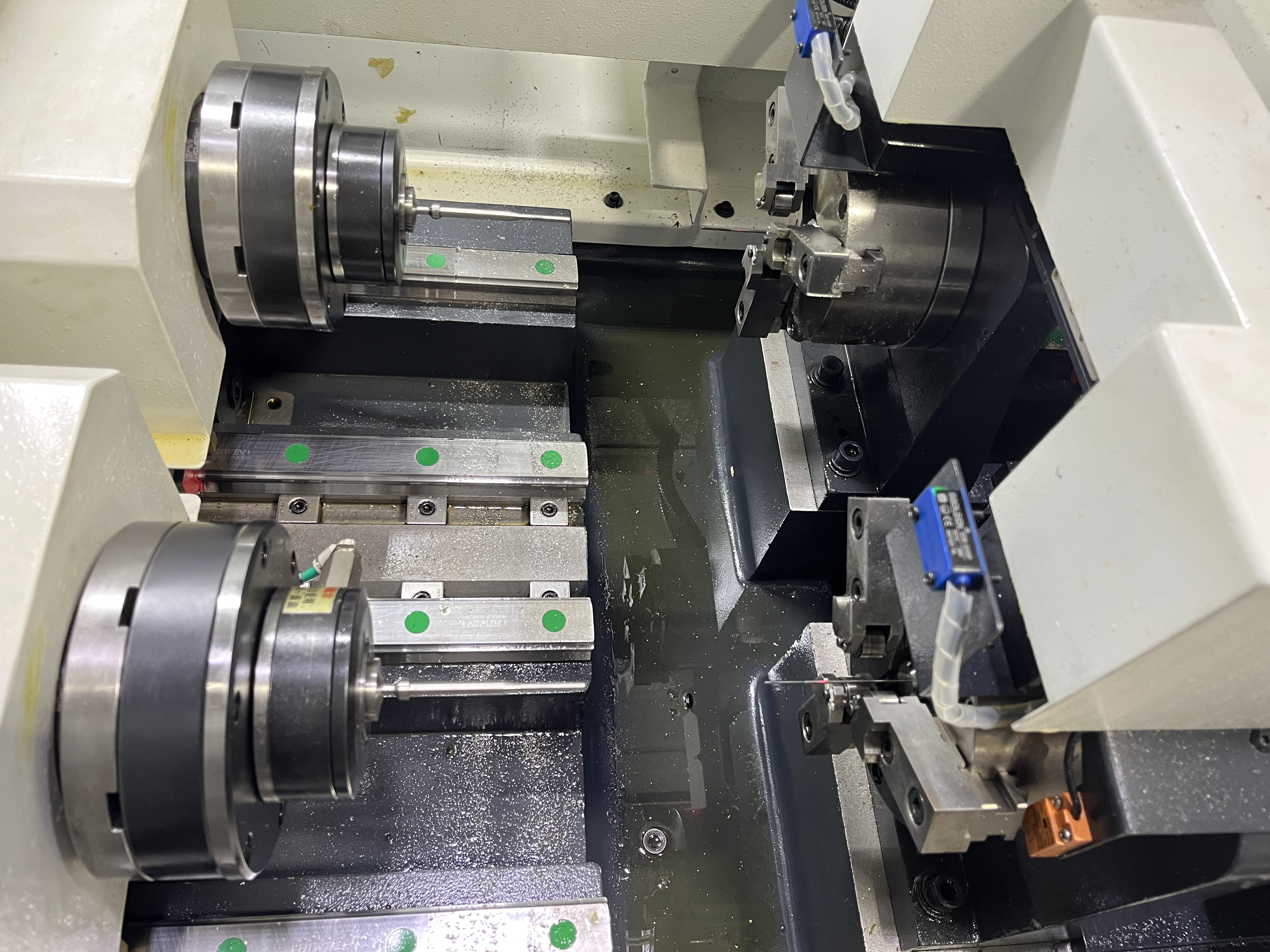
BTA drilling and gun drilling use different tools, different coolant systems, and different machine designs. I’ve run both types extensively, and the differences in the machines are more than just the spindle RPM range.
Here’s what I’ve noticed about the design differences and why they matter.
Spindle Design
Gun drilling machines have high-speed spindles — typically 5000-12,000 RPM — with lower torque. They’re designed for small-diameter drills that need high surface speed but can’t take high feed force.
BTA machines have lower-speed spindles — typically 500-3000 RPM — with much higher torque. A BTA drill at 50mm diameter needs high torque to drive the multi-edge cutting head through the material at high feed rates.
I’ve seen shops try to use a gun drilling machine for BTA work by slowing down the spindle and increasing feed. It doesn’t work. The gun drilling spindle doesn’t have the torque to drive a BTA head at the required feed. The spindle stalls or the drive belt slips.
Coolant System
The coolant system is where the two machine types differ most.
A gun drilling machine delivers coolant through the center of the rotating tool at high pressure — 1000-3000 psi. The coolant flows out through the drill tip and returns along the external flute, carrying chips out of the hole.
A BTA machine delivers coolant through the gap between the drill tube and the bore wall at lower pressure — 200-600 psi — but much higher flow. The coolant flows forward along the outside of the drill tube, passes through the cutting head, and returns through the center of the tube carrying the chips.
The coolant pump on a BTA machine needs high flow, not just high pressure. I’ve seen BTA machines with pumps rated at 800 L/min and 500 psi. A gun drilling machine of similar power might be rated at 40 L/min and 2000 psi.
Feed System
Gun drilling machines use a precision feed system with low feed rates — 0.01-0.10 mm/rev. The feed needs to be smooth and consistent at very low speeds. A stick-slip in the feed system at 0.02 mm/rev can destroy the cutting edge.
BTA machines use a heavier feed system with higher feed rates — 0.08-0.25 mm/rev. The feed force is higher, but the feed rate is less critical. A small variation in BTA feed doesn’t affect the result as much as it would in gun drilling.
Workpiece Support
BTA machines need heavier workpiece support because the cutting forces are higher. A BTA drill at 100mm diameter with 0.18 mm/rev feed generates several tons of thrust force. The workpiece needs to be firmly clamped against this force.
Gun drilling machines need good support too, but the forces are lower. A 10mm gun drill at 0.03 mm/rev generates a few hundred pounds of thrust.
Guide Bushing Arrangement
Gun drilling machines use a guide bushing close to the workpiece to support the drill at entry. The bushing is typically mounted on the machine’s bushing holder, which can be adjusted for alignment.
BTA machines don’t always use a guide bushing. The BTA drill is guided by the bore it’s cutting — the carbide guide pads on the drill head contact the bore wall and keep the tool centered. Some BTA machines use a starter bushing for the first few millimeters, but the drill is self-guiding once it’s engaged. I typically use a starter bushing on BTA for the first 5mm, then pull it back once the guide pads engage.
Machine Rigidity
Both machine types need rigidity, but for different reasons:
- Gun drilling machines need rigidity to prevent vibration at high spindle speeds. A vibration at 8000 RPM destroys the gun drill edge quickly.
- BTA machines need rigidity to handle the high thrust forces. A BTA machine that flexes under load produces tapered bores.
I’ve found that a machine built for BTA work is typically 30-50% heavier than a gun drilling machine of similar capacity. The extra mass goes into the bed, column, and spindle carrier.
When the Difference Matters
| Factor | Gun Drilling Machine | BTA Machine |
|---|---|---|
| Spindle speed | 5000-12,000 RPM | 500-3000 RPM |
| Spindle torque | Low | High |
| Coolant pressure | 1000-3000 psi | 200-600 psi |
| Coolant flow | 20-80 L/min | 200-800 L/min |
| Feed rate | 0.01-0.10 mm/rev | 0.08-0.25 mm/rev |
| Thrust force | Low | High |
| Machine weight | Moderate | Heavy |
| Typical diameter | 1-50mm | 20-300mm |
If you’re buying a machine and planning to do both gun drilling and BTA work, you’ll likely need two machines or a combination machine that can be configured for both. I’ve seen very few machines that do both well. Most are optimized for one process or the other.
I’ve seen shops buy a gun drilling machine and then try to use it for BTA work on larger diameters. The machine can’t deliver enough coolant flow or torque. The result is slow cycle times and poor hole quality. If your work includes both small and large diameters, it’s better to have one machine for each process.
Machine Cost Comparison
The cost difference between gun drilling and BTA machines reflects their different construction:
| Machine Type | Typical Cost Range | Typical Weight | Foundation Cost |
|---|---|---|---|
| Single-spindle gun drill | $150,000-$350,000 | 3,000-6,000 kg | $5,000-$15,000 |
| Single-spindle BTA | $250,000-$600,000 | 8,000-20,000 kg | $15,000-$40,000 |
| Combination (gun drill + BTA) | $400,000-$800,000 | 10,000-25,000 kg | $20,000-$50,000 |
The BTA machine costs more because it needs a heavier structure, a high-flow coolant system, and larger spindle drive components. The combination machine costs the most because it needs both a high-speed spindle and a high-torque spindle plus two coolant systems.
I recommend buying separate machines for gun drilling and BTA work unless the volume of each process does not justify a dedicated machine. Combination machines are a compromise that works best when the changeover between processes happens infrequently. For more on how machine design affects rigidity, see Machine Rigidity and Hole Quality.
Key Takeaways
- Gun drilling machines use high-speed spindles (5000-12,000 RPM) with low torque; BTA machines use lower-speed (500-3000 RPM) with high torque.
- Gun drilling coolant: 1000-3000 psi at 20-80 L/min. BTA coolant: 200-600 psi at 200-800 L/min.
- Gun drilling feed rates are 0.01-0.10 mm/rev; BTA feed rates are 0.08-0.25 mm/rev.
- BTA machines are typically 30-50% heavier than gun drilling machines of similar capacity.
- Gun drills use a guide bushing; BTA drills use carbide guide pads that self-center in the bore.
- Few machines do both processes well — it is better to have one machine for each.