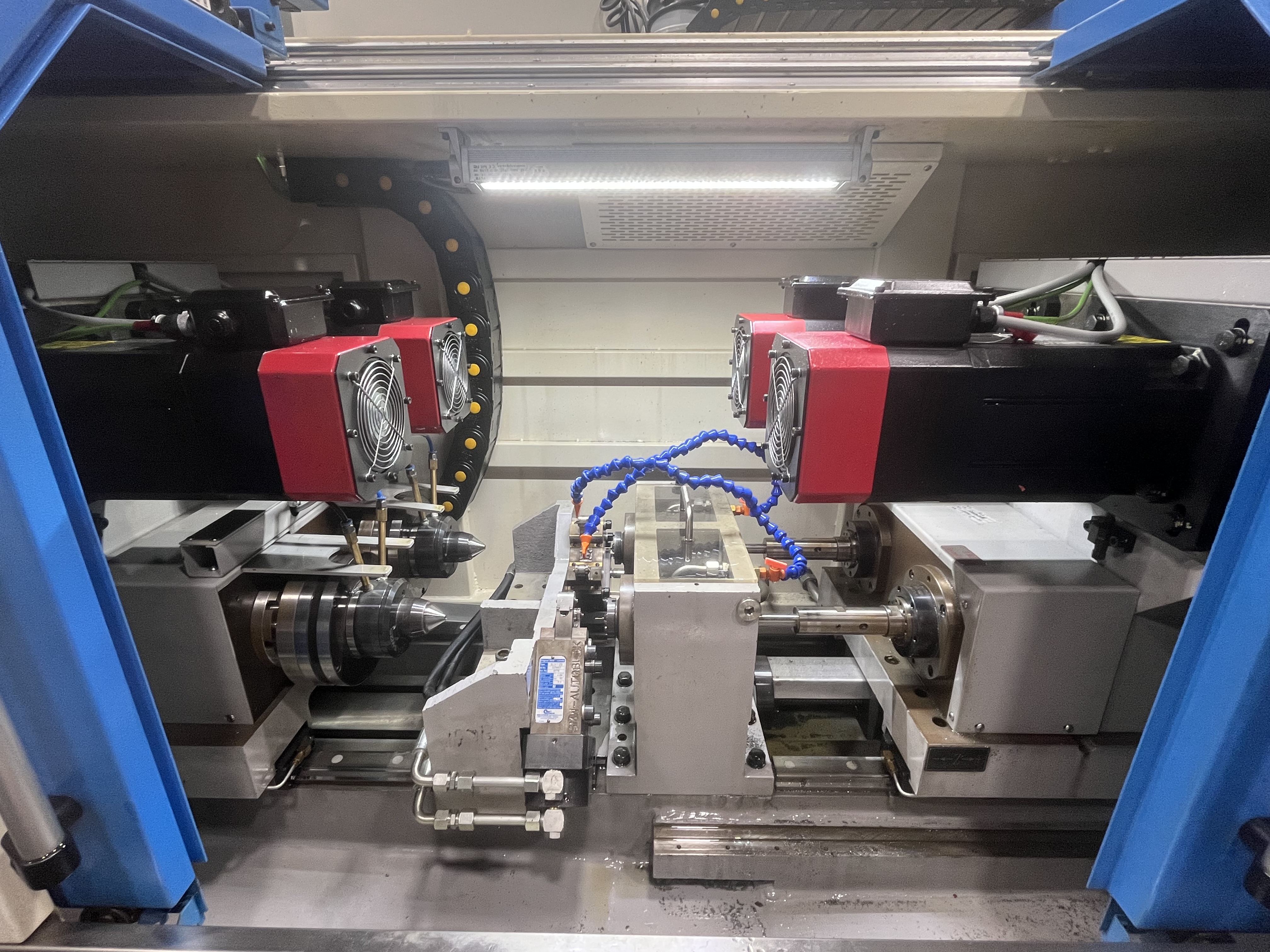
Way oil lubricates the machine guide ways and prevents stick-slip motion during slow feed movements. Deep hole drilling machines operate at low feed rates — 0.01-0.10 mm/rev — which makes stick-slip a potential problem. I have dealt with stick-slip on three different machine models and the fix always came back to the right oil selection.
Viscosity Selection by Way Type
The oil viscosity depends on the way type. Box ways need higher viscosity oil than linear guides. For box ways, I use ISO 150-220 way oil. For linear guides, I use ISO 68-100 way oil.
Box ways have large surface areas that need a thick oil film to prevent metal-to-metal contact. In my experience, switching from ISO 100 to ISO 150 on a box way machine that runs at 0.02 mm/rev feed eliminated the stick-slip vibration that was causing surface finish problems. The higher viscosity fills the gaps between the way surfaces and provides a continuous oil film even at near-zero feed rates. I measured the stick-slip amplitude with a vibration meter before and after the change — it went from 12 microns down to 2 microns.
Linear guides use recirculating ball bearings that create a rolling contact rather than sliding contact. These bearings need a thinner oil that can penetrate the bearing raceways. ISO 68 works well for most linear guide applications. ISO 100 is better when the machine runs in a warm environment above 35 C because the higher viscosity compensates for the oil thinning at elevated temperatures. I had one machine in a foundry environment where the ambient temperature hit 42 C in summer, and switching to ISO 100 kept the linear guides running smoothly. I discuss stick-slip prevention in more detail in my article on deep hole machine vibration troubleshooting.
| Way Type | Recommended Viscosity | Typical Application | Industry Standard |
|---|---|---|---|
| Box ways (sliding) | ISO 150-220 | Heavy-duty deep hole machines with slow feed rates | Cincinnati P-50 (ISO 220) |
| Linear guides (rolling) | ISO 68-100 | High-speed positioning and precision drilling | Cincinnati P-47 (ISO 68) |
| Dovetail ways | ISO 100-150 | Older manual machines and vertical milling heads | Cincinnati P-53 (ISO 150) |
| Hydrostatic ways | ISO 32-68 | Ultra-precision machines with oil film levitation | Custom per OEM spec |
Oil Grade Comparison Table
I have tested several commercial way oils across different machines. Here is my comparison data:
| Brand | ISO Grade | Tackiness | Water Separation (ASTM D1401) | My Rating | Price/Gallon |
|---|---|---|---|---|---|
| Mobil Vactra No. 2 | 68 | High | 25 min | Excellent | $38 |
| Mobil Vactra No. 4 | 220 | High | 28 min | Excellent | $45 |
| Shell Tonna S2 V 68 | 68 | Medium | 20 min | Good | $32 |
| Shell Tonna S2 V 220 | 220 | Medium | 22 min | Good | $40 |
| Chevron Way Lubricant 68 | 68 | Medium | 30 min | Good | $28 |
| Chevron Way Lubricant 220 | 220 | Medium | 32 min | Good | $35 |
| Castrol Magna SW 68 | 68 | High | 18 min | Excellent | $36 |
| Castrol Magna SW 220 | 220 | High | 20 min | Excellent | $44 |
I have standardized on Mobil Vactra for my deep hole machines. The water separation is consistent and the tackiness holds well on vertical ways. The extra cost over budget brands pays for itself in reduced way wear.
Tackiness Additives for Vertical Surfaces
The oil needs tackiness additives to stick to the vertical way surfaces. Plain hydraulic oil does not have these additives and will run off vertical surfaces, causing inadequate lubrication. I learned this lesson the hard way on a vertical deep hole machine where the headstock ways were scored after three months of using a standard hydraulic oil.
Tackiness additives are long-chain polymers that increase the oil’s adhesion to metal surfaces. I have tested oils with and without tackiness additives on a vertical box way. The oil without tackiness ran off the way surface within 15 seconds, leaving a dry patch. The oil with tackiness stayed in place for over 2 minutes. That difference is critical when the machine feeds slowly and the oil needs to stay on the way for the full duration of the cut. The test is simple — apply a drop of oil to a vertical surface and time how long it takes to run down 100 mm.
The tackiness level is measured by the oil’s adhesive strength. I look for way oils that specify “high tack” or “extreme pressure” on the data sheet. These oils have the additives needed for vertical surfaces. Oils labeled only “way lubricant” without the tackiness specification often lack sufficient adhesive properties. I keep a reference chart of approved oils for each machine in my shop.
Consumption Rates and Lubricator Settings
I track consumption rates to catch developing problems early. Here are typical consumption rates I have measured across different machine sizes:
| Machine Size | Way Type | Lubricator Setting | Oil Consumption (L/month) | Single Shift | Two Shifts |
|---|---|---|---|---|---|
| Small (1-3 m travel) | Linear guide | 0.05 cc/cycle | 3-5 L | 5-8 L | |
| Medium (3-5 m travel) | Box way | 0.10 cc/cycle | 8-12 L | 14-18 L | |
| Large (5-8 m travel) | Box way | 0.15 cc/cycle | 15-20 L | 25-30 L | |
| Twin-spindle | Box way | 0.10 cc/cycle per spindle | 12-18 L | 20-28 L |
I log consumption monthly. A sudden increase in consumption means a leak or a worn wiper. A decrease means the lubricator pump is failing or the line is blocked. I caught a failing lubricator pump this way — consumption dropped from 10 L/month to 4 L/month over two months and the ways were nearly dry when I inspected.
Water Separation and Coolant Contamination
I use a way oil with good water separation properties. Coolant can contaminate the way oil, and oil that emulsifies with water does not lubricate properly. Deep hole drilling machines generate coolant splash and mist that inevitably finds its way onto the guide ways regardless of the covers and wipers.
Way oils are rated by their water separation ability, measured by the ASTM D1401 test. The test measures how long it takes for an oil-water mixture to separate into distinct layers at 54 C. A good way oil should separate from water within 30 minutes. I have seen some budget oils that took over 60 minutes to separate, which means they hold water in suspension and form a milky emulsion that provides no lubrication.
I check the way oil condition monthly. If the oil looks milky, it has water contamination from coolant. Milky oil needs to be changed. If the oil has metal particles, the ways are wearing and need inspection. I keep a log of oil condition for each machine to track contamination trends over time.
| Contamination Sign | Likely Cause | Action Required |
|---|---|---|
| Milky appearance | Coolant in way oil | Change oil, check wiper seals |
| Metal particles in oil | Way wear or gib scoring | Inspect ways, adjust gib clearance |
| Dark discoloration | Oxidation from heat | Change oil, check for hot spots on ways |
| Foaming on way surfaces | Wrong oil grade or contamination | Change oil, verify viscosity |
| Rust spots on ways | Insufficient oil film | Increase feed rate, check lubricator |
Oil Feed Rate and Lubrication Intervals
The oil feed rate should be adjusted so the ways are wet with oil but not flooding. Too much oil wastes lubricant and contaminates the coolant. Too little oil causes way wear. I have seen machines where the operator turned up the lubricator to maximum because “more oil is better,” only to contaminate the coolant tank with way oil that caused the coolant to separate.
Automatic lubrication systems deliver the right amount of oil at set intervals. I set the system to cycle every 30 minutes with about 0.1 cc per lubrication point. I calculate the required oil volume based on the way surface area. For a typical deep hole drilling machine with 2 meters of travel, the way surface area is about 0.5 square meters. That area needs 0.5-1.0 cc of oil per cycle to maintain a proper film thickness of about 5-10 microns.
I adjust the feed rate by checking the oil film on the ways. The film should be visible as a thin transparent layer. If I can see oil pooling at the edges of the ways, the feed rate is too high. If the ways look dry between cycles, the feed rate is too low. I verify the adjustment by placing a white paper towel on the way after a lubrication cycle — it should show an even oil stain about the size of a hand.
| Symptom | Root Cause | Correction |
|---|---|---|
| Oil pooling at way edges | Feed rate too high | Reduce lubricator output by 20% |
| Dry ways between cycles | Feed rate too low | Increase lubricator output by 20% |
| Oil dripping from way ends | Cycle interval too frequent | Extend interval to 45 minutes |
| Way scoring visible | Wrong viscosity grade | Change to higher ISO grade |
| Coolant tank has oil slick | Way oil leaking past wipers | Replace wiper seals, reduce feed rate |
Maintenance Schedule for Way Lubrication Systems
I follow this schedule for way lubrication maintenance across all my machines:
| Task | Frequency | My Method |
|---|---|---|
| Visual check of way oil film | Daily | Look for even film on all way surfaces |
| Check lubricator reservoir level | Weekly | Top up before it drops below 25% |
| Inspect wiper seals for wear | Monthly | Look for tears, hardening, or gaps |
| Test oil for water contamination | Monthly | Milky appearance = change oil |
| Replace lubricator filter element | Quarterly | Standard 25-micron filter element |
| Clean way surface and reapply oil | Quarterly | Degrease and re-oil per OEM spec |
| Calibrate lubricator output | Semi-annual | Measure output per cycle at each point |
I use a maintenance log app on a tablet at each machine. Operators check off daily and weekly tasks, and I review the log every Monday morning. This system caught a failing wiper seal three weeks before it would have caused way damage.
Key Takeaways
- Choosing the right way oil is not a set-and-forget decision. I match the viscosity to the way type, verify the tackiness properties for vertical surfaces, and check the water separation rating before putting any oil into service.
- The industry standard for deep hole box ways is Cincinnati P-50 (ISO 220). For linear guides, Cincinnati P-47 (ISO 68) is the right spec.
- The few extra dollars per gallon for a quality way oil with proper additive packages pays back in reduced way wear, fewer coolant changes from oil contamination, and less machine downtime for way reconditioning.
- I keep a sample of every oil batch I receive and label it with the date — this has helped me trace contamination problems back to bad batches twice in the last five years.
- I cover machine lubrication system design in more detail in my article on deep hole drilling machine maintenance schedules.
- The time spent on way oil selection and monitoring is time saved on way repair.