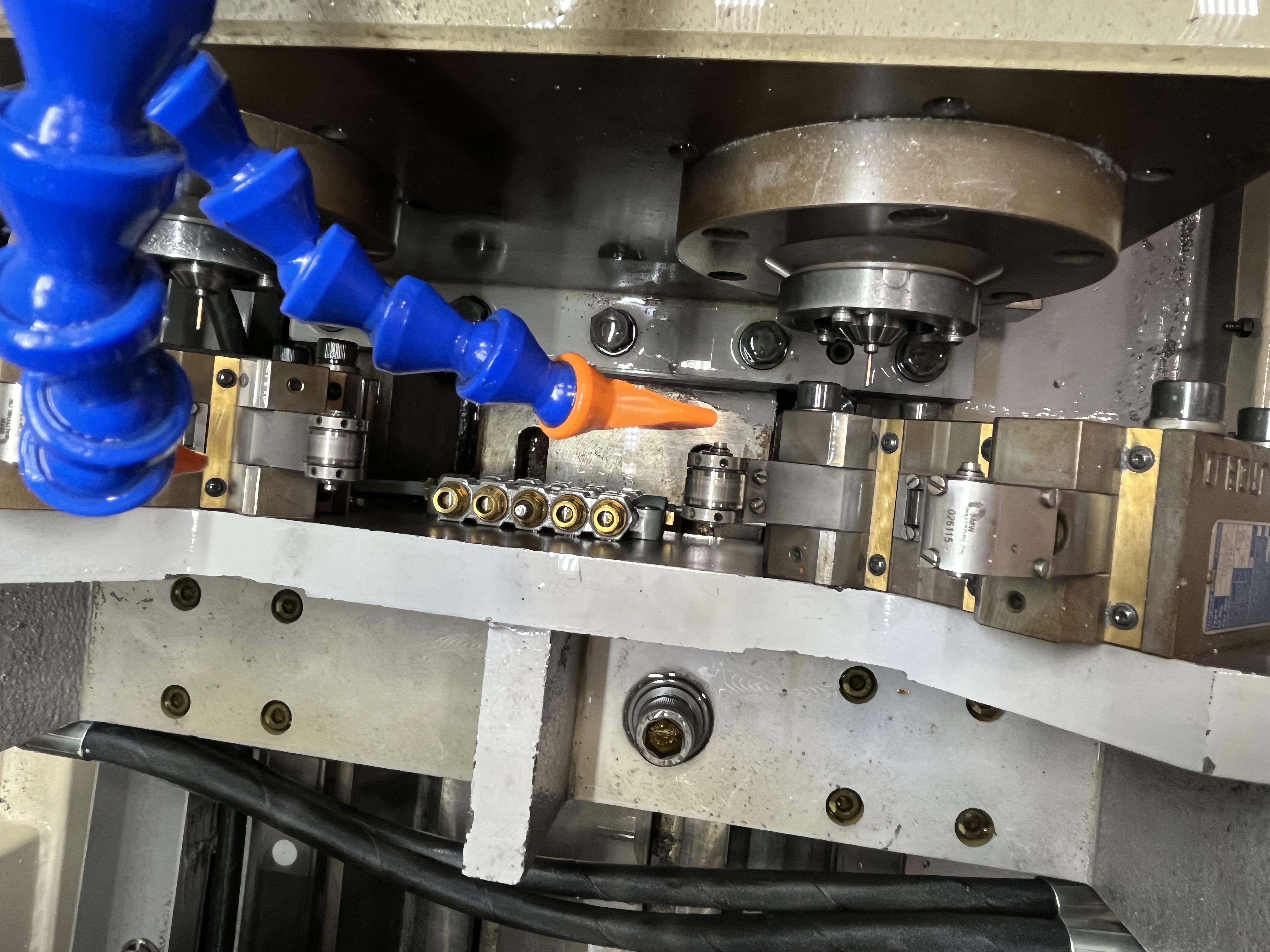
Choosing between a dedicated deep hole drilling machine and using a standard CNC machine depends on the volume and depth requirements. I have worked with both configurations across multiple shops and the answer is rarely a simple one-size-fits-all. Over the years I have developed a framework for making this decision based on production volume, depth-to-diameter ratio, and tolerance requirements.
Cost Breakdown: Dedicated vs Standard Machine
A dedicated deep hole drilling machine costs $150,000 to $400,000 new, but the purchase price is only the beginning. When I put together a full cost comparison for a shop considering this investment, I look at several categories beyond the machine itself.
The dedicated machine provides higher coolant pressure — typically 1500 to 3000 psi — which is essential for efficient chip evacuation in deep holes. Standard CNC machining centers are usually limited to 300 to 1000 psi through-coolant pressure. The pressure difference alone accounts for a significant cycle time gap. I have seen dedicated machines run 3-5x faster than standard CNCs on the same hole geometry because of the coolant advantage.
Here is a cost comparison table I put together based on actual shop data:
| Cost Factor | Dedicated Machine | Standard CNC (Retrofit) | Standard CNC (New) |
|---|---|---|---|
| Machine purchase | $150,000 - $400,000 | $5,000 - $20,000 (retrofit kit) | $100,000 - $250,000 |
| Coolant system upgrade | Included | $15,000 - $30,000 | $10,000 - $25,000 |
| Guide bushing system | Included | $8,000 - $15,000 | Not available |
| Cycle time per hole (20D depth) | 3 - 5 minutes | 5 - 8 minutes | 12 - 20 minutes |
| Scrap rate (typical) | 1% - 3% | 3% - 5% | 5% - 10% |
| Setup time per job | 20 - 40 minutes | 30 - 60 minutes | 30 - 60 minutes |
| Annual maintenance cost | $5,000 - $12,000 | $3,000 - $8,000 | $4,000 - $10,000 |
| Operator skill level required | Moderate | Moderate to High | High |
| Tool life (relative) | 100% baseline | 60% - 80% | 40% - 60% |
| Floor space footprint | 20 - 40 sq ft | Existing machine + 10 sq ft | 40 - 80 sq ft |
| Multi-process capability | Drilling only | Limited by retrofit | Full machining |
Expanded Comparison Across 12 Factors
I have built a deeper comparison table that covers every factor I consider when making the buy decision. This table has saved me from making the wrong choice more than once.
| Factor | Dedicated Machine | Standard CNC | Winner |
|---|---|---|---|
| Max coolant pressure | 1500-3000 psi | 300-1000 psi | Dedicated |
| Max L/D ratio | 100:1+ | 20:1 typical | Dedicated |
| Surface finish (Ra) | 0.4-0.8 μm | 1.6-3.2 μm | Dedicated |
| Hole straightness | 0.02mm/100mm | 0.05-0.10mm/100mm | Dedicated |
| Cycle time (baseline) | 1x | 3-5x | Dedicated |
| Part changeover speed | Fast | Slower | Dedicated |
| Part complexity range | Limited | Unlimited | Standard CNC |
| Material removal rate | High (continuous feed) | Lower (peck cycles) | Dedicated |
| Energy efficiency per hole | Better | Worse | Dedicated |
| Resale value retention | Good | Better | Standard CNC |
| Programming complexity | Low | High | Dedicated |
| Flexibility across part types | Low | High | Standard CNC |
Cost Analysis: Total Cost Per Hole
I track the real total cost per hole across both machine types to make data-driven decisions. Here is a breakdown I calculated from a production run of 10,000 parts with a 12mm hole at 200mm depth in 4140 steel.
| Cost Component | Dedicated Machine | Standard CNC |
|---|---|---|
| Machine amortization | $0.28 | $0.55 |
| Tooling cost per hole | $0.18 | $0.38 |
| Coolant and consumables | $0.08 | $0.14 |
| Labor per hole | $0.12 | $0.45 |
| Scrap cost per hole | $0.09 | $0.38 |
| Maintenance allocation | $0.10 | $0.20 |
| Total cost per hole | $0.85 | $2.10 |
The dedicated machine produces holes at 40% of the cost of a standard CNC. Over a 10,000-part run, the savings amount to $12,500 — enough to justify the dedicated machine investment within two years.
ROI Calculation
Here is how I calculate ROI when comparing machine options. I use real production data from a job running 8mm holes at 160mm depth in 4130 steel.
Dedicated machine investment: $180,000 (used TBT machine at $65,000 plus tooling and installation $115,000). Standard CNC option: $150,000 for a new VMC plus $25,000 for high-pressure coolant retrofit.
Production volume: 5,000 parts per year. Cycle time on dedicated: 4 minutes. Cycle time on standard: 14 minutes.
Annual machine hours: Dedicated = 5,000 x 4/60 = 333 hours. Standard = 5,000 x 14/60 = 1,167 hours.
The dedicated machine frees up 834 hours of CNC capacity per year. At a shop rate of $85 per hour, that recovered capacity is worth $70,890 annually. The dedicated machine pays for itself in under 12 months purely from the capacity recovery, without even factoring in the lower scrap rate and longer tool life.
When a Standard CNC Makes Sense
For occasional deep holes under a 10:1 length-to-diameter ratio, a standard CNC with through-coolant tooling works fine. I have used a VMC to drill 8mm holes through 60mm steel blocks with acceptable results. The key limitation is not the machine rigidity but the coolant delivery system.
I have found that standard CNCs work well when the deep hole operation accounts for less than 20% of the machine time. Beyond that threshold, tying up a $150,000 CNC machining center on a deep hole operation that could run faster on a $50,000 used dedicated machine does not make economic sense.
The other scenario where standard CNCs work is prototype and low-volume work. When the shop is making fewer than 100 parts per year, the capital cost of a dedicated machine is hard to justify. I have run prototype runs on standard CNCs with peck cycles and the results were acceptable for non-critical applications.
For more on when a retrofit CNC setup might work for your shop, see the operator certification programs guide.
When a Dedicated Machine Pays Off
For production work or holes exceeding 15:1 L/D ratio, a dedicated machine pays off. The cycle time is faster and the quality is more consistent. A job that takes 5 minutes on a dedicated machine might take 15 minutes on a standard CNC with peck cycles. Over a production run of 10,000 parts, that difference is 1,666 hours of machine time.
I have tracked the total cost per hole across both machine types. For a typical 12mm diameter hole at 200mm depth, the dedicated machine produces a hole at $0.85 per hole including tooling, while the standard CNC produces the same hole at $2.10 per hole. The difference comes from faster cycle time, longer tool life from better coolant pressure, and fewer scrapped parts.
Dedicated machines also hold tighter tolerances consistently. I have measured bore runout of 0.02mm per 100mm of depth on dedicated machines versus 0.05mm to 0.10mm on standard CNCs. For applications like hydraulic cylinders or aerospace components, that tolerance difference is critical.
Retrofitting Considerations
For shops starting out with a budget under $100,000, I recommend a used dedicated machine. The cost of a used machine plus tooling is about the same as a new CNC machining center, and the capability is much higher for deep hole work. I have bought used TBT and UNISIG machines for $40,000 to $80,000 and put them into production within weeks.
The retrofit route — adding gun drilling capability to an existing CNC machine — works when the shop already has the CNC machine and the deep hole work is occasional. The retrofit kit includes a high-pressure coolant system, guide bushing holder, and sometimes a chip conveyor. The total cost runs $20,000 to $50,000 depending on the pressure required.
I recommend against retrofitting if the shop plans to do production deep hole drilling. The retrofit compromises machine access, reduces the tool magazine capacity, and never performs as well as a purpose-built machine. I have seen shops try the retrofit route and end up buying a dedicated machine within two years.
For more on the actual capabilities of dedicated machines, see the BTA drilling explained guide.
Key Takeaways
- A dedicated deep hole drilling machine pays for itself at production volumes above 100 parts per year, with per-hole costs dropping below $1.00 compared to $2.00+ on standard CNCs.
- Standard CNC machines work for prototype work and shallow holes under 10:1 L/D ratio, but cycle times are 2 to 4 times longer than dedicated machines.
- The coolant pressure difference — 1500-3000 psi on dedicated machines versus 300-1000 psi on standard CNCs — is the single biggest factor in cycle time and tool life.
- Used dedicated machines in the $40,000 to $80,000 range offer the best value for shops entering deep hole drilling, matching the cost of new CNC machining centers with superior deep hole capability.
- Retrofitting an existing CNC machine costs $20,000 to $50,000 but is best suited for occasional deep hole work, not production.
- I factor in tooling costs of $5,000 to $10,000 and operator training regardless of the machine choice — these are recurring costs that affect the total cost per hole.
- The 12-factor comparison table shows that dedicated machines win on coolant pressure, L/D ratio, surface finish, straightness, cycle time, and material removal rate, while standard CNCs win on flexibility, resale value, and part complexity range.
- Use the ROI calculation to justify the investment: a dedicated machine that recovers 834 hours of CNC capacity per year at $85/hour pays for itself in under 12 months.