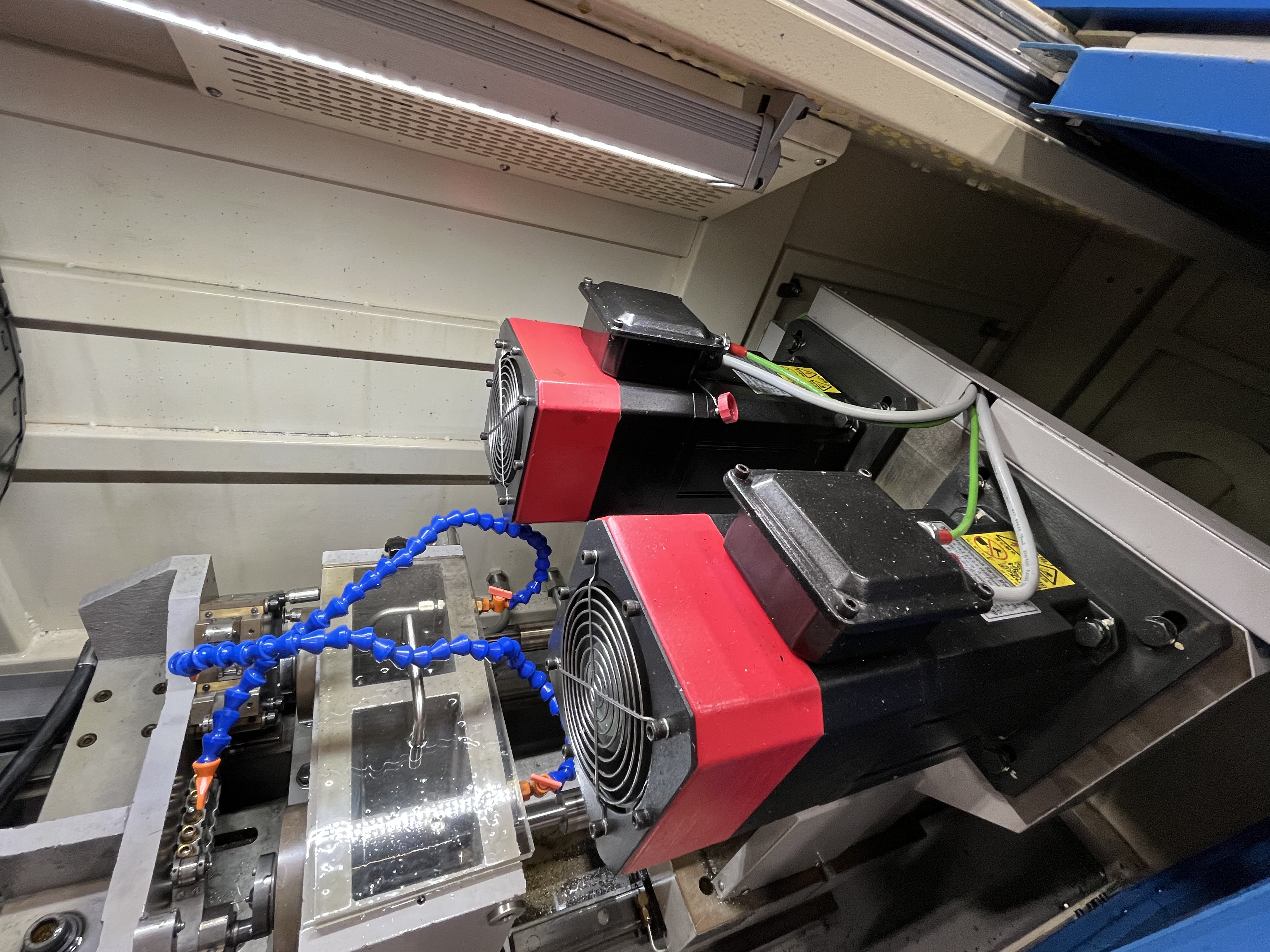
Standard machining centers — both VMCs and HMCs — are not designed for deep hole drilling, but they can handle limited work. I’ve used them for shallow deep holes on prototype parts and low-volume production. The main limitations I’ve run into are coolant pressure, guide bushing support, and chip evacuation.
Coolant Pressure Limitations
Coolant pressure on a standard machining center is usually 300-1000 psi. This is enough for drilling down to about 6mm diameter at moderate depths up to 10:1 L/D. For smaller diameters or deeper holes, a higher pressure system is needed.
The problem is that machining centers use coolant-through-spindle systems designed for conventional drilling. The coolant path from the machine’s coolant tank to the tool tip has multiple restrictions — the rotating union, the tool holder, and the tool itself. Each restriction drops pressure. I’ve seen a machine that shows 800 psi at the pump but delivers only 300 psi at the tool tip.
For diameters under 6mm, the coolant passages in the drill are so small that pressure drops significantly. A 3mm gun drill needs at least 1000 psi at the tool tip to clear chips effectively. Most machining centers cannot deliver that.
No Guide Bushing Support
Machining centers do not have guide bushings. The drill enters the workpiece unsupported, which limits the depth-to-diameter ratio to about 10:1 before the drill starts to wander.
Without a guide bushing, the drill deflects on entry. The first few millimeters of engagement determine the hole path. If the drill wanders by even 0.05mm on entry, the hole will drift at depth. I’ve measured hole position errors of 0.3mm at 100mm depth on a machining center — the drill wandered on entry and never corrected.
Some shops use a spot drill or center drill to create a starting point for the gun drill. This helps but does not replace a guide bushing. The spot drill creates a conical start that guides the drill tip, but once the drill body enters the cut, it still has lateral freedom.
Chip Evacuation Challenges
Chip evacuation is harder on a machining center because the coolant flow is not directed through the tool as effectively. Gun drills rely on high-velocity coolant passing through the drill’s internal passage to flush chips back out the V-flute. If the coolant velocity is too low, chips pack in the flute and cause drill breakage.
Peck cycles help clear chips but add cycle time. On a dedicated gun drill, I drill a 200mm deep hole in one continuous pass with no pecking. On a machining center, the same hole might need 5-10 pecks, each adding 10-20 seconds to the cycle.
Coolant return flow is also an issue. On a dedicated machine, the coolant returns through the machine bed and is filtered continuously. On a machining center, the coolant dumps into the work area and flows back through the chip conveyor. Chips can block the return path and cause coolant to pool in the machine enclosure.
When a Machining Center Works
| Condition | Works on Machining Center | Needs Dedicated Machine |
|---|---|---|
| L/D ratio under 10:1 | Yes | No |
| L/D ratio 10:1 to 30:1 | Marginal, needs testing | Yes |
| L/D ratio over 30:1 | No | Yes |
| Diameter over 6mm | Yes | No |
| Diameter under 6mm | Marginal | Yes |
| Volume under 100 parts/year | Yes | No |
| Volume over 500 parts/year | No (cycle time too long) | Yes |
| Tight straightness tolerance | No | Yes |
| Production work | No | Yes |
This table is based on my experience running jobs on both types of machines. I’ve pushed machining centers past their comfortable limits, and the results were never good.
Upgrades That Help
If you need to do deep hole drilling on a machining center, you can make some upgrades:
- High-pressure coolant system. An external coolant pump and filtration unit can deliver 1500+ psi. Cost is $15,000-$30,000 installed. This is the most effective upgrade.
- Through-coolant tool holders. Standard collet holders restrict coolant flow. Specialized tool holders with coolant-through capability reduce pressure loss.
- Peck cycle optimization. Fine-tuning the peck parameters reduces cycle time. I reduce the peck depth to 2x diameter and the retract distance to 5mm to clear chips efficiently.
I’ve installed an external high-pressure coolant system on a Haas VF-3 for a job that required 8mm holes at 12:1 L/D. The system worked, but the machine still could not match the consistency of a dedicated gun drill. The hole straightness was 0.1mm over 100mm compared to 0.05mm on a dedicated machine.
When to Switch to a Dedicated Machine
I tell shops that if they are drilling deep holes on a machining center more than once a month, they should consider a dedicated gun drilling machine. The time lost to peck cycles and the risk of drill breakage from poor chip evacuation add up.
A dedicated machine also frees up the machining center for work it is better suited for — milling, tapping, and conventional drilling. I’ve seen shops where the VMC was tied up on a deep hole drilling job for hours while milling work waited. The machining center time was worth more than the cost of a used gun drill.
Measuring Results on a Machining Center
When I do deep hole drilling on a machining center, I measure results against these benchmarks:
| Measurement | Machining Center | Dedicated Gun Drill |
|---|---|---|
| Hole straightness at 10:1 L/D | 0.05-0.10mm | 0.02-0.05mm |
| Hole position repeatability | 0.02-0.05mm | 0.005-0.015mm |
| Surface finish | Ra 1.6-3.2 | Ra 0.8-1.6 |
| Drill breakage rate | 1 per 50-100 holes | 1 per 500-2000 holes |
| Cycle time (8mm x 80mm in steel) | 5-8 minutes | 2-3 minutes |
These numbers are based on jobs I have run on both types of machines. The machining center is viable for low-volume work, but the quality and consistency drop off compared to a dedicated machine.
Key Takeaways
- Machining centers work for shallow deep holes under 10:1 L/D with diameters over 6mm
- Lack of guide bushing support causes drill wander and hole position errors at depth
- Coolant pressure at the tool tip is often 50% lower than the pump rating
- An external high-pressure coolant system is the most effective upgrade for deep hole work on a VMC or HMC
- If you do deep hole drilling more than once a month, a dedicated machine is worth considering