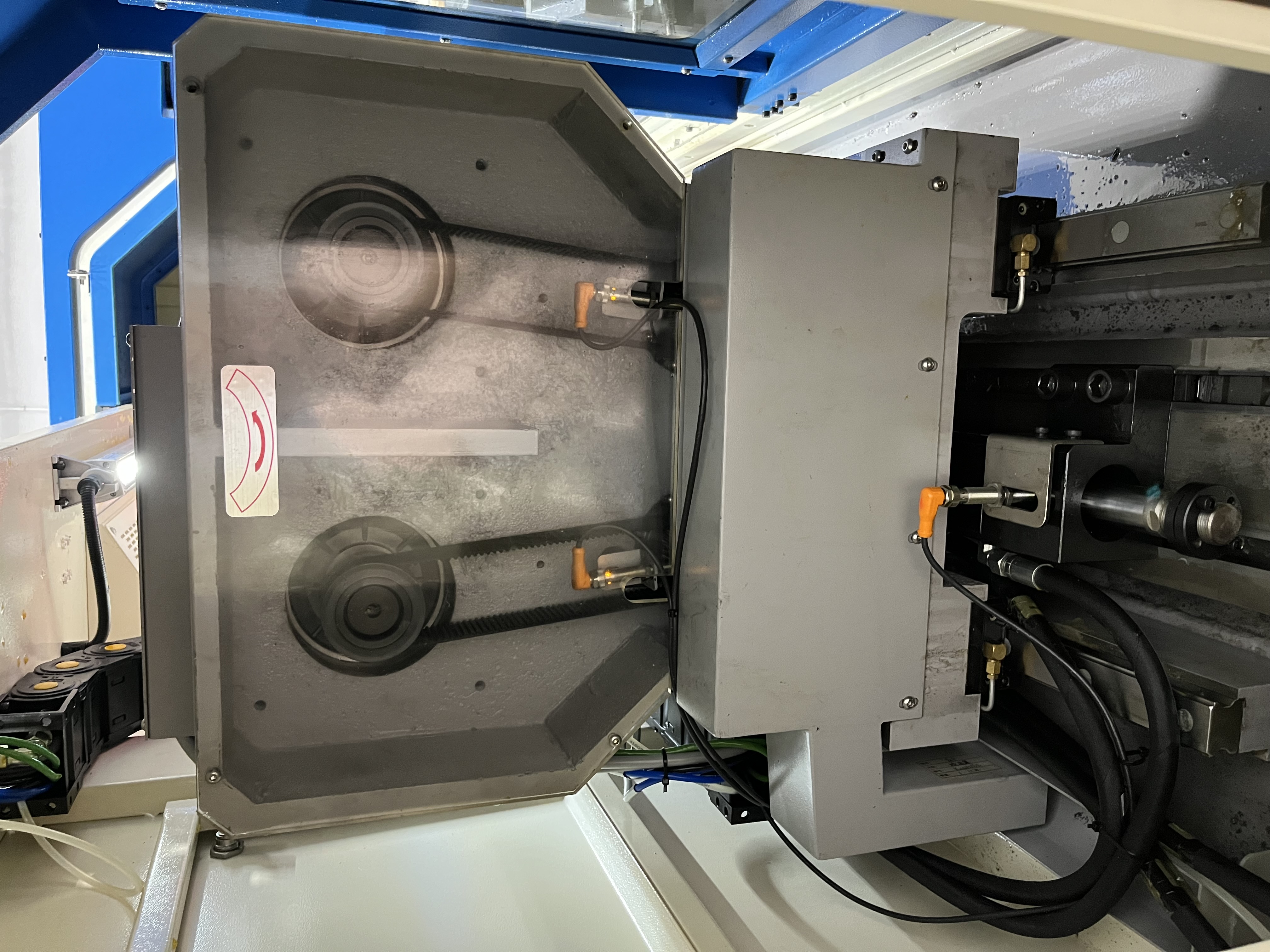
I get calls from shops that bought a gun drill and want to run it on their existing CNC lathe or manual mill. Half the time, the machine can handle it. The other half, they are fighting the machine’s limitations from day one.
Here is how I evaluate whether a machine is suitable — and what to look for if it is not.
Spindle Speed Range
Gun drilling needs relatively low RPM compared to conventional drilling. For a 10mm gun drill running at 250 SFM, spindle speed is about 2400 RPM. Most lathes and mills can reach that easily.
The problem is the low end. For a 20mm drill at 200 SFM, spindle speed is about 1200 RPM. For a 30mm drill, about 800 RPM. These are within range for most machines.
But for small diameters — under 6mm — speeds can be 5000-8000 RPM. Some older lathes cannot reach those speeds. Check your machine’s maximum RPM against your smallest drill diameter before buying tooling.
| Drill Diameter | RPM at 250 SFM | Machine Requirement |
|---|---|---|
| 3mm | 8000 | High-speed spindle |
| 6mm | 4000 | Most CNC machines |
| 10mm | 2400 | All machines |
| 20mm | 1200 | All machines |
| 30mm | 800 | All machines |
Feed Rate Capability
Gun drill feed rates are measured in ten-thousandths of an inch per revolution — 0.0005 to 0.002 IPR (0.012 to 0.050 mm/rev). Many manual lathes cannot feed that slowly.
I have seen shops with manual lathes that have a minimum feed rate of 0.005 IPR. That is 5-10 times faster than a gun drill needs. Running at that feed will overload the drill and snap it.
On a CNC machine, feed rate is programmable and not an issue. On a manual machine, check the feed gearbox chart. If the slowest feed is over 0.002 IPR, you need a feed reducer or a different machine.
I cover the relationship between feed and tool life in Feed Speed Optimization.
Coolant System Capacity
This is the most common dealbreaker. The machine’s existing coolant pump almost certainly cannot deliver the pressure and flow required.
For gun drilling, you need:
- Pressure: 500-3000 psi depending on diameter
- Flow: 1-25 GPM depending on diameter
- Filtration: 20 micron or better
- Coolant type: Oil-based (not water-soluble)
Most machine tool coolant pumps deliver 20-50 psi at 5-10 GPM. That is 10-50 times less pressure than needed.
If the machine has a through-spindle coolant system rated for 200-300 psi, it can work for larger diameters (20mm+). For smaller diameters, you need a separate high-pressure coolant system — either integrated through the spindle or external through a rotary inducer.
I cover the detailed pressure requirements by diameter in Coolant Minimum Requirements.
Machine Rigidity
Gun drilling generates lower cutting forces than conventional drilling, but those forces are applied continuously. A machine with worn ways, loose gibs, or excessive spindle bearing play will produce inconsistent holes.
I check rigidity with a simple test: mount a dial indicator against the tool holder and apply moderate hand pressure. If the indicator moves more than 0.02mm, the machine has excessive play.
The critical areas are:
- Spindle bearings (axial and radial play)
- Turret or tool post rigidity
- Carriage or saddle gib adjustment
- Tailstock alignment (for lathe setups)
Rigidity is less critical for gun drilling than for interrupted cuts or heavy roughing, but it matters for straightness. A machine that deflects 0.02mm under hand pressure will deflect 0.05-0.10mm under cutting load.
Through-Spindle Coolant vs External Induction
If the machine has through-spindle coolant capability rated for the required pressure, use it. This is the cleanest setup.
If it does not, you need a rotary coolant inducer — a device that feeds high-pressure coolant into the rotating drill shank. These are available for about $1000-3000 and mount on the tool post or tailstock.
The inducer adds complexity: it requires a seal that wears over time, and it adds one more pressure drop point. But it is a practical solution for many manual lathe conversions.
For mills, gun drilling attachments with built-in coolant induction are available. These mount in the spindle like any other tool and are probably the most practical option for a first-time setup.
Spindle Condition and Runout
Gun drills are sensitive to runout. The drill tip rotates off-center, cutting an oversized hole and loading one cutting edge more than the other.
I check spindle runout with a test bar and dial indicator:
- At spindle nose: under 0.005mm
- At 200mm from nose: under 0.010mm
If runout is over 0.015mm at the nose, the spindle bearings need attention before gun drilling will be reliable. I cover alignment in Machine Alignment and Concentricity.
The Minimum Viable Machine
Based on what I have seen work, the minimum viable machine for gun drilling is:
| Requirement | Minimum |
|---|---|
| Spindle speed range | 500-4000 RPM (adjust to your diameters) |
| Feed rate capability | 0.0005 IPR or slower |
| Coolant pressure | See coolant requirements article |
| Coolant through-spindle or inducer | One or the other |
| Spindle runout at nose | Under 0.010mm |
| Ways and gibs | Adjustable and in good condition |
If your machine meets these, you can make gun drilling work. If it does not, I recommend either upgrading the machine or sending the work out.
Key Takeaways
- Check spindle speed range against your smallest drill diameter. Small drills need high RPM.
- Feed rate is the most overlooked limit on manual machines. If your lathe cannot feed below 0.002 IPR, you need a modification.
- Coolant pressure is the dealbreaker. Assume your existing coolant system is insufficient unless it is rated for 500+ psi.
- Runout under 0.010mm at the spindle nose is required for reliable gun drilling.
- A rotary coolant inducer costs $1000-3000 and solves the coolant delivery problem on most manual lathes.