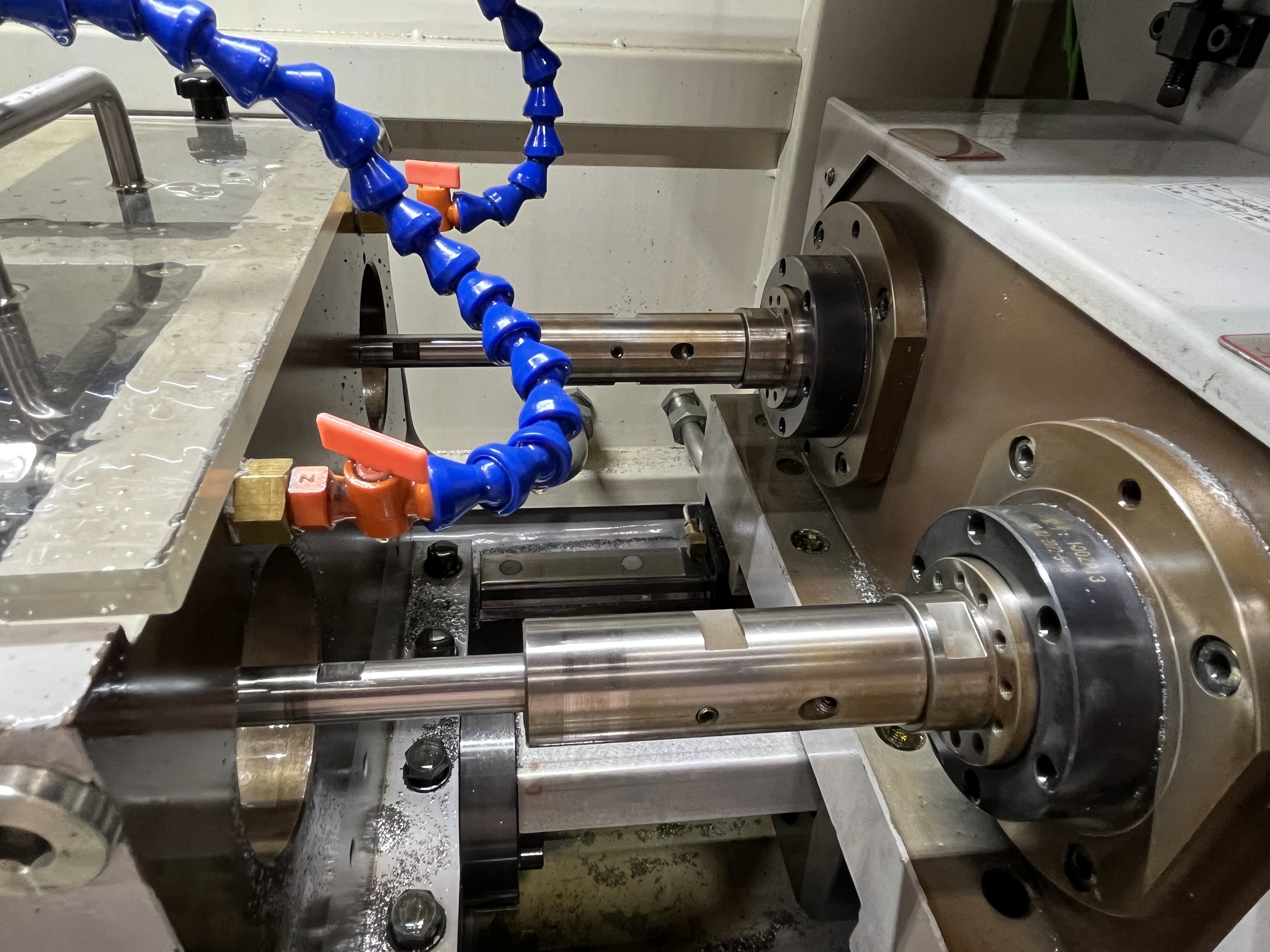
Swiss-type lathes are designed for machining small, slender parts. With live tooling and through-coolant capability, they can handle gun drilling for short deep holes. I have been running gun drilling operations on Swiss lathes for about four years, primarily for medical and precision instrument components. The approach is different from a dedicated gun drilling machine, but with the right setup it produces acceptable results for the right applications.
Capabilities and Limitations
A Swiss lathe is suitable for gun drilling diameters under 6 mm through lengths up to about 10:1 L/D ratio. Beyond that ratio, the coolant pressure and chip evacuation limitations become too severe. The main limitation is coolant pressure — most Swiss lathes have 200-500 psi coolant systems, while dedicated gun drilling machines run at 1000-3000 psi.
| Parameter | Swiss Lathe | Dedicated Gun Drill |
|---|---|---|
| Coolant pressure | 200-500 psi | 1000-3000 psi |
| Max L/D ratio | 10:1 | 100:1+ |
| Diameter range | 1-6 mm | 1-50 mm+ |
| Typical hole tolerance | +/- 0.02 mm | +/- 0.01 mm |
| Surface finish (Ra) | 0.8-1.6 um | 0.4-0.8 um |
| Cycle time (typical) | 2-5 min | 1-3 min |
| Machine cost | $150-300k | $200-500k |
I use a Swiss lathe for drilling 2-4 mm diameter holes through 20-40 mm of material. The parts are typically medical components, watch parts, or small precision shafts. In my experience, if the hole is longer than 10x the diameter or requires tighter than +/- 0.02 mm tolerance, I move the job to a dedicated gun drilling machine.
Recommended Cutting Parameters
I have developed parameter sets for common materials based on testing and production data. These are starting points that I adjust based on chip color and shape:
| Material | Cutting Speed (m/min) | Feed Rate (mm/rev) | Coolant Pressure (psi) |
|---|---|---|---|
| 303 Stainless | 35-45 | 0.008-0.012 | 400-500 |
| 316L Stainless | 30-40 | 0.005-0.010 | 450-500 |
| Titanium (Grade 5) | 25-35 | 0.005-0.008 | 500 |
| 12L14 Steel | 50-60 | 0.015-0.020 | 300-400 |
| Aluminum 6061 | 55-65 | 0.012-0.018 | 250-350 |
| Brass C360 | 55-65 | 0.015-0.022 | 200-300 |
| Inconel 718 | 15-25 | 0.004-0.006 | 500 |
For titanium (Grade 5), I have found that pushing the coolant pressure to the machine maximum of 500 psi is essential. Below 450 psi, the chips weld to the drill body and the tool fails within 5 holes. I also reduce the peck length to 2 mm for titanium to improve chip clearance.
I check the chip form after the first hole and adjust accordingly. Ideal chips for gun drilling on a Swiss lathe are short, broken chips about 2-5 mm long. Long stringy chips mean the feed is too low or the coolant pressure is insufficient. Powder chips mean the feed is too high and the tool is being overloaded.
Chip Evacuation Strategy
The main challenge is chip evacuation. The low coolant pressure does not clear chips as effectively as a dedicated gun drill. I use a peck cycle with short pecks of 3-5 mm to clear chips.
| Material | Peck Length | Dwell at Retract | Coolant Strategy |
|---|---|---|---|
| Stainless steel | 3 mm | 0.5 seconds | Full pressure on; no interruption |
| Titanium | 2 mm | 1.0 seconds | Full pressure; pause at retract for chip flush |
| Steel (free-machining) | 5 mm | 0.3 seconds | Full pressure on |
| Aluminum | 5 mm | 0.2 seconds | Can reduce pressure to 200 psi if finish is priority |
I have experimented with M-code-controlled coolant on/off during the peck cycle. On some Swiss lathes, turning the coolant off during the retract stroke helps wash chips away from the drill entrance. The effect is marginal and depends on the machine’s coolant nozzle placement.
The single most effective improvement I made was installing a through-coolant pressure booster between the machine’s coolant pump and the tool holder. The booster increases the pressure from the machine’s 300 psi to about 700 psi at the tool tip. This cost about $1,200 and improved chip evacuation noticeably for stainless and titanium.
Guide Bushing and Tool Support
The guide bushing on the Swiss lathe acts as the gun drill support. I use a custom guide bushing that matches the gun drill diameter. The clearance should be within 0.005 mm.
| Drill Diameter | Guide Bushing ID | Clearance |
|---|---|---|
| 2.00 mm | 2.003 mm | 0.003 mm |
| 3.00 mm | 3.005 mm | 0.005 mm |
| 4.00 mm | 4.005 mm | 0.005 mm |
| 5.00 mm | 5.008 mm | 0.008 mm |
I machine the guide bushing from oil-hardening tool steel (O1) or pre-hardened 4140, depending on production volume. For prototype runs under 100 parts, I use 4140. For production runs over 1000 parts, I use O1 hardened to 58-60 HRC.
The bushing length should be 2-3 times the drill diameter. A bushing that is too short does not provide adequate support and the drill wanders off-center. A bushing that is too long traps chips and causes scoring.
I align the guide bushing with the spindle centerline using a test bar and dial indicator. The runout at the bushing exit must be under 0.005 mm. I check alignment after every tool change because the bushing can shift when the tool holder is removed and reinstalled.
Tool Selection
Gun drills for Swiss lathes are typically solid carbide with a single internal coolant hole. The drill diameter tolerance should be h6 or better. I use these common drill sizes:
| Stocked Diameters | Application |
|---|---|
| 1.50 mm, 1.80 mm | Medical bone screws (titanium) |
| 2.00 mm, 2.50 mm | Watch components, precision pins |
| 3.00 mm, 4.00 mm | General-purpose small shafts |
| 5.00 mm, 6.00 mm | Larger medical and automotive components |
The gun drill tip geometry matters. I use a standard 120-degree point with a 4-6 degree relief angle for most materials. For titanium, I switch to a 130-degree point with a 3-degree relief angle to reduce the cutting force on the outer corner.
Tool life in Swiss lathe gun drilling is shorter than in dedicated machines because the lower coolant pressure leads to higher cutting temperatures. I track tool life in number of holes and change drills when surface finish degrades:
| Material | Average Tool Life (holes) | Stop Criteria |
|---|---|---|
| 303 Stainless | 80-120 | Surface finish > 1.6 um Ra |
| Titanium Grade 5 | 30-50 | Burr height > 0.05 mm |
| 12L14 | 200-300 | Hole size drift > 0.01 mm |
| Aluminum 6061 | 150-250 | Chip jamming in hole |
When to Use a Dedicated Gun Drill
Despite the capabilities I have described, I am clear-eyed about the limitations. I have learned that Swiss lathe gun drilling is a compromise. It works for prototypes, short runs, and parts with modest tolerance requirements. For production work with tight tolerances, a dedicated gun drilling machine produces more consistent results.
I move work to a dedicated machine when any of these conditions apply:
- Hole L/D ratio exceeds 10:1
- Diameter tolerance tighter than +/- 0.015 mm
- Production volume exceeds 500 parts per month
- Material is difficult to machine (Inconel, hardened steel)
- Surface finish requirement below 0.8 um Ra
Key Takeaways
- Swiss lathe gun drilling works well for diameters 1-6 mm and L/D ratios up to 10:1
- Coolant pressure is the main limitation — a pressure booster is a worthwhile investment
- Custom guide bushings with 0.005 mm clearance are essential for hole straightness
- Peck cycles of 2-5 mm are required to clear chips at low coolant pressures
- Move to a dedicated gun drilling machine for tight tolerances, high volumes, or difficult materials