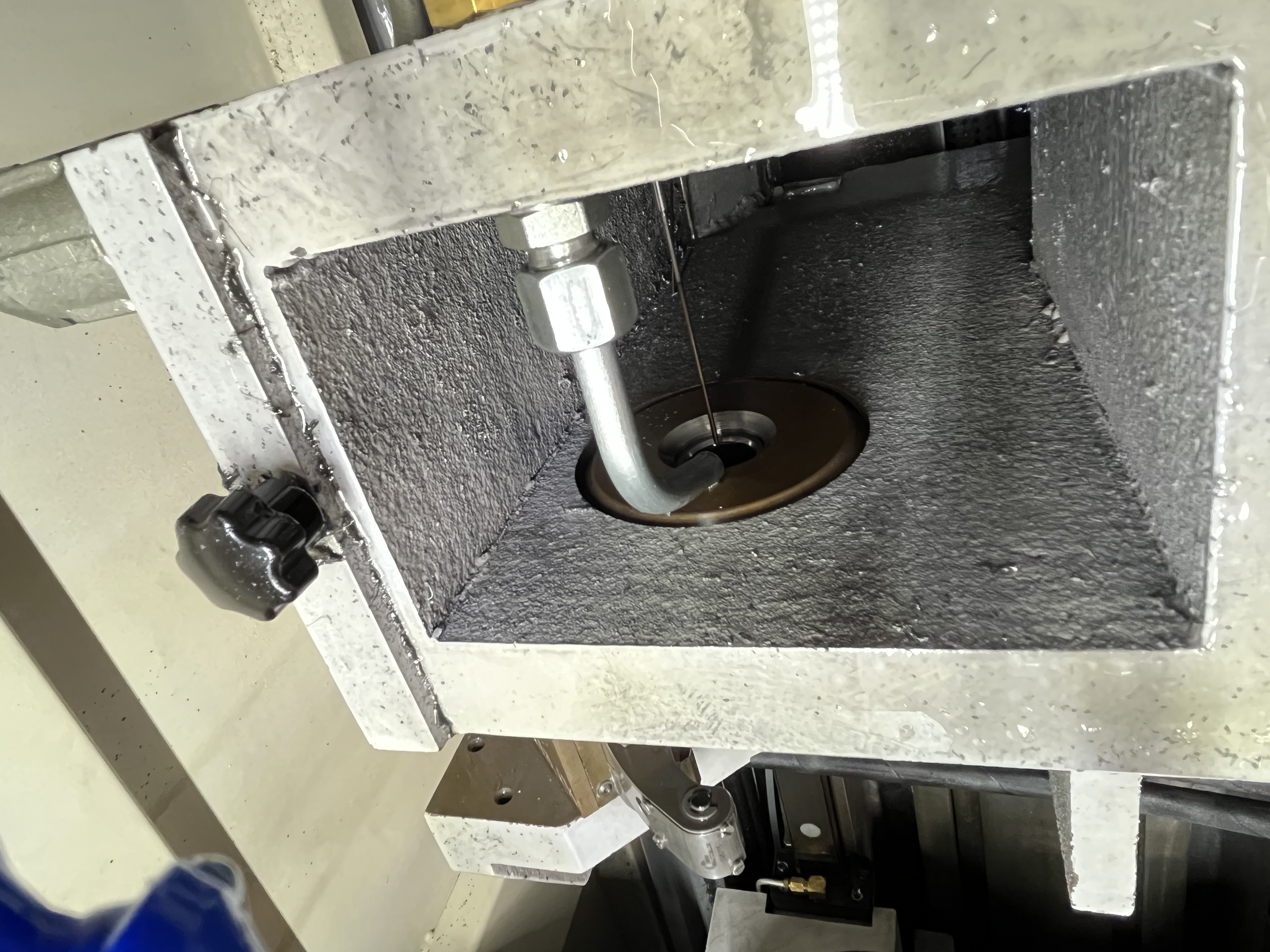
Tool change time on a deep hole drilling machine gets overlooked because the drilling cycle itself is long. A typical BTA drilling cycle might run five to fifteen minutes, so a three-minute tool change seems insignificant. But add up thirty tool changes per shift across three shifts and suddenly you are losing 4.5 hours of spindle time per day. Quick-change tooling addresses exactly this hidden productivity drain.
The Cost of Conventional Tool Changes
On a standard machine, changing a gun drill or BTA drill head involves stopping the spindle, retracting the tool past the guide bushing, loosening set screws or a drawbar mechanism, pulling the tool, inserting the new one, tightening, resetting coolant pressure, and restarting. I have timed this at 4.5 to 8 minutes for a competent operator on a typical machine.
| Change Method | Typical Time | Annual Cost (4 changes/day, $100/hr) |
|---|---|---|
| Set screw + spanner wrench | 6–8 min | $6,400–$8,500 |
| Drawbar with hex key | 4–6 min | $4,300–$6,400 |
| Quick-change collet system | 1.5–3 min | $1,600–$3,200 |
| Hydraulic clamping | 0.5–1 min | $530–$1,060 |
I have seen a shop with eight deep hole drilling machines running three shifts. They switched from set screw retention to a quick-change collet system and recovered 3,600 hours of spindle time per year across the shop. That is effectively adding one machine shift per day without spending a dollar on capital equipment.
Types of Quick-Change Systems
Collet-Style Quick-Change
This is the most common system for gun drills up to 50 mm diameter. The tool shank inserts into a precision collet, and a threaded cap or lever mechanism clamps it. Most systems use a 5C or 16C collet format, though proprietary designs exist. The runout accuracy depends on the collet quality. I have measured 0.005 mm TIR with high-end collets compared to 0.015 mm with set screw retention.
Hydraulic Chuck Systems
For larger BTA tools above 50 mm diameter, hydraulic expansion chucks provide exceptional gripping force and vibration damping. The clamping pressure ranges from 300 to 700 bar depending on the design. These chucks use an oil-filled chamber that expands a thin steel sleeve when tightened with a torque wrench or hydraulic pump.
| Chuck Type | Diameter Range | Gripping Force | TIR Accuracy | Cost Range |
|---|---|---|---|---|
| 5C collet | 1–26 mm | 4,000–8,000 N | 0.008–0.015 mm | $200–$500 |
| 16C collet | 3–38 mm | 6,000–12,000 N | 0.008–0.015 mm | $300–$700 |
| Hydraulic expansion | 20–100 mm | 15,000–40,000 N | 0.003–0.005 mm | $800–$2,500 |
| Shrink fit | 3–50 mm | 10,000–25,000 N | 0.003–0.005 mm | $150–$400 (holder only) |
Tapered Shank Systems
Systems like HSK or steep taper (CAT/BT) with a quick-change interface are popular on CNC deep hole machines. The hollow taper provides dual-face contact that improves rigidity. I prefer HSK over steep taper for high-pressure coolant applications because the face seal handles 80 bar coolant pressure reliably, while steep taper systems sometimes leak at the flange interface above 50 bar.
Coolant Delivery Through Quick-Change Tooling
This is where things get tricky. Deep hole drilling requires coolant at high pressure through the tool. The quick-change interface must seal reliably at operating pressure. I have seen collet chucks with O-ring seals that failed after a few hundred cycles, causing pressure drops that affected chip evacuation.
The best designs use a metal-to-metal seal at the face of the chuck with a replaceable wear insert. For coolant pressures above 70 bar, I recommend a system with a separate coolant connection that seals independently of the tool clamping mechanism. The high-pressure coolant seals used at the spindle interface follow the same principle.
Tool Presetter Integration
A quick-change tooling system works best when combined with a tool presetter that matches the machine tool holder interface. The presetter should use the same collet or chuck system so the runout measured at the presetter transfers directly to the machine.
I set up a dedicated tool prep station next to each machine group. The station includes the presetter, the quick-change collet wrenches, and a cleaning station. The operator presets the tool, installs it in the machine, and records the data in one continuous workflow. The tool prep time dropped from 12 minutes to 4 minutes per change after we organized the station.
Cost-Benefit Analysis
The decision to switch to quick-change tooling should include a realistic payback calculation. The initial investment includes the chucks or collets for each tool size, any spindle adapter modifications, and the presetter if needed.
| Cost Factor | Small Shop (4 machines) | Large Shop (12 machines) |
|---|---|---|
| Quick-change chucks/collets | $3,000–$8,000 | $10,000–$25,000 |
| Spindle adapters | $1,200–$4,000 | $4,000–$12,000 |
| Tool shank grinding setup (if needed) | $2,000–$5,000 | $5,000–$15,000 |
| Training and implementation | $500–$1,500 | $2,000–$5,000 |
| Total investment | $6,700–$18,500 | $21,000–$57,000 |
| Annual time savings (3 shifts) | 1,200–2,400 hours | 3,600–7,200 hours |
| Annual cost savings at $100/hr | $120,000–$240,000 | $360,000–$720,000 |
| Payback period | 2–8 weeks | 3–10 weeks |
The payback is fast enough that I have never had a shop regret the investment. The only caveat is that the savings depend on having enough tool changes per day. A machine running two tool changes per shift will not see the same return as one running ten changes per shift.
Implementation Considerations
Switching to quick-change tooling usually requires a new tool holder adapter for the spindle. Some machines have a proprietary nose piece that limits the options. I have retrofitted machines where we had to machine a new spindle nose adapter, and the cost was $1,200 to $3,500 plus labor.
Tool shank preparation matters. Most quick-change collet systems require a ground shank diameter with 0.005 mm tolerance. Out-of-tolerance shanks cause runout problems and inconsistent clamping force. I recommend adding shank grinding to the tool prep workflow for any shop adopting quick-change systems.
Key Takeaways
- Quick-change tooling reduces tool change time from 6–8 minutes to 1–3 minutes.
- Hydraulic chuck systems offer the best vibration damping and runout accuracy for large BTA tools.
- Collet-style systems are cost-effective for gun drills under 50 mm diameter.
- Coolant sealing at the quick-change interface is critical for deep hole applications.
- Tool shank preparation quality directly affects system performance.
- Annual time savings justify the initial investment in six months or less for multi-shift operations.