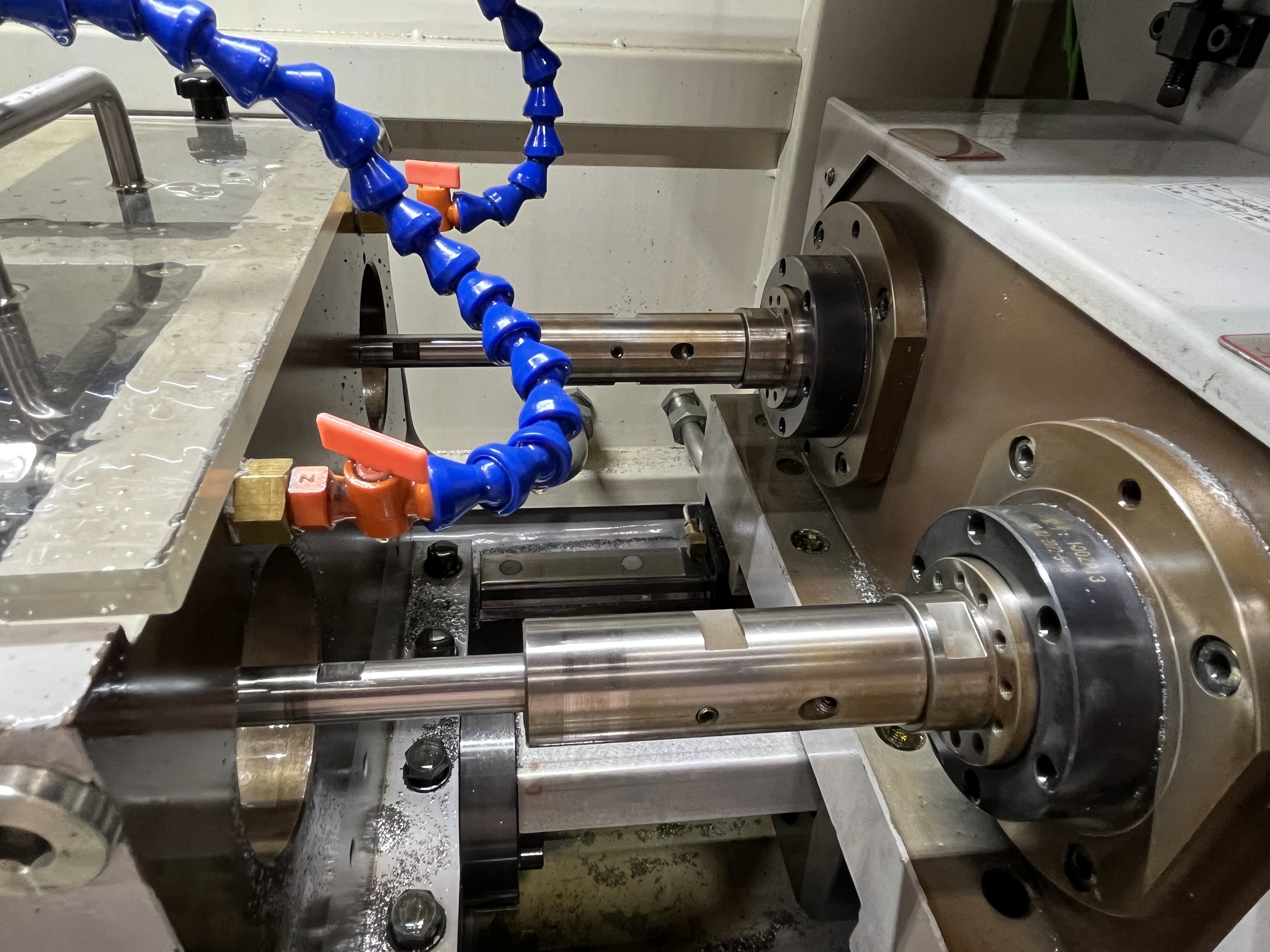
I do a risk assessment before every new job setup. It takes 30 minutes and identifies hazards that might otherwise be overlooked. In my experience, the jobs where I nearly skipped the assessment are the ones that would have bitten me. I use a structured hazard register rather than a mental checklist because it leaves a record that can be reviewed later if something does go wrong.
Hazard Identification
The main hazards on a deep hole drilling machine fall into six categories. I walk through each category systematically during the risk assessment:
| Hazard Category | Specific Risks | Typical Severity (1-5) | Typical Likelihood (1-5) |
|---|---|---|---|
| High-pressure coolant | Coolant injection injury, hose whipping | 5 | 2 |
| Rotating parts | Entanglement, impact from rotating tools | 5 | 2 |
| Hot chips / thermal | Burns from chips, fire from oil mist | 3 | 4 |
| Heavy workpieces | Crushing, pinch points during setup | 4 | 3 |
| Sharp tools / edges | Cuts during tool handling and deburring | 2 | 5 |
| Electrical | Shock from coolant ingress into cabinets | 4 | 1 |
Severity is on a 1-to-5 scale where 5 is permanent injury or fatality. Likelihood is 1-to-5 where 5 is happens daily. I multiply the two to get a risk priority number. Any item with an RPN above 12 requires additional controls before the job starts.
High-Pressure Coolant Injection
Coolant at 2000 psi can penetrate the skin. This is the hazard that scares me most because a coolant injection injury looks minor at first but causes tissue necrosis within hours. I keep the machine doors closed and check hoses for wear weekly.
Controls I enforce:
- All machine access doors must be interlocked. I verify the interlock functions before each job setup.
- High-pressure hoses are replaced every 12 months regardless of visual condition.
- Operators wear cut-resistant gloves when handling hose connections.
- A pressure relief valve is fitted between the pump and the rotating union. I test this valve quarterly.
- No one opens the machine door while coolant pressure is above 10 bar. I set this as a hard limit in the machine control logic.
Rotating Parts and Entanglement
The spindle, drill tube, and workpiece rotate at high speeds. On a BTA machine, the drill tube can exceed 3000 RPM while the workpiece rotates in the opposite direction. Loose clothing or long hair can get caught between the rotating tube and the workpiece.
I require the following controls:
- All operators wear fitted clothing and tie back long hair. I enforce this strictly. Loose sleeves are the most common violation I observe.
- Ring guards are installed over the rotating coupling between the drill tube and the chip box.
- The work zone is enclosed with polycarbonate panels rated for impact from broken tools.
- An emergency stop bar runs the full length of the machine. I check that it stops all axes within 250 milliseconds during the weekly safety walk.
Hot Chips and Thermal Hazards
Chips come out at high temperature and velocity. In gun drilling, the chips exit through the drill flute at speeds approaching 10 meters per second. In BTA drilling, they travel through the inner tube at even higher velocity. The chip temperature at the exit point can reach 300 degrees Celsius when drilling steel.
Controls include:
- Chip guards positioned at the drill exit point. I use clear polycarbonate so the operator can see the chip flow without opening the guard.
- Operators wear heat-resistant gloves when handling chip bins.
- A fire extinguisher rated for Class A and Class B is stationed within 5 meters of every deep hole machine. I have seen oil mist ignite from a hot chip twice in my career.
- Chip bins are emptied at the end of every shift. A pile of hot chips left overnight can smolder and start a fire.
Heavy Workpiece Handling
Some parts weigh several hundred kilograms. Moving a 300 kg cylinder with a manual hoist requires careful planning. I use a gantry lift for parts over 50 kg.
| Workpiece Weight | Lifting Method | Support During Drilling | Operator Required |
|---|---|---|---|
| Under 20 kg | Manual handling | Standard steady rest | 1 |
| 20 - 100 kg | Jib crane or gantry | Steady rest + tailstock | 1 |
| 100 - 500 kg | Overhead crane | Multiple steady rests | 2 |
| Over 500 kg | Forklift or power roller | Powered steady rests + roller supports | 2 |
The risk assessment for heavy parts includes a lifting plan that specifies the lift points, the rated capacity of each sling or strap, and the path the part travels from the staging area to the machine.
Lockout / Tagout Procedure
Every risk assessment includes a written lockout/tagout procedure for that specific machine. I do not use generic procedures. The deep hole machine has stored energy in the coolant accumulator, the spindle drive, and the hydraulic steady rests. Each of these must be isolated and verified zero-energy before any maintenance or setup activity inside the work zone.
My LOTO procedure covers:
- Shut off main electrical disconnect and lock with personal lock.
- Close coolant supply valve and lock.
- Bleed pressure from coolant accumulator by opening the test port.
- Verify zero energy by pressing the coolant start button (it should not run) and checking the pressure gauge reads 0 bar.
- Apply a secondary lock to any hydraulic or pneumatic accumulators.
- Tag the machine with the operator name, date, and reason for lockout.
Real Incident
I have seen a shop skip the risk assessment on a new job and pay for it. A heavy cylinder was not properly supported, shifted during drilling, and damaged the guide bushing holder. The repair cost more than the job was worth. A simple risk assessment would have caught the inadequate support. That incident forced a redesign of the workholding approach and added three days of downtime. The risk assessment form now includes a mandatory check for workpiece support calculation on every job with a length-to-diameter ratio above 10:1.
Key Takeaways
- A structured hazard register with severity and likelihood ratings is more effective than a mental checklist. It creates a record that can be audited and reviewed.
- High-pressure coolant injection is the most severe hazard in deep hole drilling. Treat it with the same respect as a spinning tool.
- Hot chips are the most frequent hazard. They cause burns and fires. The controls are simple and cheap.
- Lockout/tagout procedures must be machine-specific. A generic procedure misses the stored energy unique to deep hole machines.
- The risk assessment takes 30 minutes. The cost of skipping it is measured in injuries and machine repairs that take days or weeks.