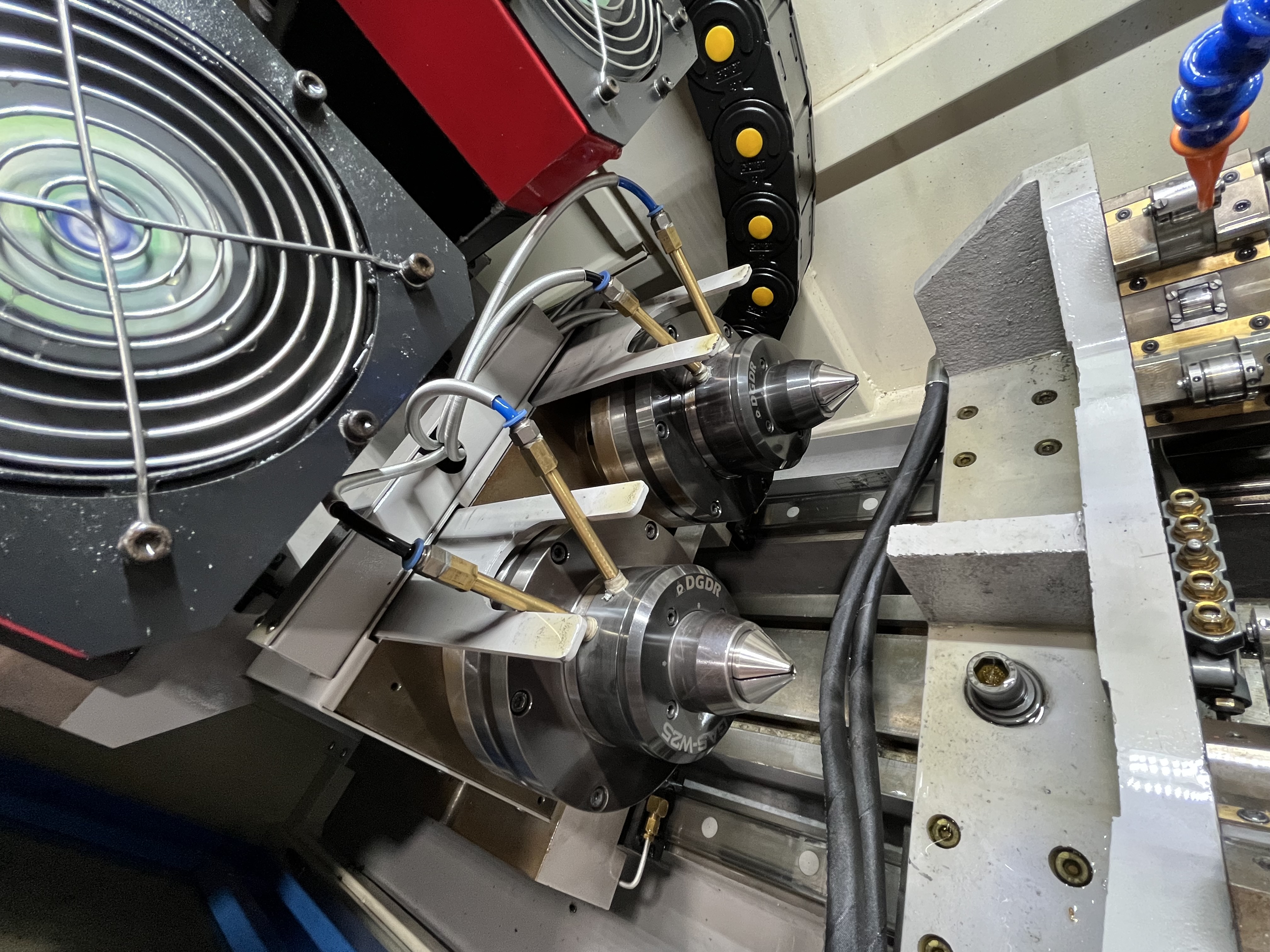
When I look at a deep hole drilling machine — whether for purchase or for a specific job — I check certain features that tell me whether the machine is capable of producing good holes consistently.
Here’s what I look for.
Spindle Condition
The spindle is the most important component. I check:
- Runout at the tool interface. Should be under 0.005mm TIR for a good machine, under 0.01mm for an acceptable machine.
- Bearing noise. A quiet spindle has good bearings. A rumbling spindle needs bearing replacement.
- Speed range. The spindle should reach the speeds needed for the diameters you’ll drill. A machine with a 6000 RPM max is limited to drills over about 3mm diameter.
- Coolant union. Check for leaks at the rotating union. A leaking union means pressure loss at the tool.
Coolant System
The coolant system determines whether the machine can clear chips effectively. I check:
- Maximum pressure. Gun drilling needs 1000-2000 psi. BTA needs 200-500 psi.
- Flow rate. Gun drilling needs about 3-4 L/min per mm of tool diameter. BTA needs much higher flow.
- Filtration. 20 microns minimum for gun drilling. Check filter condition.
- Tank size. A larger tank maintains temperature better. Minimum 5 minutes of pump flow.
- Chiller. Essential for consistent temperature during long runs.
I’ve seen machines with excellent spindles that couldn’t drill a straight hole because the coolant system was undersized. The coolant system is the first thing I check.
Guide Bushing Holder
The guide bushing holder supports the drill at entry. I check:
- Alignment. The bushing holder should be adjustable and lockable.
- Range. The holder should accept bushings for the full range of drill diameters you’ll use.
- Condition. A worn bushing holder causes drill wandering at entry.
Machine Bed and Ways
The bed and ways determine the machine’s long-term accuracy. I check:
- Way wear. Check for play in the feed axis. A machine with worn ways produces inconsistent feed rates.
- Leveling. Check that the machine is level within 0.02mm per meter.
- Chip evacuation. The bed should have good chip flow. Chips accumulating on the ways cause wear.
Control and Programming
The control should support deep hole drilling cycles. I check:
- Peck cycle programming. Can the operator set peck depth, retract distance, and feed rate easily?
- Load monitoring. Does the control monitor spindle load and alarm on overload?
- Tool life management. Does the control track tool usage?
- Program storage. Can the control store enough programs for your work mix?
Automation Features
I check whether the machine is ready for automation:
- Auto-door. Does the machine have an automatic door or is it manual?
- Part sensor. Does the machine detect whether a part is loaded?
- Coolant auto-shutoff. Does the coolant shut off automatically when the cycle ends?
- Communication. Does the control support data collection or remote monitoring?
Accessories
Check what accessories are included:
- Steady rests. How many? What diameter range?
- Tooling. Does the machine come with any drills, bushings, or holders?
- Coolant system. Is the coolant system complete with pump, tank, filter, and chiller?
- Documentation. Are manuals, electrical schematics, and maintenance guides available?
Test Run
Before buying a used machine, I run a test part:
- Drill a test hole in a material I’m familiar with (typically 1045 steel)
- Measure the diameter at both ends and mid-length
- Measure the straightness
- Check the surface finish
- Compare the results to what the machine should produce
A used machine that drills a straight hole with good surface finish is worth considering. A machine that can’t produce a straight test hole has problems that may be expensive to fix.
Key Specifications at a Glance
When I evaluate a machine, I check these minimum specs:
| Feature | Acceptable | Good | Excellent |
|---|---|---|---|
| Spindle runout TIR | Under 0.010mm | Under 0.005mm | Under 0.003mm |
| Coolant pressure | 1000-1500 psi | 1500-2000 psi | 2000-3000 psi |
| Coolant filtration | 50 microns | 20 microns | 10 microns |
| Guide bushing range | 1-20mm | 1-30mm | 0.5-50mm |
| Axis positioning | 0.020mm | 0.010mm | 0.005mm |
| Control | Basic CNC | CNC with peck cycles | CNC with load monitoring |
This table is my quick reference when I walk into a shop to evaluate a machine. If the machine hits the “Good” column in all categories, it will produce quality holes for most work.
Key Takeaways
The best indicator of a machine’s condition is the test hole. Specs and features are useful, but the proof is in the hole the machine drills. A machine with basic features that drills straight holes is more valuable than a machine with all the features that can’t hold a tolerance.
Key Takeaways
- Check spindle runout first — anything over 0.01mm TIR means bearing issues
- The coolant system is the most commonly undersized component on deep hole drilling machines
- A test hole is the best indicator of machine condition — run one before buying used
- Minimum specs for quality work: 1500 psi coolant, 20 micron filtration, 0.010mm positioning
- Automation features like auto-door and part sensors are valuable for production but not essential for job shop work