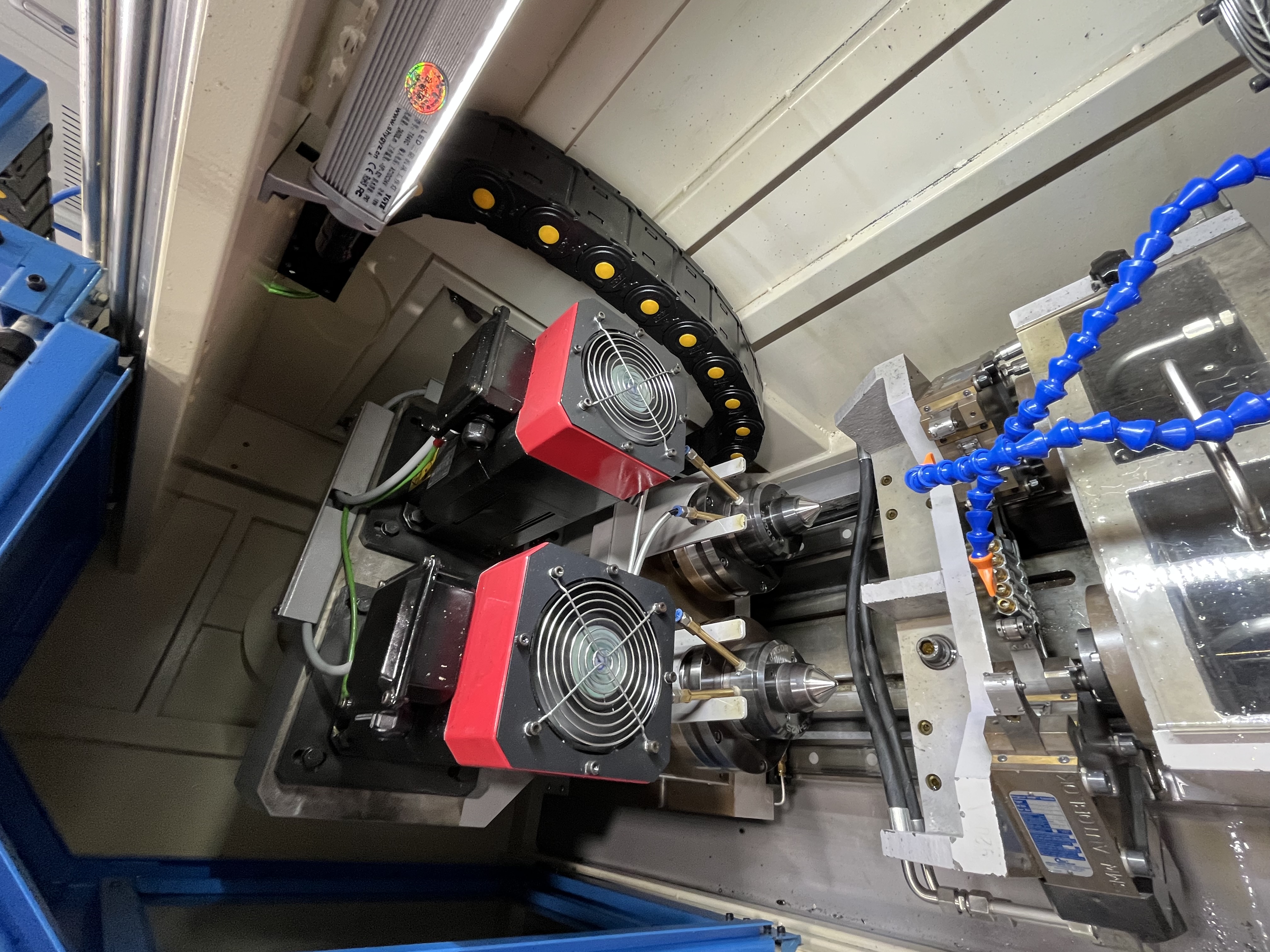
Workholding is more important in deep hole drilling than in most other machining operations. The cutting forces are high, the cycle times are long, and a part that shifts even 0.1mm during drilling can produce a scrap bore.
I’ve used many workholding methods for deep hole drilling. Each has its place depending on the part geometry and production volume.
Chucks
Chucks are the standard method for holding round parts. A three-jaw or four-jaw chuck grips the OD of the part at the headstock end. The chuck provides the rotational drive if the workpiece rotates.
For deep hole drilling, I use chucks with:
- High grip force to prevent the part from slipping under cutting torque
- Accurate runout (0.03mm TIR or better)
- Through-hole large enough for the drill to pass through (if applicable)
- Quick-change jaws for different part diameters
Hydraulic chucks give more consistent grip force than manual chucks. I’ve seen hydraulic chucks reduce setup time by 50% on production jobs.
Steady Rests
Steady rests support long parts at intermediate points. A steady rest has three or more rollers that contact the part OD and prevent it from deflecting under cutting forces.
For deep hole drilling, steady rests need:
- Adjustable rollers for different diameters
- Rollers that don’t mark the part surface
- Rigid mounting to the machine bed
- Easy adjustment for alignment
The number of steady rests depends on the part length. I use one steady rest per meter of part length as a general rule.
Collets
Collets are used for smaller diameter parts where a chuck would interfere with the cutting area. A collet grips the part OD with a split sleeve that’s tightened by a drawbar or collet nut.
Collets provide better concentricity than chucks — typically 0.01mm TIR or better. The trade-off is that each collet fits only one diameter, so a collet change is needed for each different part size.
Fixtures for Non-Round Parts
Non-round parts — valve bodies, manifolds, and irregular shapes — need fixtures instead of chucks. A fixture holds the part in a fixed position while the tool rotates.
Good fixture design for deep hole drilling:
- Supports the part at the bore location to prevent deflection
- Provides clearance for the drill entry and exit
- Allows coolant to flow freely through the bore
- Includes locating points for repeatable positioning
I’ve seen fixtures that located a valve body within 0.02mm of the correct position for the spool bore. The bore came out straight and concentric because the part was rigidly supported.
Face Drivers
Face drivers are used for shaft work when the entire OD needs to be machined in one setup. The face driver grips the end face of the part with carbide pins and drives the part through the tailstock center.
Face drivers allow the OD to be turned in the same setup as the bore drilling. This ensures concentricity between the OD and the bore.
Tailstock Centers
Tailstock centers support the end of a workpiece opposite the chuck. A live center rotates with the part. A dead center is stationary and needs lubrication.
For long parts, the tailstock center provides essential support. Without it, the part would whip and the bore would be non-straight.
The tailstock center should be aligned to the spindle axis within 0.02mm. Misalignment causes the bore to drift off center.
Choosing the Right Workholding
| Part Type | Recommended Workholding |
|---|---|
| Round shaft, short | Chuck at headstock |
| Round shaft, long | Chuck + steady rests + tailstock center |
| Tube, any length | Chuck + steady rests |
| Non-round, small | Collet block fixture |
| Non-round, large | Custom fixture |
| Valve body | Fixture with bore support |
| Thin-walled tube | Mandrel (internal support) |
Common Problems
The most common workholding problems I’ve seen:
- Part slippage. The chuck or collet doesn’t grip hard enough. The part rotates during drilling, producing an out-of-round hole.
- Vibration. The part isn’t supported at enough points. The part vibrates during drilling, producing chatter marks.
- Misalignment. The workholding isn’t aligned to the spindle axis. The bore drifts off center.
- Part marking. The chuck jaws or steady rest rollers mark the part surface. Soft jaws or rubber-coated rollers prevent this.
Key Takeaways
Workholding is the foundation of a successful deep hole drilling job. A part that’s properly supported and aligned will produce a good hole. A part that’s poorly supported will produce a bad hole regardless of the cutting parameters.
I spend more time on workholding setup than on tool selection. The extra setup time pays for itself in consistent results and reduced scrap. For deep detail on custom fixture design, see Fixture Design Principles.
Key Takeaways
- Workholding is more critical in deep hole drilling than in most other machining operations.
- Use one steady rest per meter of part length as a general rule.
- Hydraulic chucks provide more consistent grip force than manual chucks.
- Collets deliver better concentricity than chucks but are diameter-specific.
- Align the tailstock center to the spindle axis within 0.02mm.
- Part slippage, vibration, misalignment, and marking are the most common workholding problems.