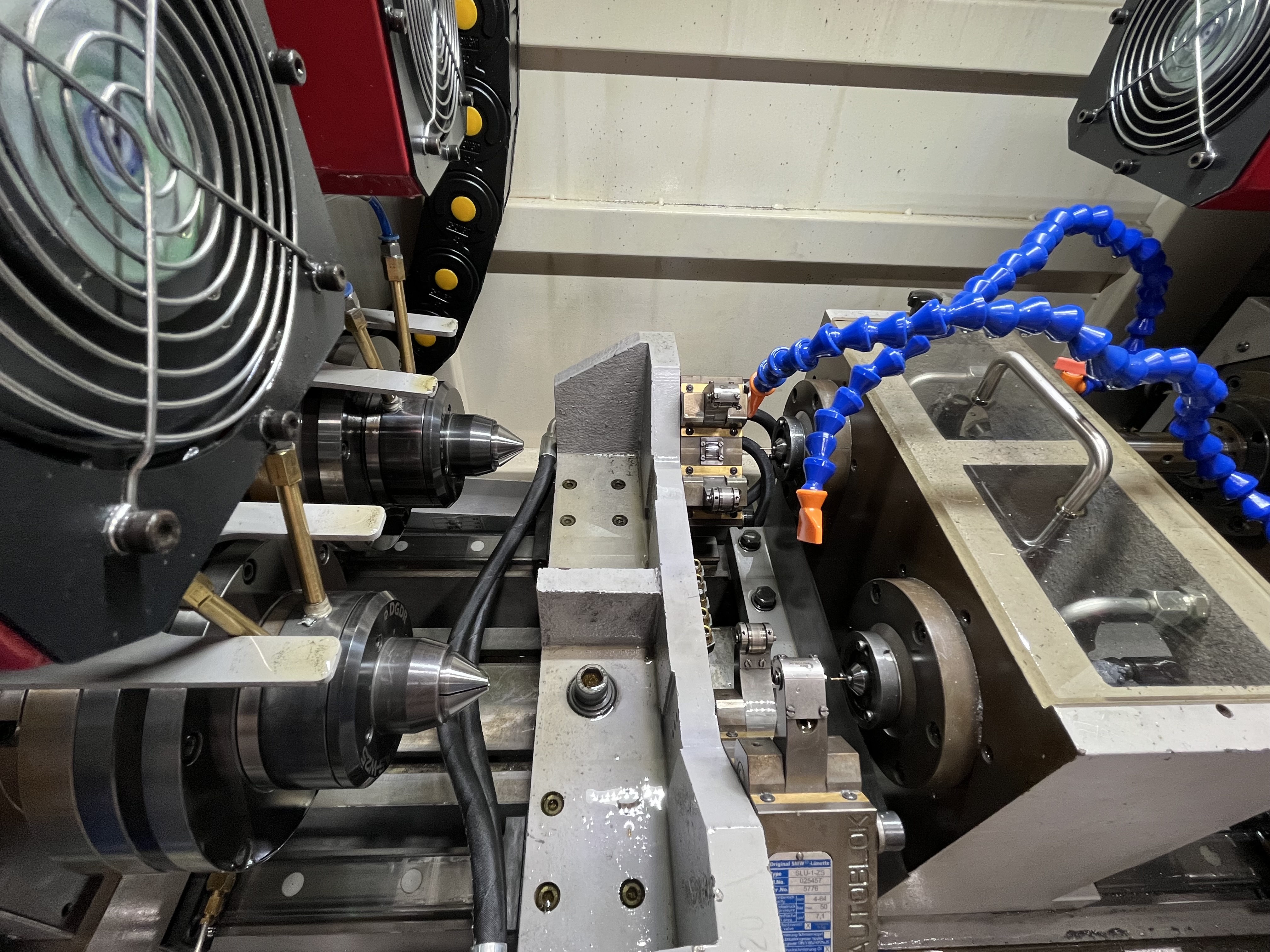
I use BTA drilling for holes over about 20mm that need fast cycle times. When I need to remove a lot of material quickly and the diameter is large enough to support the tool, BTA drilling is my go-to process. It is also called single tube system drilling because the coolant flows around a single drill tube rather than through a double-tube arrangement like ejector drilling.
BTA drilling — named after the Boring and Trepanning Association — is a deep hole drilling process for larger diameters. It’s the method I use when the hole is over about 20mm diameter and needs to be cost-effective. The process was developed in Germany in the 1930s and has been refined continuously since then. Modern BTA drilling machines can produce holes up to 300mm diameter and 20 meters deep.
How BTA Drilling Works
In BTA drilling, coolant is delivered through the gap between the drill tube and the bore wall. The coolant passes through the cutting head, cools the cutting edges, and returns through the center of the drill tube carrying chips with it. The pressure head seals against the workpiece face to contain the coolant and direct it around the tube.
The chip evacuation through the center of the tube is the key difference from gun drilling. In gun drilling, chips return along an external flute. In BTA drilling, chips go through the center. This internal chip evacuation allows higher feed rates than gun drilling. The chips don’t have to travel along a narrow flute — they flow freely through the center of the tube.
The chip evacuation area in BTA drilling represents over 60% of the hole area, compared to only about 22-26% for gun drilling. That difference in flow area is why BTA can run at higher material removal rates without chip packing.
BTA vs Gun Drilling Comparison
Here is the detailed comparison I use when deciding between BTA drilling and gun drilling for a new job.
| Factor | Gun Drilling | BTA Drilling |
|---|---|---|
| Diameter range | 0.5-50mm | 8-300mm+ |
| Depth ratio | Up to 400:1 | Up to 100:1 |
| Surface finish | Ra 0.1-0.8μm | Ra 0.4-3.2μm |
| Feed rate | Moderate | 3-5x higher |
| Coolant pressure | 1000-3000 psi | 200-500 psi |
| Coolant flow rate | Low (1-10 GPM) | High (20-100+ GPM) |
| Tool stiffness | Lower (V-flute, offset mass) | 2.4x higher torsional rigidity |
| Machine power needed | Lower (~5 hp per inch dia) | Higher (~11 hp per inch dia) |
| Machine cost | Lower | 25-35% higher |
| Chip evacuation area | 22-26% of hole area | 60%+ of hole area |
| Tool types | Brazed carbide tip | Brazed or indexable inserts |
| Typical tolerance | ±0.02mm | ±0.05mm |
| Materials removal rate | Baseline | 5-10x faster |
| Surface finish quality | Excellent, may eliminate reaming | Good, may need honing |
I pick BTA drilling when the diameter is over 20mm and the production volume justifies the tooling cost. For small diameters under 20mm, gun drilling is the only practical option. For diameters between 8-20mm, both processes can work, but the decision comes down to the required surface finish and production volume.
BTA Tool Types
Brazed Carbide Tools
Brazed carbide BTA heads cover the 8-65mm diameter range. The carbide cutting tip and guide pads are brazed onto a steel body and ground to a precise diameter. I use these for smaller diameters where the head cost is manageable and the tightest tolerances are needed. The downside is that when the cutting edges wear, the entire head is scrapped.
Indexable Insert Tools
For diameters over 20mm, I prefer indexable insert BTA heads. The inserts are mounted directly in the head body or in adjustable cartridges. When an insert wears, I replace just the insert, not the entire head. The cartridge-mounted versions let me adjust the hole diameter by moving the insert position. This is useful when I need to dial in the exact bore size.
Indexable heads typically have 2-4 cutting edges, with more edges on larger diameters. The guide pads are still brazed carbide and need replacement separately when they wear.
Trepanning Heads
For very large diameters over 100mm, trepanning heads remove a ring of material rather than cutting the full face. This leaves a solid core in the center that can be used for another part. I have trepanned 200mm diameter holes and used the core for a smaller shaft. The material savings are significant — up to 60% less waste compared to drilling the full face.
Coolant Requirements
BTA drilling has specific coolant needs that differ significantly from gun drilling. I have learned these requirements through trial and error.
| Parameter | BTA Drilling | Gun Drilling |
|---|---|---|
| Coolant type | Water-soluble emulsion (10-12%) or oil | Oil preferred, emulsion acceptable |
| Pressure range | 20-50 bar (290-725 psi) | 1000-3000 psi |
| Pressure source | Constant-volume pump | Variable-volume, pressure-compensated |
| Flow rate | 20-100+ GPM depending on diameter | 1-36 GPM depending on diameter |
| Filtration | 10-20 micron required | 20 micron acceptable |
| Temperature control | Heat exchanger recommended | Keep below 80°F |
| Coolant concentration | 10% minimum for guide pad life | 6-8% acceptable |
The coolant in BTA drilling serves three critical roles. First, it lubricates the cutting edges and guide pads. The guide pads are in constant contact with the bore wall and will gall without adequate lubrication. Second, it cools the cutting zone. Third, the coolant pressure differential forces chips through the center of the tube.
I run coolant at 10-12% concentration for BTA drilling. Anything below 8% causes accelerated guide pad wear. The guide pads act as bearings sliding against the bore wall, and they need the EP additives in the coolant to prevent metal-to-metal contact.
BTA Head Selection Guide
| Application | Recommended Head Type | Typical Inserts | Guide Pad Material |
|---|---|---|---|
| Steel (4140, 4340) | Indexable with coated carbide | TiAlN or AlTiN coated | Brazed carbide |
| Stainless steel | Indexable with sharp edge geometry | Uncoated or TiN coated | Fine grain carbide |
| Cast iron | Brazed or indexable with polished rake | CBN or polished carbide | Special wear-resistant |
| Aluminum | Brazed with polished flutes | Polished carbide with high rake | Diamond or PCD |
| High-temp alloys | Indexable with reinforced edge | SiAlON ceramic or AlTiN | Micrograin carbide |
Applications
BTA drilling is used for many industrial applications. Here are the ones I have worked on directly:
- Hydraulic cylinder bores — BTA drilling produces the straight, smooth bore that hydraulic cylinder tubes need. The surface finish is typically Ra 0.8-1.6μm, which is acceptable for hydraulic applications without further processing.
- Heat exchanger tube sheets — drilling hundreds of holes through thick tube sheets requires the material removal rate that only BTA can deliver.
- Valve body bores — large valve bodies for oil and gas applications need deep, accurate bores that BTA drilling provides reliably.
- Large shafts and spindles — center holes through long shafts for generators, turbines, and marine propulsion.
- Oil and gas components — drill collars, production tubing, risers, and wellhead components all use BTA drilling.
- Automotive components — transmission shafts, axle housings, and engine blocks with deep oil passages.
- Aerospace components — landing gear struts, turbine shafts, and structural components.
For more on related deep hole drilling processes, see the ejector drilling troubleshooting guide and the dedicated vs standard machine comparison.
When to Use BTA
I use BTA drilling when:
- The diameter is over 20mm and the production volume justifies the tooling cost
- The material removal rate is important and faster cycle times pay off
- The hole surface finish needs to be good enough to avoid secondary operations
- The workpiece material requires robust chip evacuation
For smaller diameters or lower volumes, gun drilling is more economical. For very deep holes above 100:1 L/D ratio, gun drilling is the only option regardless of diameter.
Key Takeaways
- BTA drilling uses internal chip evacuation through the center of the drill tube, achieving over 60% chip evacuation area compared to 22-26% for gun drilling.
- The detailed BTA vs gun drilling comparison covers 13 factors including diameter range, feed rate, coolant requirements, tool stiffness, and machine power.
- BTA drilling runs at 3-5x higher feed rates than gun drilling, making it the most efficient method for large-diameter deep holes over 20mm.
- Three BTA tool types exist: brazed carbide (8-65mm), indexable insert (20mm+), and trepanning heads (100mm+ for material savings).
- Coolant concentration must be 10-12% for BTA drilling — lower concentrations cause rapid guide pad wear.
- BTA coolant operates at lower pressure (290-725 psi) but much higher flow rates (20-100+ GPM) than gun drilling.
- The BTA head selection guide covers head and insert choices for steel, stainless steel, cast iron, aluminum, and high-temperature alloys.