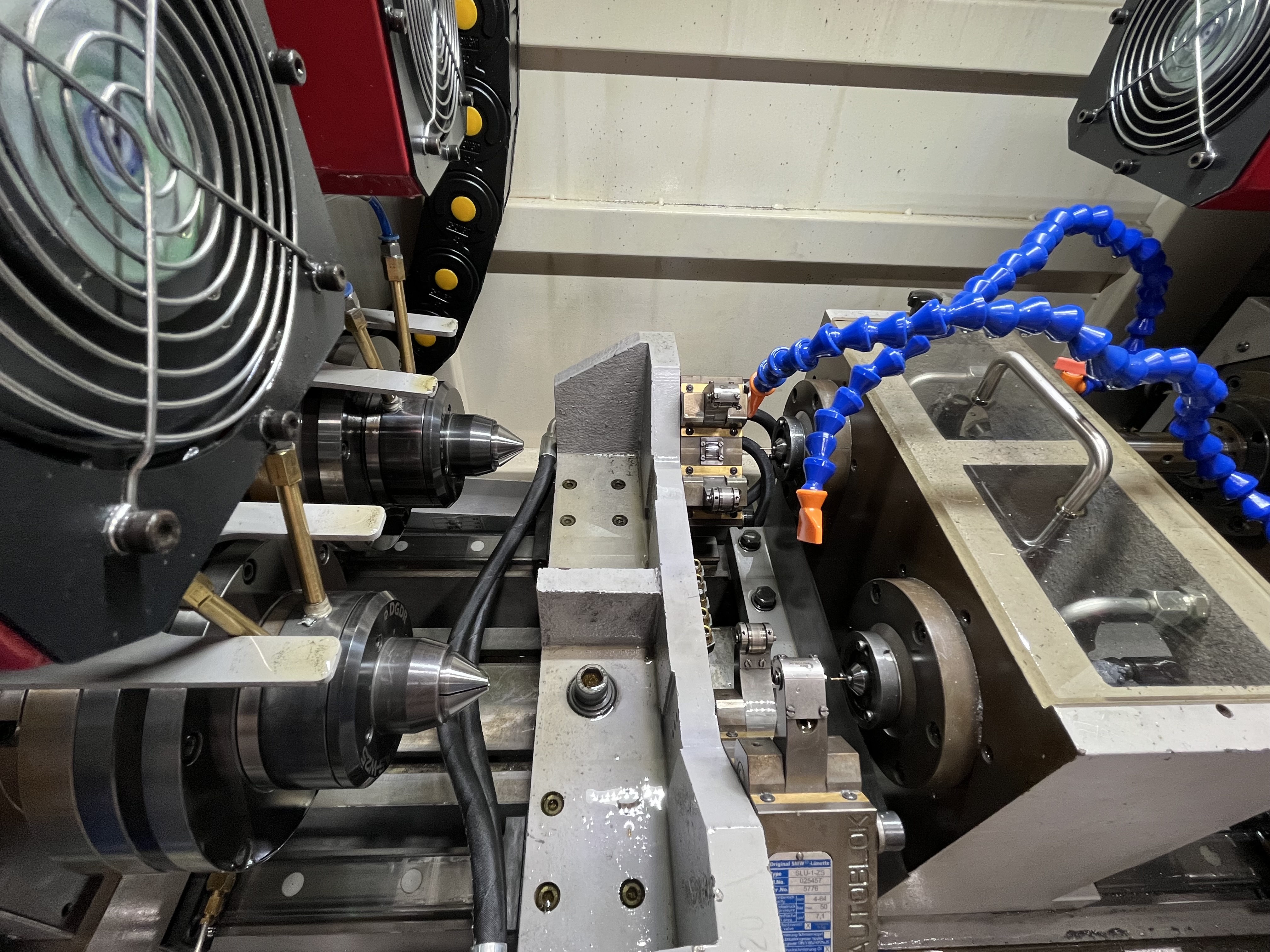
I use carbide for production and HSS for prototypes. That rule of thumb has served me well across hundreds of jobs, but the real answer depends on material, volume, hole geometry, and your shop’s tolerance for risk.
Gun drills are made from either carbide or high-speed steel. Each has distinct advantages, and picking the wrong one costs time and broken tools. Here is what I have learned from running both in production.
When Carbide Wins
Carbide is my default for any job running more than 200 holes. The higher upfront cost disappears fast when you factor in tool life and cycle time.
Production volume. Carbide holds an edge 3-to-1 on tool life over HSS in most steels. On a 500-hole production run, I change a carbide drill maybe once. With HSS I am changing it five or six times. That downtime adds up.
Harder materials. In materials over 35 HRC, carbide is the only reliable choice. HSS edge breaks down rapidly in hardened steels, tool steels, and stainless grades like 17-4 PH. I have tried pushing HSS in 4140 pre-hard and regretted it every time.
Better finish and tolerances. Carbide’s stiffness produces straighter holes with better surface finish. If your print calls for IT7-IT8 tolerance or Ra 0.8 finish, start with carbide. HSS can get there but requires more regrind attention and slower feeds.
Higher cutting speeds. I routinely run carbide gun drills at 250-350 SFM in steel. HSS tops out around 100-150 SFM in the same material. That speed advantage alone often justifies the carbide premium.
When HSS Wins
HSS is not obsolete. I keep HSS gun drills in the toolbox for several situations where carbide works against you.
Small diameters under 1mm. Below 1mm, carbide drills are too brittle. I have watched shops snap three carbide drills in a row trying to drill 0.8mm holes before switching to HSS and getting consistent results. HSS absorbs the deflection that would shatter carbide at that scale.
Interrupted cuts. Cross-holes, keyways, or any break in the bore surface punish carbide. The shock load from an interrupted cut travels straight through the carbide and cracks the tip. HSS handles the impact much better. I use HSS for any job where the drill exits and re-enters material mid-hole.
Low volume and prototypes. For a one-off job or a five-piece prototype run, HSS makes financial sense. A carbide gun drill might cost three times as much, and you will not run enough holes to see the payoff.
Shops with limited budgets. Not every shop can drop several hundred dollars on a custom carbide drill. HSS gets the job done for less upfront cash. If you are starting out or running small job lots, HSS keeps your tooling bill manageable.
Cost Comparison Per Hole
I track cost per hole obsessively because that is the number that matters.
A typical carbide gun drill for a 10mm hole in 4140 steel costs about $120. An HSS equivalent runs around $40. At first glance HSS wins. But a carbide drill might last 1,500 holes before needing regrind, while HSS gives you 400-500 holes.
Carbide: 120 / 1500 = $0.08 per hole before regrind. HSS: 40 / 400 = $0.10 per hole before regrind.
After regrind costs (roughly $15-25 per cycle for carbide, $10-15 for HSS), carbide usually stays cheaper per hole past 200 holes in most steels. In abrasive materials like cast iron or carbon composites, the gap widens further.
Runout and Deflection
Carbide is roughly three times stiffer than HSS. That stiffness translates directly into less deflection at the drill tip.
In deep-hole drilling, deflection is your enemy. A gun drill that walks off center produces oversized, crooked holes or, in the worst case, breaks. I measure runout at the bushing and at the drill tip. Carbide drills consistently hold runout within 0.001 inches. HSS drills in the same setup show 0.003-0.005 inches of deflection.
For holes deeper than 20x diameter, I insist on carbide. The stiffness advantage prevents the helical wander that plagues HSS drills in deep bores.
Regrind Considerations
Both carbide and HSS gun drills need regrinding. The difference is in how many times you can do it.
Carbide gun drills typically handle 8-12 regrinds before the carbide blank is too short. HSS gets 5-8 regrinds. The regrind cost is higher for carbide because it requires diamond wheels, but the per-cycle cost per hole still favors carbide in most cases.
One thing I watch for: after the third regrind on an HSS drill, the edge quality degrades faster. Carbide holds its edge geometry more consistently across regrind cycles. If you need repeatable hole quality across a long production run, carbide gives you more consistency from grind to grind.
Comparison Table
| Criteria | Carbide | HSS |
|---|---|---|
| Cost per tool | Higher ($80-250) | Lower ($25-80) |
| Cost per hole (steel) | $0.06-0.10 | $0.08-0.15 |
| Tool life (holes between regrinds) | 1,200-2,000 | 300-600 |
| Cutting speed (steel) | 250-350 SFM | 100-150 SFM |
| Surface finish capability | Ra 0.4-0.8 | Ra 0.8-1.6 |
| Deflection | Low (stiff) | Moderate (flexes more) |
| Diameter range | 1mm and up | 0.5mm and up |
| Material suitability | Hardened steels, stainless, abrasive materials | Mild steel, aluminum, brass, plastics |
| Regrind cycles | 8-12 | 5-8 |
| Impact resistance | Low (brittle) | High (tough) |
Material-Specific Recommendations
Here is my rule of thumb for common workpiece materials.
| Material | Recommendation | Reasoning |
|---|---|---|
| Mild steel (1018, A36) | Either | Both work. Carbide if volume over 200 holes. |
| Alloy steel (4140, 4340) | Carbide | Hardness and abrasive chips wear HSS fast. |
| Stainless steel (304, 316) | Carbide | Work hardening kills HSS edges quickly. |
| Tool steel (D2, A2) | Carbide | High hardness requires carbide toughness. |
| Aluminum (6061, 7075) | HSS | Low cutting forces. HSS is cheaper and works fine. |
| Brass / Bronze | HSS | No need for carbide. HSS handles these easily. |
| Cast iron | Carbide | Abrasive graphite flakes wear HSS fast. |
| Titanium alloys | Carbide | High heat and work hardening demand carbide. |
| Plastics / Composites | HSS | Low cutting forces. HSS reduces risk of edge chipping. |
| Inconel / Superalloys | Carbide | No contest. HSS will not survive. |
For a deeper look at geometry differences that affect material performance, see the gun drill geometry guide.
Coatings and Materials Interaction
Coatings shift the decision slightly. A TiAlN-coated HSS drill can close the gap on tool life in some steels, but it still does not match carbide on stiffness or speed. If you want to understand how coatings like TiAlN, AlTiN, or diamond-like carbon affect both carbide and HSS gun drills, read the gun drill coatings and materials guide.
My simplified rule: coatings help HSS catch up on wear, but they cannot fix the stiffness gap. If deflection or speed is the constraint, carbide wins regardless of coating.
Key Takeaways
- Carbide is my go-to for production over 200 holes, hardened materials, and tight tolerances.
- HSS is the right call for diameters under 1mm, interrupted cuts, prototype work, and soft materials.
- Cost per hole almost always favors carbide past the 200-hole mark in steel.
- Carbide’s stiffness gives better runout control, especially in holes deeper than 20x diameter.
- HSS handles impact and shock loads that would crack carbide.
- Regrind cycles favor carbide 8-12 versus 5-8 for HSS, with more consistent edge quality across cycles.
- Material choice trumps everything — match the drill material to the workpiece, not the budget.