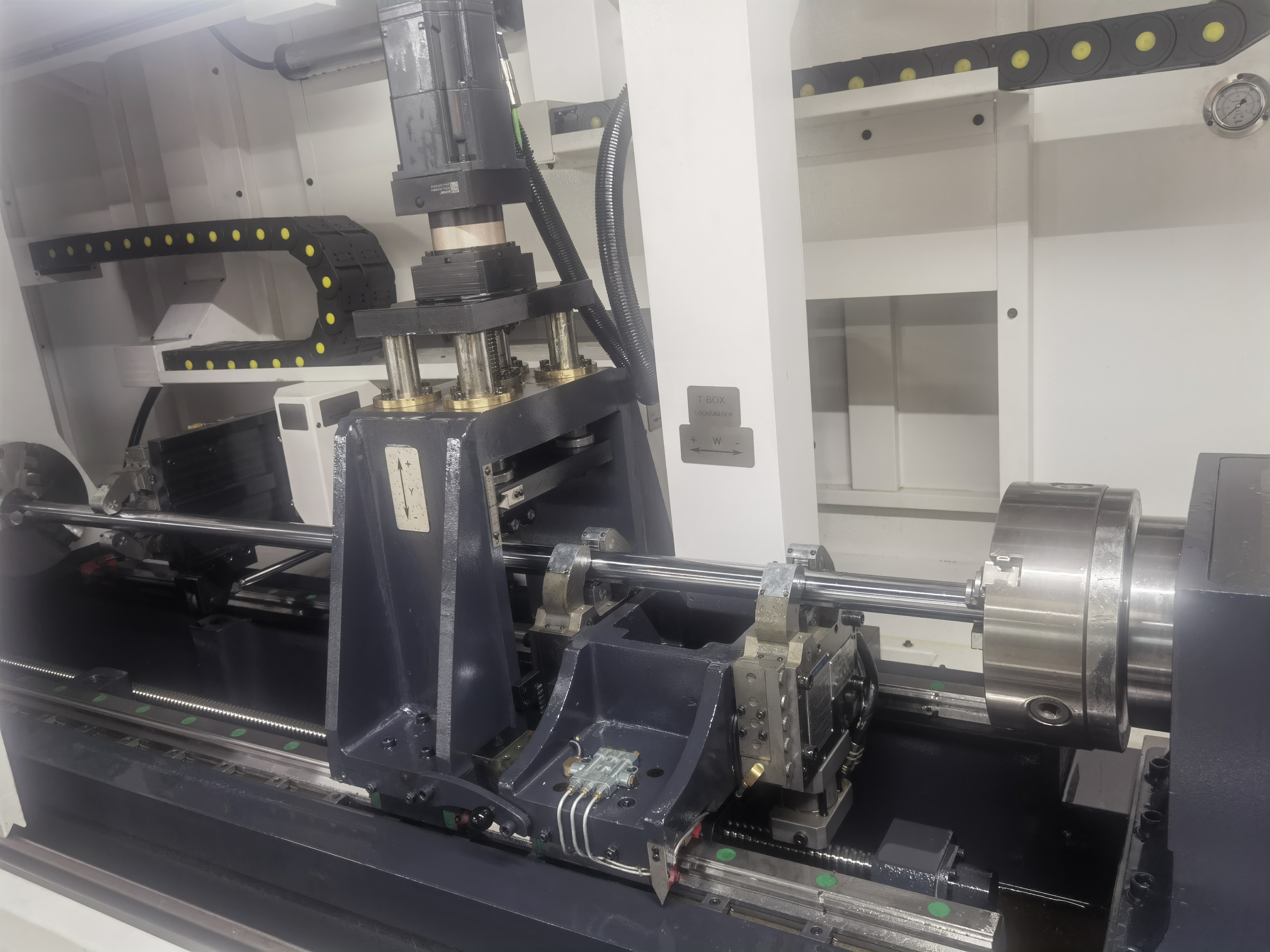
The pilot hole that guides the gun drill at entry determines the accuracy of the entire deep hole operation. I use center drilling for rotating parts and spot drilling for stationary parts. Getting this choice wrong creates problems that cannot be fixed later.
Center Drilling: When and How to Use It
Center drilling uses a combined drill and countersink tool to create a conical starting hole matching the gun drill tip angle. I use center drilling for rotating workpieces — shafts, axles, and cylindrical parts.
For a typical shaft job, I run the center drill at 800-1200 RPM with a manual feed of 0.05-0.10 mm/rev in mild steel. The pilot depth should reach at least the full diameter of the center drill body. The most common center drill sizes I use are #3 (3/16 inch tip) for holes under 6 mm and #5 (5/16 inch tip) for holes up to 12 mm.
I have seen center drills break when fed too fast. The small tip is weak and snaps off if you push it. I slow the feed to 0.03 mm/rev at the point of entry, then increase to 0.08 mm/rev once the full diameter engages.
Spot Drilling: When and How to Use It
Spot drilling uses a short, rigid end mill or a dedicated spot drill to create a flat-bottomed pilot hole. The flat bottom gives the gun drill a clean entry without the bell-mouth effect that happens with center drills on flat surfaces. I use spot drilling for blocks, plates, and irregular shapes that do not rotate.
The spot drill should be 120-150% of the gun drill diameter. A smaller spot drill does not provide enough guidance. I use a 12 mm spot drill for an 8 mm gun drill. The spot depth should be 2-3 mm deeper than the gun drill tip length to ensure the tip is fully guided before it starts cutting.
Center Drill vs Spot Drill: Decision Table
| Factor | Center Drill | Spot Drill |
|---|---|---|
| Entry shape | Conical (60-90 deg) | Flat bottom |
| Best for | Rotating parts (shafts, axles) | Stationary parts (blocks, plates) |
| Pilot depth | 1.5x gun drill diameter | Tip length + 2-3 mm |
| Typical RPM (steel) | 800 - 1200 | 1200 - 1800 |
| Feed at entry | 0.03 mm/rev (reduce at first contact) | 0.05 - 0.10 mm/rev |
| Runout tolerance | Under 0.01 mm | Under 0.01 mm |
| Tool cost (typical) | $15 - $30 | $25 - $60 |
| Tool life | 1000 - 3000 holes | 2000 - 5000 holes |
| Risk of breakage | High (thin tip) | Low (rigid body) |
Tool Selection Guide
Center drill sizes follow a numbering system that corresponds to the tip diameter and body diameter.
| Center Drill Size | Tip Diameter | Body Diameter | Max Gun Drill Diameter |
|---|---|---|---|
| #3 | 3/16 in (4.8 mm) | 3/8 in (9.5 mm) | 6 mm |
| #4 | 1/4 in (6.4 mm) | 1/2 in (12.7 mm) | 10 mm |
| #5 | 5/16 in (7.9 mm) | 9/16 in (14.3 mm) | 12 mm |
| #6 | 3/8 in (9.5 mm) | 5/8 in (15.9 mm) | 16 mm |
| #7 | 7/16 in (11.1 mm) | 3/4 in (19.1 mm) | 20 mm |
For spot drills, I use a 2-flute carbide end mill with a 135-degree included angle. The end mill must be short — no more than 3x diameter flute length — to maintain rigidity. I avoid long-reach end mills for spot drilling because they deflect and produce an off-center pilot.
Depth Recommendations
Pilot depth is the most overlooked parameter in gun drilling setup. I have measured gun drills that wandered at entry because the pilot was too shallow. By the time the drill reached 50 mm depth, the hole was already 0.2 mm off position.
| Gun Drill Diameter | Minimum Center Drill Depth | Minimum Spot Drill Depth |
|---|---|---|
| 3 mm | 4.5 mm | 4 mm |
| 6 mm | 9 mm | 7 mm |
| 10 mm | 15 mm | 11 mm |
| 15 mm | 22.5 mm | 16 mm |
| 20 mm | 30 mm | 21 mm |
I verify pilot depth with a depth mic on every setup. Visual inspection is not reliable — I have seen operators judge a pilot as deep enough when it was 2 mm short.
Common Mistakes
Running pilot diameter too small. I see this frequently. Operators use a center drill or spot drill that matches the gun drill diameter. The pilot should be larger than the gun drill — at least 120% of diameter for center drills and 150% for spot drills. A tight pilot seizes the gun drill on entry.
Skipping the indicator check. Runout in the pilot hole is the most common cause of bell-mouthed deep holes. If the pilot hole center is off by 0.02 mm, the deep hole can drift by 0.1 mm per meter. I indicate every pilot hole location before drilling.
Not cleaning the pilot hole. Chips from the pilot hole can lodge between the gun drill and the pilot wall during entry. This pushes the drill sideways and creates an oversized entry. I blow out the pilot hole with compressed air before starting the gun drill.
Feeding center drill too fast at entry. The small tip of a center drill snaps under heavy feed. I reduce feed to 0.03 mm/rev at initial contact and increase after the full body engages.
Using the wrong angle. The center drill angle must match or be close to the gun drill tip angle. A 60-degree center drill with a 120-degree gun drill tip creates a gap that lets the drill wander on entry. I match the angles within 10 degrees.
Forgetting about existing bores. For parts with existing features, I use a guide bushing instead of cutting a new pilot. The bushing aligns the drill with the existing bore and eliminates the separate piloting operation. See the gun drilling attachments guide for bushing setup.
Key Takeaways
- Use center drilling for rotating cylindrical parts and spot drilling for stationary flat parts — mixing them up causes entry errors.
- Pilot depth should be at least 1.5 times the gun drill diameter — shallower pilots guarantee entry wander.
- Pilot diameter must be 120-150% of gun drill diameter — too tight and the drill seizes on entry.
- Indicate every pilot hole location before drilling to catch runout issues early.
- Blow out pilot holes with compressed air before gun drilling to prevent chip packing at entry.
- Center drills break easily at the tip — use reduced feed of 0.03 mm/rev at initial contact.
- Match center drill angle to gun drill tip angle within 10 degrees to prevent entry wander.