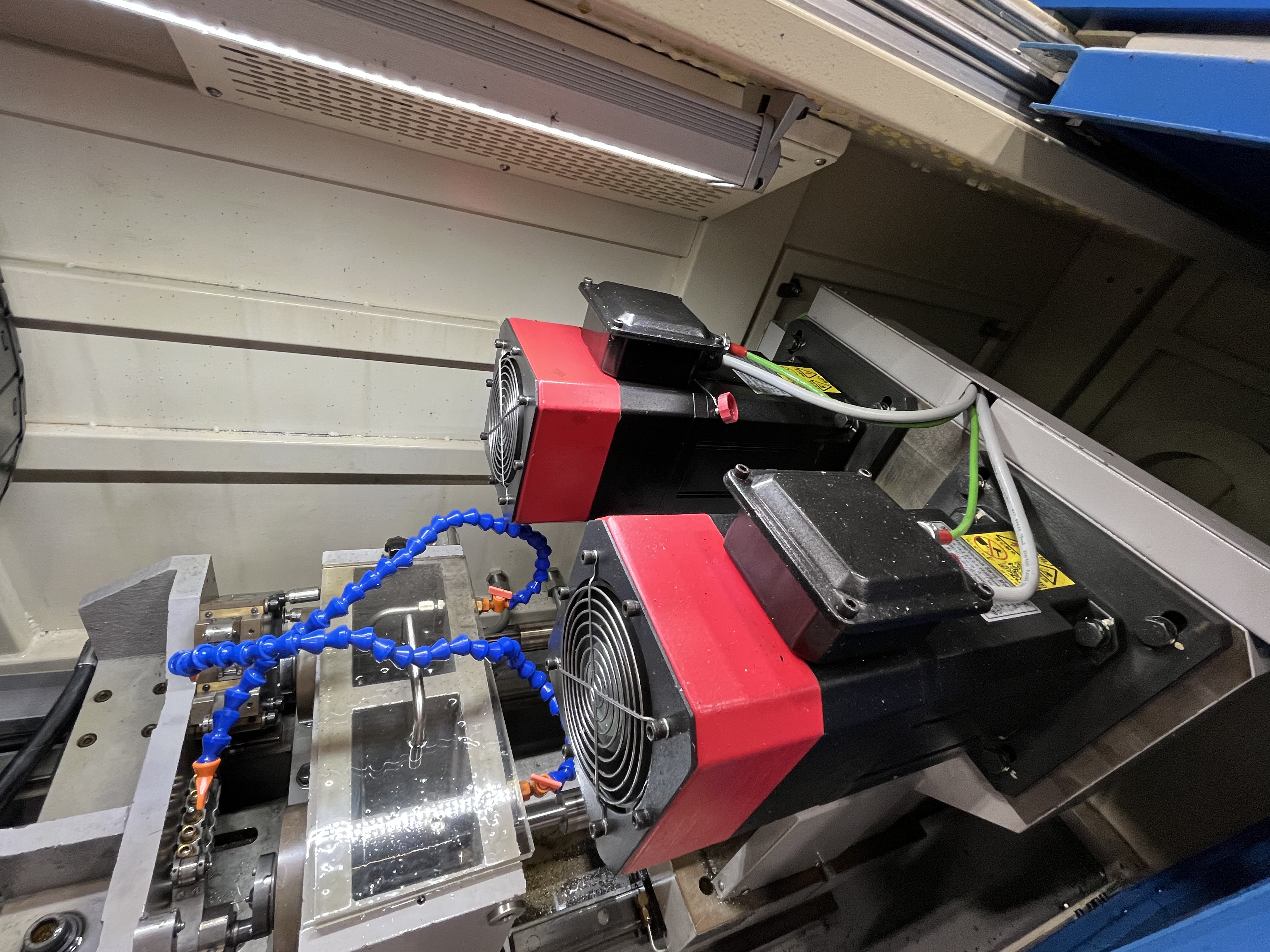
I spend more time managing coolant on my deep hole drilling machines than on any of my conventional CNC equipment. The reason is simple: deep hole drilling pushes coolant through the tool at high pressure, blasts chips out through the drill flute or annular gap, and in the process generates a massive volume of contaminated fluid that needs continuous treatment. After ten years of running BTA and gun drilling machines, I have learned that treating coolant as a disposable consumable is far more expensive than treating it as a managed resource.
Why Deep Hole Drilling Coolant Management Is Different
Every machining process uses coolant, but deep hole drilling is in a class of its own when it comes to coolant management. Three factors make this true: volume, chip load, and contamination rate.
Volume. A typical gun drilling machine operating at 70 bar and 80 liters per minute circulates the entire coolant tank volume through the system every two to three minutes. A BTA machine running at 30 bar and 400 liters per minute cycles through a 1,200-liter tank in three minutes. Compare that to a CNC lathe where the same 1,200-liter tank might last an entire shift. The high circulation rate means any contamination gets distributed throughout the entire system almost instantly, and the filter system has to handle the full flow continuously.
Chip load. Deep hole drilling produces long, stringy chips that pack together and form dense masses. A 50 mm BTA drill removes about 2 kg of material per meter drilled. At a penetration rate of 100 mm/min on a 500 mm deep hole, the machine generates 1 kg of chips in five minutes. Those chips carry coolant with them — as much as 20% of the coolant volume can leave the system stuck to chips if you are not recovering it with a centrifuge or wringer.
Contamination rate. The chip load is only part of the problem. Deep hole drilling generates fine particulate from the cutting action that is measured in microns — particles that pass through standard paper band filters and build up in the coolant over time. The combination of tramp oil from hydraulic leaks, fine metallic fines, and bacterial growth from trapped food sources creates a contamination profile that requires active management rather than passive filtration. If you are designing a coolant system from scratch, I recommend reading the article on coolant system design for the fundamentals on tank sizing, pump selection, and piping layout.
Coolant Recycling System Options
I have used several coolant recycling methods over the years, and each has strengths depending on the material, volume, and budget. Here is what I have found in practice:
Centrifuges. A disc-stack centrifuge spins coolant at 4,000 to 8,000 RPM to separate solids based on density. The solids discharge as a dry sludge and the clean coolant returns to the tank. Centrifuges handle fine particulate down to 5 microns and remove tramp oil simultaneously, which makes them the most versatile single solution. The downside is capital cost — a unit sized for a single BTA machine runs $15,000 to $30,000 — and maintenance on the rotating assembly.
Paper band filters. These are the workhorse of deep hole drilling filtration. A continuous roll of filter media passes over a conveyor belt, and coolant flows through the paper by gravity or vacuum. The paper traps particles down to 20-50 microns depending on the media grade. Paper band filters are simple and reliable, but the consumable cost adds up. I spend about $400 to $800 per month on filter paper for a single machine running two shifts. The paper also becomes a solid waste disposal item because it is saturated with coolant and fines.
Magnetic separators. For ferrous materials, magnetic drum or magnetic bar separators remove steel and iron fines before they reach the paper filter. This extends paper life by 40-60% because the magnetic fines are what clog the paper most quickly. A magnetic separator costs $3,000 to $8,000 and pays for itself in paper savings within six months on steel work.
Distillation systems. Vacuum distillation boils coolant and condenses the water, leaving behind concentrated contaminants and tramp oil. Distillation recovers nearly 100% of the water and coolant concentrate, but it is energy-intensive and slow. I only use distillation for central coolant systems serving multiple machines where the volume justifies the equipment cost of $40,000 to $100,000.
| Method | Capital Cost | Operating Cost (Monthly) | Coolant Life Extension |
|---|---|---|---|
| Paper band filter | $3,000 - $8,000 | $400 - $800 (media) | 2-4x over no filtration |
| Magnetic separator | $3,000 - $8,000 | $50 - $100 (maintenance) | 1.5-2x (used with paper) |
| Centrifuge | $15,000 - $30,000 | $200 - $400 (maintenance + power) | 6-10x over no filtration |
| Distillation | $40,000 - $100,000 | $500 - $1,500 (energy + maintenance) | Indefinite (full recovery) |
Coolant Life Extension Strategies
Recycling equipment only works if you also manage the chemical and biological health of the coolant. Extending coolant life is a combination of three practices that I apply in parallel.
Biocide dosing. Bacteria and fungi grow in coolant tanks because the environment is warm, dark, and full of organic nutrients. The chips themselves carry bacteria from the machine environment, and once the bacterial count hits about 10^6 CFU/mL, the coolant starts to smell, the pH drops, and the emulsion destabilizes. I dose with a formaldehyde-releasing biocide on a weekly schedule rather than waiting for the smell to appear. The dosing rate is about 0.1% by volume, and I test with dip slides every two weeks to confirm the count stays below 10^4 CFU/mL.
Concentration control. Coolant concentrate is expensive at $8 to $15 per liter. Over-diluting to save concentrate actually costs more in the long run because diluted coolant loses corrosion protection and supports bacterial growth. Under-diluting wastes concentrate and can cause skin irritation. I use a handheld refractometer daily to check the concentration and top up with either concentrate or water as needed. The target Brix reading for most semisynthetic coolants in deep hole drilling is 6-8%, which corresponds to about 8-10% concentration for the specific coolant I use.
Tramp oil removal. Tramp oil from hydraulic systems, way lube, and spindle bearings floats on top of the coolant and creates a layer that blocks oxygen transfer, traps chips and fines, and provides a breeding ground for anaerobic bacteria. A belt skimmer running continuously removes tramp oil for about $500 in equipment cost and $50 per year in replacement belts. I have also used coalescing plate separators, which work better but cost $2,000 to $5,000 and need more maintenance.
I have written a separate article covering specific contamination problems and what to do when things go wrong — see coolant contamination troubleshooting.
Waste Disposal Regulations and Options
Coolant disposal is regulated under the Resource Conservation and Recovery Act in the US, which classifies used coolant as hazardous waste if it exhibits certain characteristics — typically the toxicity characteristic for heavy metals or the corrosivity characteristic for low pH. The regulations change by jurisdiction, so I check with my local environmental agency rather than relying on federal rules alone.
Hazardous waste disposal. If the coolant fails a paint filter test (meaning it contains free liquids) or has heavy metals above the regulatory thresholds, it must go to a licensed treatment, storage, and disposal facility. Disposal costs range from $200 to $600 per drum depending on the region and the waste profile. I keep a log of every drum disposal with the manifest number, date, and volume.
Non-hazardous disposal. Coolant that is treated on-site — by distillation, filtration, or biological treatment — can sometimes be discharged to sanitary sewer under a local pretreatment permit. I have a permit for my facility that allows discharge of treated coolant at concentrations below specific limits for oil and grease, pH, and metals. The permit costs about $1,000 per year and requires quarterly sampling and reporting.
On-site treatment. I prefer on-site treatment over off-site disposal because it reduces liability and cost. Vacuum distillation generates clean water that I reuse for coolant make-up, and the concentrated waste volume is about 5% of the original volume. The concentrated waste still needs disposal, but at $200 per drum on 5% of the original volume, the cost is dramatically lower than hauling the full volume.
Cost Analysis of Recycling vs Fresh Coolant
The decision to invest in recycling equipment comes down to numbers. Here is the cost comparison I use when evaluating whether a coolant recycling system makes financial sense for a given production volume.
| Monthly Coolant Volume | Fresh Coolant Cost (Purchase + Disposal) | Recycling Cost (Equipment + Consumables + Energy) | Monthly Savings |
|---|---|---|---|
| 500 liters | $750 - $1,250 | $200 - $400 | $550 - $850 |
| 1,000 liters | $1,500 - $2,500 | $350 - $700 | $1,150 - $1,800 |
| 2,000 liters | $3,000 - $5,000 | $600 - $1,200 | $2,400 - $3,800 |
| 5,000 liters | $7,500 - $12,500 | $1,300 - $2,500 | $6,200 - $10,000 |
The assumptions behind these numbers: fresh coolant cost at $10 per liter for concentrate plus water and biocide, disposal at $300 per drum for 200-liter drums, and recycling cost including paper media, centrifuge maintenance, electricity, and labor for system cleaning. The savings increase with volume because the fixed cost of recycling equipment is spread over more liters.
For a job shop running a single gun drilling machine through 500 liters per month, the savings of $550 to $850 per month justify a paper band filter and magnetic separator within the first year. For a production facility with multiple BTA machines using 5,000 liters per month, the savings of $6,200 to $10,000 per month easily justify a centrifuge system, and the payback period is typically 4 to 8 months.
I also factor in the intangible cost of machine downtime caused by coolant problems. Clogged filters, bacterial smells causing operator complaints, and coolant concentration drift causing tool life variation all cost money that does not show up on the coolant purchase order. Recycling systems reduce those problems because they maintain consistent coolant quality.
Key Takeaways
- Deep hole drilling coolant management is fundamentally different from conventional machining because of the high volume, high chip load, and rapid contamination rate. Approach it as a process in itself, not an afterthought.
- Centrifuges provide the best coolant life extension and solids removal but cost more upfront. Paper band filters with magnetic separators are the most cost-effective entry point for smaller shops.
- Biocide dosing, concentration control, and tramp oil removal are complementary to mechanical filtration. You need both chemical management and physical filtration to maximize coolant life.
- On-site treatment — especially vacuum distillation — reduces disposal costs and regulatory liability compared to hauling full-volume waste coolant off-site.
- The economics of recycling are strongly volume-dependent, but even a single gun drilling machine running 500 liters per month saves $550 to $850 per month over fresh coolant purchase and disposal.
- Track your coolant volumes, disposal costs, and recycling equipment expenses. The data will tell you exactly what system pays off for your operation.