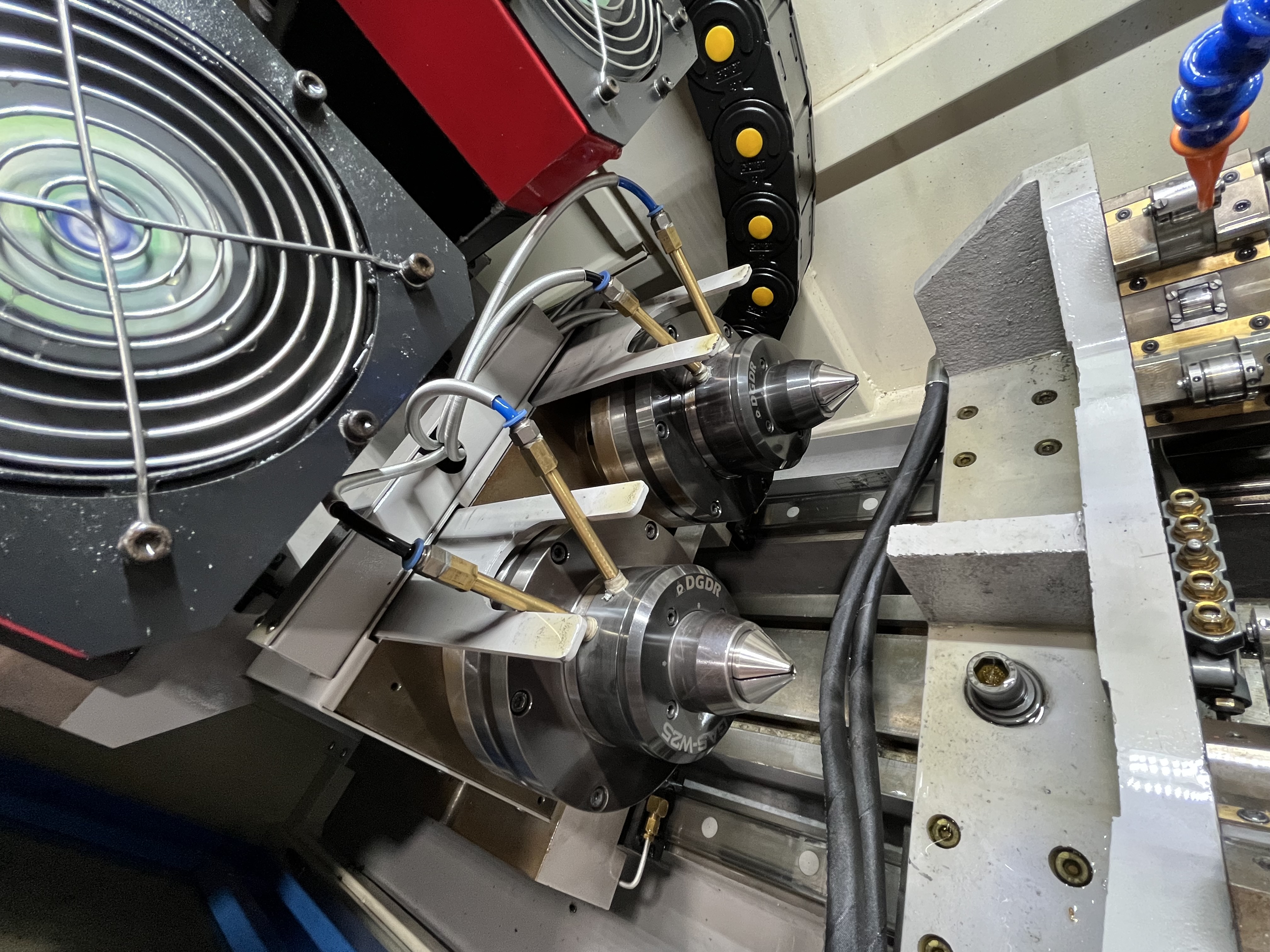
I use counterboring for bolt head seats and spot facing for sealing surfaces after deep hole drilling. Both operations are done after the main bore is complete. Getting them wrong means the fastener does not seat or the seal leaks — either one scrapes the part.
Counterboring Deep Holes
Counterboring enlarges the entry of a hole to create a flat-bottomed recess for a bolt head or cap screw. The counterbore has a pilot that fits the existing hole to keep the counterbore concentric with the bore. I use a counterbore with replaceable pilots so the same cutter body works for different hole sizes.
The pilot fit determines the concentricity. I use pilots with 0.01-0.02mm clearance on the bore diameter. A loose pilot lets the counterbore shift off-center by the clearance amount. For a counterbore that needs to seat a bolt head, 0.05mm concentricity is acceptable. For a counterbore that locates a mating part, I hold it to 0.02mm.
Counterbore depth needs to account for the bolt head height plus washer thickness plus 0.5mm clearance. I set the depth stop on the machine rather than trusting the operator to judge by eye. A counterbore that is too shallow does not seat the bolt. A counterbore that is too deep weakens the wall.
For counterboring deep holes in hardened materials, I run at 40-60 SFM with carbide tools and a feed of 0.05-0.10 mm/rev. The feed must be continuous — stopping in the cut leaves a witness mark at the bottom of the counterbore.
Spot Facing for Sealing Surfaces
Spot facing creates a flat surface around the hole entry that is perpendicular to the bore axis. This is critical when the hole entry needs a sealing surface for an O-ring, gasket, or valve seat. The spot face must be flat within 0.01mm across its diameter.
I use a spot face cutter with a pilot that fits the bore. The pilot extends below the cutting teeth and guides the tool into the existing hole. The cutting teeth are on the face of the tool and cut a flat annulus around the hole.
| Feature | Counterbore | Spot Face |
|---|---|---|
| Purpose | Bolt head recess | Sealing surface |
| Depth | Specified by bolt height | 0.3-0.5mm minimum |
| Surface finish | 1.6-3.2 Ra | 0.8-1.6 Ra |
| Concentricity | 0.02-0.05mm | 0.02mm typical |
| Tool material | Carbide or HSS | Carbide preferred |
I climb mill the spot face when possible. Climb milling produces a cleaner surface than conventional milling. The tool rotates in the same direction as the feed, which shears the material cleanly instead of rubbing it.
Tool Selection Table
Selecting the right tool for counterboring and spot facing depends on the hole geometry and material. Here is the tool selection guide I use:
| Application | Tool Type | Pilot Style | Best For | Maximum Depth |
|---|---|---|---|---|
| Standard counterbore | Piloted counterbore | Interchangeable | Bolt head seats in steel | 3x diameter |
| Deep counterbore (> 3x dia) | Piloted counterbore with coolant-through | Interchangeable | Deep holes in tough alloys | 6x diameter |
| Back spot face (front access) | Automatic back-spotfacer (HEULE SOLO type) | Centrifugal blade | Valve seats, sealing surfaces | Any depth |
| Large diameter spot face | Face mill with pilot extension | Integral pilot | Sealing surfaces > 40 mm | 2x diameter |
| Small hole counterbore | Integral pilot counterbore | Fixed | Holes under 6 mm | 2x diameter |
I keep interchangeable pilots in 0.5 mm increments from 6 mm to 50 mm. This covers most of the deep hole drilling work I see. The upfront cost of the pilot set is worth it compared to buying dedicated counterbore tools for every job.
Cutting Parameters by Material
The parameters change significantly by material. Here are the ranges I use for counterboring and spot facing after deep hole drilling:
| Material | Counterbore Speed (SFM) | Counterbore Feed (mm/rev) | Spot Face Speed (SFM) | Spot Face Feed (mm/rev) | Coolant |
|---|---|---|---|---|---|
| Mild steel (1018) | 75-85 | 0.08-0.13 | 60-70 | 0.05-0.08 | Emulsion 8-10% |
| Alloy steel (4140) | 60-75 | 0.05-0.10 | 50-60 | 0.04-0.06 | Emulsion 8-10% |
| Stainless 304 | 40-50 | 0.05-0.08 | 35-45 | 0.03-0.05 | Emulsion 10-12% |
| Cast iron | 120-140 | 0.10-0.15 | 100-120 | 0.05-0.08 | Dry or compressed air |
| Aluminum 6061 | 150-300 | 0.10-0.18 | 120-200 | 0.05-0.10 | Emulsion or mist |
| Inconel 718 | 25-35 | 0.03-0.05 | 20-30 | 0.02-0.04 | High-pressure emulsion |
For cast iron and brass, I typically machine dry with compressed air for chip removal. For tough alloys like Inconel, I use high-pressure coolant through the tool to prevent heat buildup and maintain tool life.
Common Problems and Solutions
I have run into these issues with counterboring and spot facing after deep hole drilling:
| Problem | Likely Cause | Fix |
|---|---|---|
| Chatter marks on surface | Tool runout over 0.01 mm, loose pilot fit | Check pilot clearance, tighten tool holder |
| Oversized counterbore | Pilot clearance too large | Reduce to 0.01-0.02 mm clearance |
| Poor spot face flatness | Tool deflection, interrupted cut | Reduce feed, use rigid setup, climb mill |
| Tool seizes in bore | Pilot galling from insufficient lubricant | Apply cutting oil to pilot before each cycle |
| Burr at counterbore edge | Dull tool or wrong speed for material | Replace insert, adjust speed per material chart |
| Witness mark at counterbore bottom | Feed stopped during cut | Keep feed continuous through entire cut |
| Blade breakage (back spotfacer) | RPM too low for blade activation | Verify activation speed (typically 1,600+ RPM) |
Runout and Chatter Prevention
Both counterbores and spot face cutters chatter easily if the setup is not rigid. Chatter leaves a wavy surface that causes leaks on sealing faces and poor bolt seating on counterbores. I check the tool runout at the pilot — it should be under 0.01mm.
I run counterbores and spot face cutters at about 60% of the RPM I would use for drilling with a manual feed. The reduced speed prevents the tool from chattering. I use a feed of 0.05-0.10 mm/rev for counterbores and 0.03-0.05 mm/rev for spot faces.
The pilot needs lubrication during the cut. I apply cutting oil to the pilot before each cycle. A dry pilot can gall on the bore surface and seize, spinning the tool off-center and ruining the finish.
For holes that need both a counterbore and a spot face, I do the counterbore first. The counterbore provides a reference surface for the spot face cutter pilot, which improves the spot face concentricity.
For more on surface finish requirements in deep hole drilling, see my guide on surface finish defects in gun drilling.
Key Takeaways
- Use pilots with 0.01-0.02mm clearance on the bore for good concentricity.
- Run counterbores and spot faces at 60% of drilling RPM to prevent chatter.
- Spot faces need 0.8-1.6 Ra finish for sealing surfaces — climb mill for best results.
- Lubricate the pilot before each cycle to prevent galling.
- Do counterbores before spot faces so the spot face pilot has a good reference.
- Maintain a set of interchangeable pilots in 0.5 mm increments for flexibility.
- Match cutting parameters to material — cast iron runs dry, Inconel needs high-pressure coolant.
- Check back spotfacer activation speed — most require 1,600+ RPM to engage the blade.