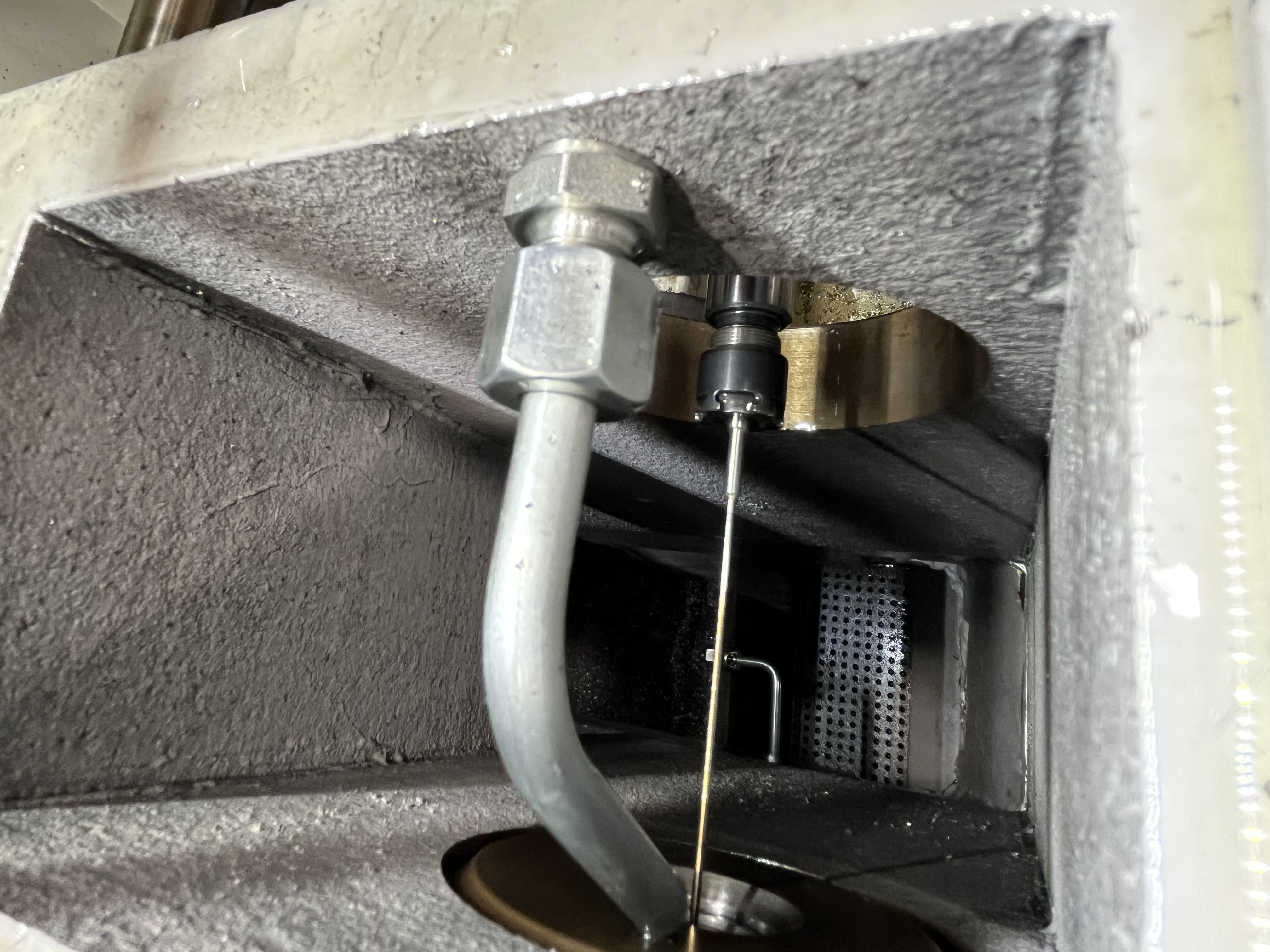
I spot face the entry before drilling eccentric holes. Eccentric holes are holes that are not centered on the part axis. The drill enters the material at an angle relative to the surface, which causes the tip to deflect if the entry is not prepared properly. A bad setup here almost always produces a scrapped part.
Preparing the Entry Surface
The first thing I do is create a flat entry surface with a spot face cutter. The spot face must be perpendicular to the drill axis, not to the part surface. Without the spot face, the drill hits the curved surface at an angle and slides down it, shifting the hole position by as much as 0.5mm on a 50mm diameter shaft.
I make the spot face diameter at least 1.5 times the drill diameter. For a 10mm gun drill, I cut a 15mm diameter spot face. The spot face depth needs to be enough to clear the surface curvature completely — usually 0.5-1mm on a turned shaft.
The spot face cutter needs to be rigid. I use a carbide-tipped spot face tool with a pilot bushing when possible. If the tool deflects during spot facing, the surface is not flat and the drill entry is compromised.
Wall Thickness Management
I check the wall thickness before drilling any eccentric hole. Eccentric holes have thin walls on one side. If the wall is too thin, the drill can break through the side wall, ruining the part and potentially damaging the machine.
I calculate the minimum wall thickness from the print. The formula is: minimum wall = part OD minus (eccentric offset x 2) minus drill diameter, divided by 2. I verify the calculation with an ultrasonic thickness gauge before setting up the job.
| Wall Thickness | Feed Reduction | Risk Level |
|---|---|---|
| Over 5mm | None | Low |
| 2-5mm | 20% reduction | Medium |
| Under 2mm | 40% reduction + support | High |
For walls under 2mm, I use a steady rest on the outside of the part opposite the thin wall. The steady rest prevents the wall from bulging outward under the cutting force. I set the steady rest pressure to 20-30 bar for steel parts.
Eccentric Drilling Challenges and Solutions
Here is the full breakdown of challenges I have encountered with eccentric deep hole drilling and how I address each one:
| Challenge | Root Cause | Solution | Success Rate |
|---|---|---|---|
| Drill deflection at entry | Angled surface entry without spot face | Spot face perpendicular to drill axis | 95% reduction in entry deviation |
| Thin wall breakthrough | Wall thickness under 2mm | Steady rest on thin wall side + 40% feed reduction | 90% success |
| Uneven cutting edge wear | Coolant directed to thin wall side first | Rotate nozzle toward thick wall side | 20% improvement in edge life |
| Chip packing in flute | Uneven chip load from variable wall thickness | Increase chip inspection frequency | 80% reduction in packing events |
| Chatter from interrupted cut | Thin wall flexes under cutting force | Reduce feed by 30%, add steady rest | 85% improvement |
| Hole wandering toward thin wall | Apex offset inconsistency in reground drills | Maintain consistent apex offset across regrinds | 50% reduction in wander |
| Guide pad scoring | Uneven load distribution on pads | Balance cutting edge geometry | 70% improvement |
Feed and Speed Adjustments
The feed rate at entry needs to be reduced by about 30% compared to a concentric hole. The lower feed prevents the drill from deflecting as it enters the angled surface. I program a feed reduction for the first 5mm of drilling, then ramp back up to normal.
I use a starting feed of 0.02 mm/rev for eccentric holes in steel, compared to 0.04 mm/rev for a concentric hole of the same diameter. The reduced feed gives the drill tip time to establish a stable cut path before taking full load.
Cutting speed stays the same as for a concentric hole. I do not reduce RPM because that changes the chip thickness independently of the feed. Keeping speed constant while adjusting feed gives me consistent surface finish.
When Eccentric Hole Drilling Works vs. When It Does Not
I have learned through experience that eccentric hole drilling is feasible under certain conditions and impractical under others:
| Condition | Works Well | Marginal | Do Not Attempt |
|---|---|---|---|
| Wall thickness | Over 5 mm | 2-5 mm | Under 2 mm without support |
| Depth-to-diameter ratio | Under 20:1 | 20:1 to 50:1 | Over 50:1 |
| Material type | Mild steel, aluminum | Stainless, titanium | Hardened tool steel over 45 HRC |
| Drill diameter | 8 mm and above | 4-8 mm | Under 4 mm |
| Eccentric offset | Under 25% of part radius | 25-40% of part radius | Over 40% of part radius |
| Machine rigidity | Dedicated deep hole drilling machine | CNC lathe with live tooling | Manual lathe without coolant-through |
For marginal cases, I run test cuts on scrap material first. If I see drill deflection or chatter in the first 10 mm of cut, I stop and reconsider the approach. Sometimes redesigning the part with a concentric hole and a milled flat is the better solution.
Coolant Direction for Eccentric Holes
Coolant delivery matters more for eccentric holes than concentric ones. The coolant stream needs to hit the cutting edge on the thick wall side first. I rotate the coolant nozzle on the drill to direct flow toward the heavy side of the cut.
If the coolant hits the thin wall side first, the cutting edge on that side sees reduced lubrication and wears faster. I have measured 20% faster edge wear on the thin wall side when the coolant is not directed properly.
I also check the chip evacuation more frequently on eccentric holes. The uneven wall thickness creates an uneven chip load, which produces inconsistent chip shapes that can pack in the flute.
For more on surface preparation before eccentric drilling, see spot facing before deep hole drilling.
Key Takeaways
- Spot face the entry perpendicular to the drill axis, not the part surface.
- Calculate and verify wall thickness before every eccentric hole job.
- Reduce feed by 30% at entry for eccentric holes to prevent drill deflection.
- Use steady rests on thin walls under 2mm to prevent bulging.
- Direct coolant toward the thick wall side to balance edge wear.
- Do not attempt eccentric holes with depth-to-diameter over 50:1 or offsets over 40% of part radius.
- For marginal cases, run a test cut on scrap material and evaluate deflection in the first 10 mm.
- Maintain consistent apex offset across reground drills to prevent hole wandering.
- Increase chip inspection frequency — uneven chip load is the norm in eccentric drilling.
- Machine rigidity determines success — dedicated deep hole drilling machines work best.