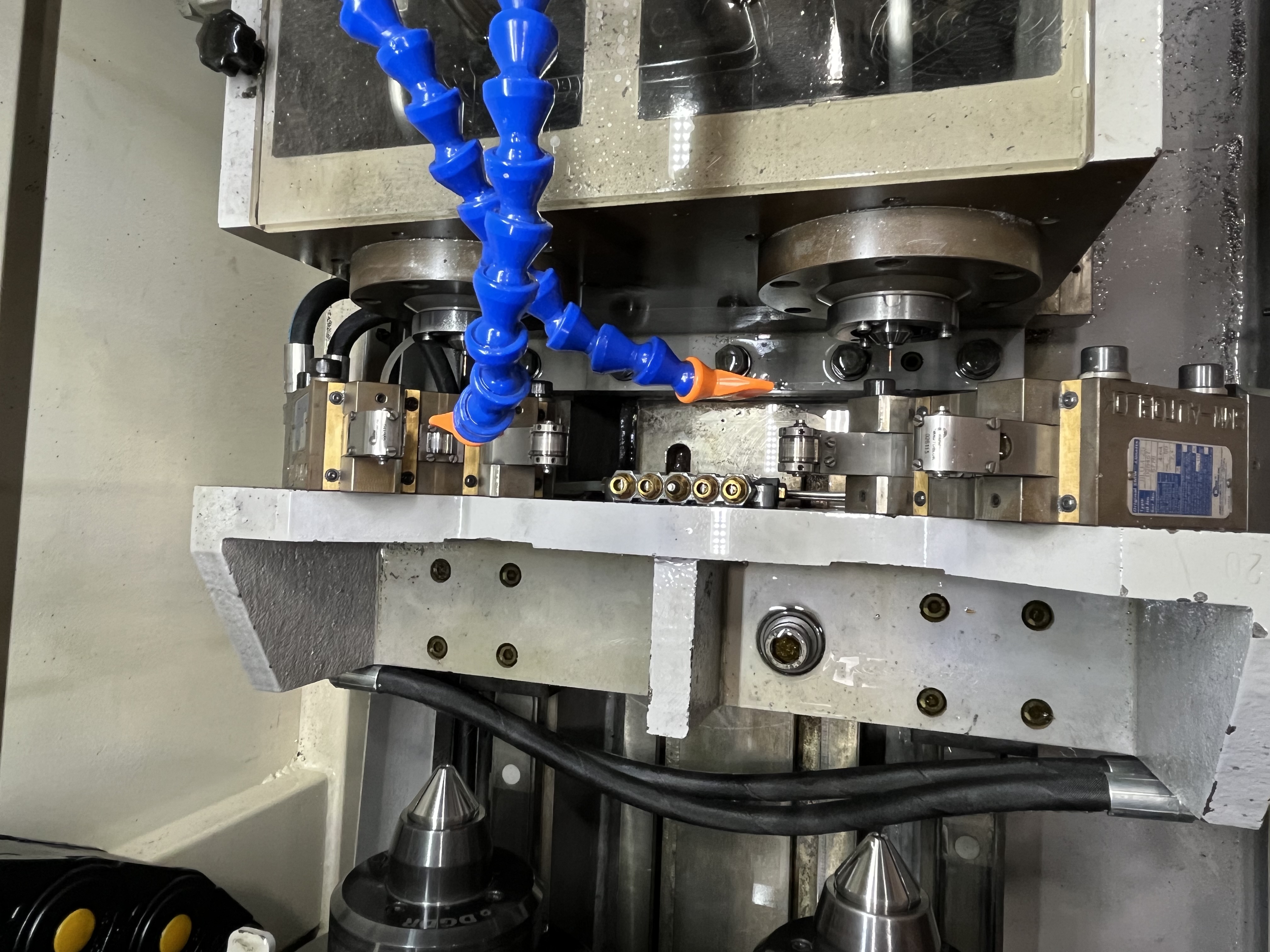
I use ejector drilling when high-pressure coolant is not available. It is the method I reach for when a customer brings in a part that needs a deep hole but the only available machine is a standard CNC mill with a through-coolant spindle.
Ejector drilling is a deep hole drilling method that uses a double-tube system. It is less common than gun drilling or BTA drilling but has specific advantages that make it the right choice in certain situations. Understanding when to pick it over the alternatives saves money and time.
How Ejector Drilling Works — The Venturi Effect
Ejector drilling relies on the Venturi effect to evacuate chips. The double-tube assembly works like this:
- Coolant enters the tool through the outer tube.
- Coolant travels down the annular gap between the outer and inner tubes.
- At the cutting head, the coolant passes through the cutting zone, lubricating and cooling the inserts and guide pads.
- The coolant then enters the ejector nozzle, which is a reduced-diameter section at the entrance of the inner tube.
- As the coolant passes through the nozzle constriction, its velocity increases and pressure drops — this is the Venturi effect.
- The pressure drop creates suction that pulls chips and return coolant through the inner tube and back to the chip collection system.
The Venturi effect is self-regulating. Higher flow through the nozzle creates stronger suction, which pulls more chips, which keeps the system in balance. I have seen this fail in two scenarios: when the nozzle clearance is too large (over 0.8 mm) and the Venturi effect weakens, and when the nozzle clearance is too small (under 0.5 mm) and back pressure builds up.
Key formula: The Venturi suction pressure is proportional to the square of the coolant velocity through the nozzle gap. A 20% reduction in flow means a 36% reduction in chip evacuation force. This is why I monitor coolant flow, not just pressure.
When to Choose Ejector Drilling Over Gun Drilling
| Factor | Ejector Drilling | Gun Drilling |
|---|---|---|
| Coolant pressure needed | 200–400 psi | 800–2,000 psi |
| Machine requirement | Standard CNC with TSC | Dedicated gun drill or high-pressure system |
| Diameter range | 18–200 mm | 2–40 mm |
| Depth capability | Up to 100:1 L/D | Up to 300:1 L/D |
| Tool cost for 25 mm hole | ~$600 (assembly) | ~$200 (single tube) |
| Surface finish typical | 1–4 microns Ra | 0.5–2 microns Ra |
Choose ejector drilling when:
- Your machine has through-spindle coolant but cannot reach 800+ psi.
- You need holes above 40 mm diameter (gun drills get very expensive above 40 mm).
- You want to avoid buying a dedicated high-pressure coolant system.
- You need good chip evacuation in gummy materials like low-carbon steel.
Choose gun drilling when:
- Hole diameter is below 18 mm (ejector tooling does not exist for small diameters).
- You need depth ratios above 100:1.
- Surface finish below 1 micron Ra is required.
- You already have a high-pressure coolant system.
I recently quoted a job for 30 mm holes at 1,500 mm depth in 4140. The customer had a standard mill with 400 psi coolant. Ejector drilling was the only option without buying a new machine.
When to Choose Ejector Drilling Over BTA
| Factor | Ejector Drilling | BTA Drilling |
|---|---|---|
| Coolant pressure | 200–400 psi | 400–1,500 psi |
| Diameter range | 18–200 mm | 6–200 mm+ |
| Depth capability | Up to 100:1 L/D | Up to 150:1 L/D |
| Setup complexity | Moderate | Complex |
| Tooling cost | Lower | Higher |
Choose ejector drilling over BTA when:
- Coolant pressure is limited to 400 psi or below.
- The hole diameter is under 20 mm (BTA tooling is available but expensive at small diameters).
- Setup simplicity matters — BTA requires more machine modifications.
- You need to change diameters frequently — ejector heads are easier to swap than BTA tooling.
Choose BTA over ejector drilling when:
- You need depth above 100:1 L/D.
- You are drilling above 60 mm diameter at high production volumes.
- Surface finish requirements are below 1 micron Ra.
- You already have a BTA system.
Diameter Range and Tooling Availability
Ejector drilling tooling is available from several major suppliers, but the range is narrower than gun drilling or BTA.
| Diameter Range | Availability | Typical Application |
|---|---|---|
| 18–25 mm | Good — standard catalog items | Hydraulic cylinders, bushings |
| 25–50 mm | Excellent — most common range | Automotive, aerospace structural |
| 50–100 mm | Good — some special-order items | Mold cooling channels, valve bodies |
| 100–200 mm | Limited — mostly special order | Large hydraulic components |
| Above 200 mm | Very limited — custom only | Not recommended for ejector |
I keep a set of ejector heads in the most common diameters — 20 mm, 25 mm, 32 mm, 40 mm, and 50 mm. These cover 90% of what I run. Anything above 50 mm I either special-order or switch to BTA.
Pressure Requirements and Coolant Flow
The pressure requirement for ejector drilling depends on the diameter and the length of the tool assembly.
Starting pressure: 300 psi for most applications. Adjust based on chip evacuation.
Pressure by diameter:
| Hole Diameter | Recommended Pressure | Flow Rate | Nozzle Gap |
|---|---|---|---|
| 18–25 mm | 250–350 psi | 8–12 gpm | 0.5 mm |
| 25–50 mm | 300–400 psi | 12–20 gpm | 0.6 mm |
| 50–100 mm | 350–450 psi | 20–35 gpm | 0.7 mm |
| 100–200 mm | 400–500 psi | 35–60 gpm | 0.8 mm |
If chips are not evacuating at 300 psi, I increase flow before I increase pressure. Flow does the chip evacuation work — pressure overcomes system resistance. A pressure reading of 400 psi with low flow means a restriction somewhere. A pressure reading of 200 psi with good flow means the Venturi is working and the process is healthy.
Setup Considerations
I go into detail on setup procedure in the Ejector Drilling Tooling and Setup Guide. Here are the most important points to consider when deciding to use ejector drilling in the first place:
Machine requirements. The machine needs through-spindle coolant with a minimum of 200 psi continuous pressure. The spindle taper must accept the outer tube shank — CAT40 or CAT50 is standard. The machine must have enough Z-axis travel for the tool length plus hole depth plus overtravel.
Workpiece setup. The workpiece must allow coolant return flow. Ejector drilling does not use a sealed starting bushing like BTA. The hole exit must be open or the coolant has nowhere to go.
Coolant system compatibility. Existing coolant pumps may need upgrading. A 300 psi system needs different hoses, fittings, and seals than a standard flood-coolant system. I have seen standard coolant hoses burst at 350 psi — always use wire-braided hoses rated for 1.5x the operating pressure.
Chip collection. The Venturi effect pushes chips through the inner tube and out the back of the spindle. Most standard machines do not have a chip collection system at the back of the spindle. I built a simple deflector shield and chip bin for my retrofitted mill. It took an afternoon of fabrication and works flawlessly.
Advantages Summary
- Low coolant pressure (200–400 psi) makes it accessible on standard CNC machines.
- Gentle process — less coolant pressure means less hydraulic force on thin-walled parts.
- Good chip evacuation — the Venturi effect actively pulls chips, unlike gun drilling where chips rely on being pushed.
- Interchangeable heads — change diameter by swapping the cutting head, not the whole tool.
- No need for a sealed starting bushing — simpler fixturing than BTA.
Disadvantages Summary
- Tooling assembly cost is higher than a comparable gun drill — roughly 3x for the same diameter.
- Depth limited to 100:1 L/D — cannot match gun drilling or BTA for deep holes.
- Limited small-diameter availability — nothing available below 18 mm.
- Fewer tooling suppliers — less competition means higher prices and longer lead times.
- Trial and error for nozzle sizing — takes time to dial in the optimal nozzle clearance.
Applications That Fit Ejector Drilling Well
- Hydraulic cylinder tubes in mild steel — 25–50 mm diameter, 500–1,500 mm depth.
- Mold cooling channels in P20 steel — 12–25 mm diameter (at the small end of ejector range).
- Aerospace structural components in aluminum — larger diameters where gun drills become impractical.
- Automotive transmission shafts — medium diameter, moderate depth, good surface finish needed.
- Shops that already own standard CNC machines and want to add deep hole capability without buying a dedicated machine.
Applications That Do Not Fit Ejector Drilling
- Small holes under 18 mm — use gun drilling.
- Holes deeper than 100:1 L/D — use gun drilling or BTA.
- High-volume production above 60 mm diameter — BTA is faster and more economical.
- Precision holes requiring 0.5 micron Ra or better — gun drilling or BTA.
- Shops without through-spindle coolant — retrofitting adds significant cost.
Key Takeaways
- Ejector drilling is the best entry point for shops getting into deep hole drilling. The machine investment is minimal if you already have a CNC mill with through-spindle coolant.
- Do not expect the same surface finish as gun drilling. Ejector is good, but gun drilling is better for finish.
- Spend time dialing in the nozzle clearance. It is the single most important parameter and the one most people get wrong.
- Buy a spare inner tube. When chips jam the inner tube and it bends, you will not want to wait a week for a replacement.
- Monitor flow, not just pressure. Flow is what makes the Venturi work and what evacuates chips.
- Keep a logbook of nozzle sizes, pressure settings, and results for each diameter and material combination. It eliminates guesswork on repeat jobs.
- Related: See Ejector Drilling Tooling and Setup Guide for detailed setup instructions.