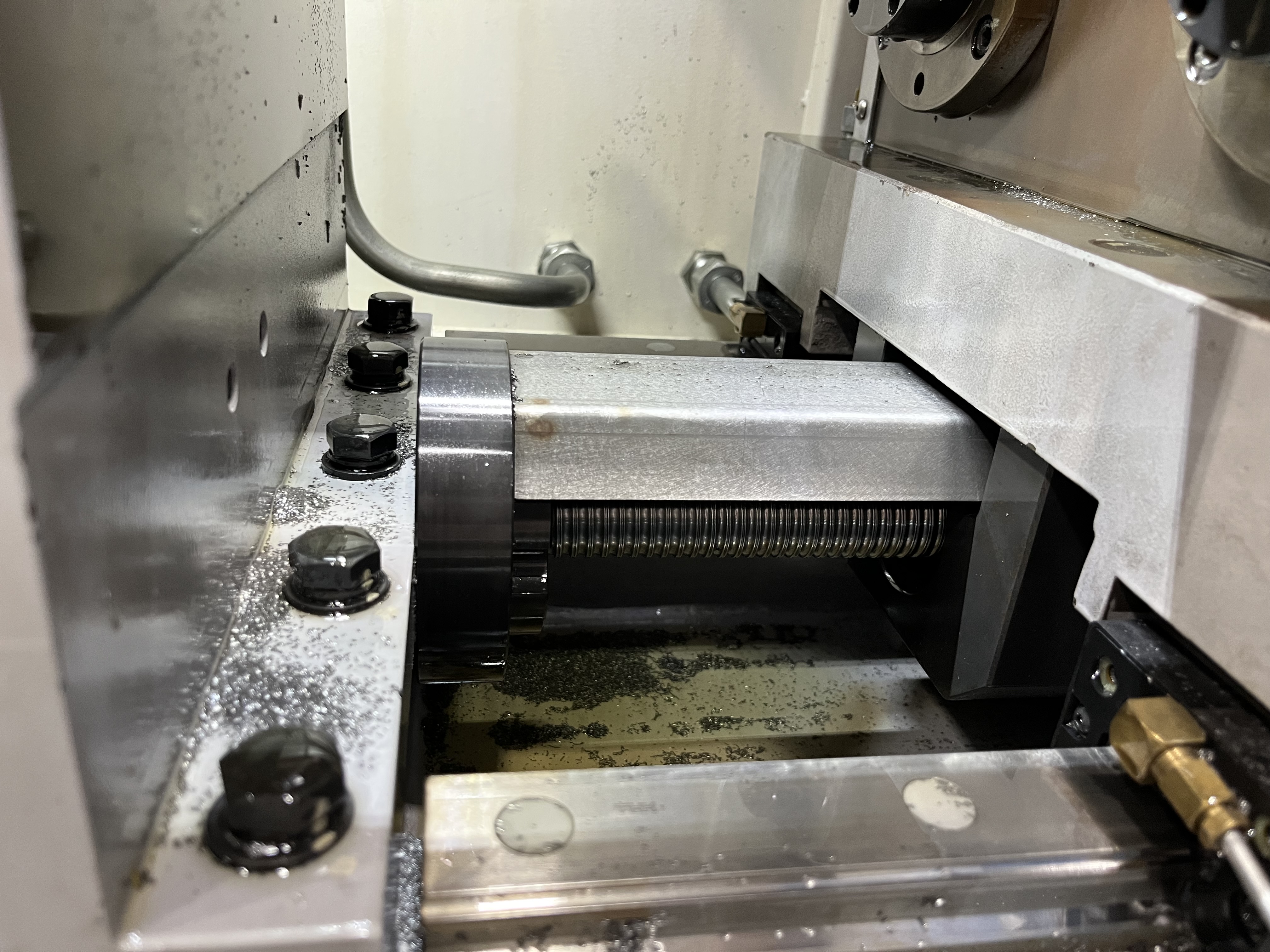
External coolant delivery directs coolant at the drill entry point from outside the bore. It cannot replace through-tool coolant for deep holes, but it plays an important supporting role. I use external coolant on every deep hole drilling job to complement the through-tool system.
The Supporting Role of External Coolant
External coolant serves three specific functions in deep hole drilling:
- Lubricates the guide bushing. The bushing rubs against the rotating drill shank and needs constant lubrication to prevent galling.
- Flushes chips away from the entry area. Chips exiting the flute can accumulate around the bushing and scratch the finished bore surface.
- Provides initial cooling at drill entry. The first few millimeters of drilling generate heat that external coolant can manage before the through-tool coolant takes over.
I use external coolant in combination with through-tool coolant on every gun drilling job. The external coolant stream is aimed at the guide bushing and the drill entry point. The through-tool coolant travels down the drill to the cutting edge.
When External Coolant Alone Is Enough
For shallow holes under 5:1 L/D, external coolant alone can work if the drill has good chip evacuation. I have used external coolant for drilling 8 mm holes through 30 mm of steel with a conventional twist drill and a standard coolant pump.
| Application | External Coolant Only | Through-Tool Required |
|---|---|---|
| Conventional drilling, L/D under 3:1 | Works well | Not needed |
| Gun drilling, L/D under 5:1 | Possible, risky | Recommended |
| Gun drilling, L/D 5:1 to 20:1 | Not sufficient | Required |
| Gun drilling, L/D over 20:1 | Fails completely | Mandatory |
| BTA drilling, any depth | Not used | Required |
| Reaming, L/D under 5:1 | Works well | Not needed |
For deep hole drilling above 5:1 L/D, external coolant alone is not sufficient. The coolant cannot reach the cutting edge at depth. Through-tool coolant is always required.
Nozzle Positioning and Flow Rate
The nozzle position matters more than most people think. I have seen shops aim a coolant hose vaguely at the drill and call it good, then wonder why the bushing wears out in 200 parts.
My nozzle setup:
| Parameter | Recommendation |
|---|---|
| Nozzle angle to drill axis | 45 degrees |
| Distance from drill entry | Within 25 mm |
| Nozzle diameter | 6-10 mm |
| Flow rate | 15-30 L/min |
| Pressure | 30-100 psi |
The nozzle should be directed so the coolant stream hits the drill shank at the bushing exit point. The coolant then flows along the drill into the bore entry. If the nozzle is too far from the entry, the coolant spray dissipates before reaching the bushing.
I use an adjustable nozzle with a ball joint that can be locked in position. The nozzle stays in place once set and does not need adjustment between jobs unless the drill diameter or bushing position changes.
External Coolant for BTA Drilling
BTA drilling does not use external coolant for the cutting process. The coolant is delivered through the annular gap between the drill tube and the bore wall. However, I still use external coolant at the BTA drill entry for a different purpose: cooling the seal between the drill tube and the chip box.
The BTA chip box seal generates friction as the drill tube rotates inside it. External coolant directed at the seal area prevents overheating and extends seal life. I have tripled seal life on BTA jobs by adding a dedicated external coolant line to the chip box seal.
Cost and Setup Simplicity
External coolant systems are simple and inexpensive. The typical setup costs:
| Component | Cost |
|---|---|
| Coolant pump (standard, 200 psi) | $300-800 |
| Flexible hose with shutoff valve | $50-100 |
| Adjustable nozzle with ball joint | $40-80 |
| Magnetic base for nozzle | $30-60 |
| Total system | $420-1,040 |
Compare that to a $15,000-25,000 high-pressure through-tool system. External coolant is a cheap addition that delivers real benefits when used correctly.
Common Mistakes I See
The most common mistake with external coolant is aiming the nozzle at the back of the part instead of the drill entry. The coolant bounces off the part and never reaches the bushing or the cutting zone.
The second mistake is using too large a nozzle. A 15 mm diameter nozzle at 50 psi delivers more flow than the entry area can handle. The coolant floods the area and makes a mess without improving cooling. I use a 6-8 mm nozzle for most applications.
The third mistake is forgetting to check the external coolant during setup. I have started jobs only to realize 20 minutes later that the coolant hose was disconnected. The bushing was running dry and wearing at an accelerated rate.
Key Takeaways
External coolant is a simple, low-cost addition that supports the main cooling system in deep hole drilling. It lubricates the guide bushing, flushes entry chips, and provides initial cooling. The nozzle position and size matter for effectiveness. I now include external coolant on every deep hole drilling setup as a standard practice. The cost is minimal and the benefit to bushing life and surface finish is clear.