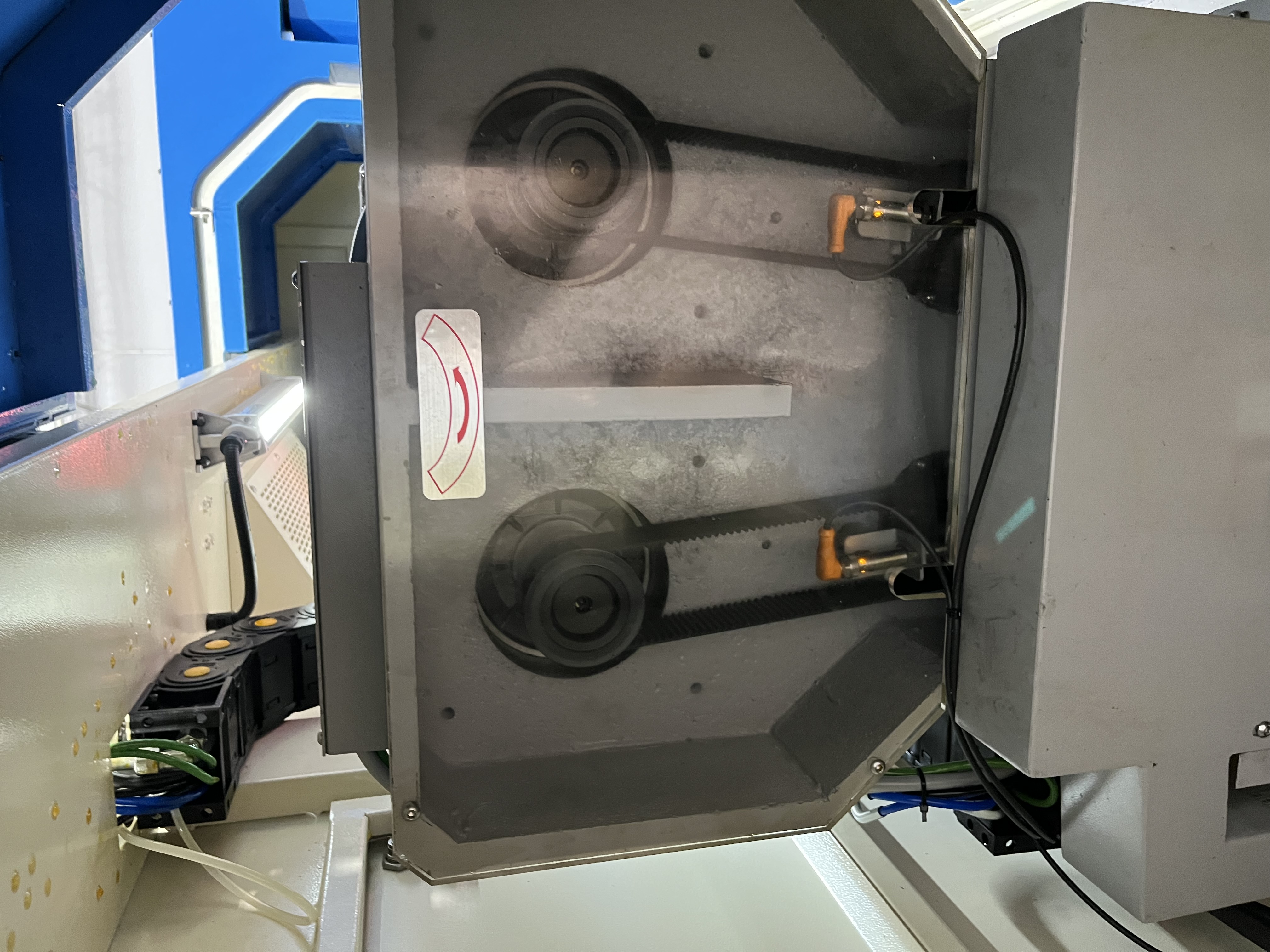
I use gun drilling attachments for occasional deep hole jobs on machining centers. A dedicated gun drilling machine is better for production work, but an attachment makes economic sense when you only drill deep holes a few times per month. The attachment turns a standard VMC or HMC into a capable deep hole drilling setup for a fraction of the cost.
Attachment Types: Spindle-Mounted vs Self-Powered
Two attachment types are available and each covers a different application range.
Spindle-Mounted Attachments
Spindle-mounted attachments fit in the machine tool holder and use the machine spindle for rotation and coolant. They are simpler and cheaper at $3,000 to $8,000. The machine spindle provides rotation up to its rated RPM. Coolant comes from the machine’s existing coolant system.
Limitations: The machine coolant pressure on standard machining centers is 300-1000 psi. This limits spindle-mounted attachments to drills under 10 mm diameter in steel. The machine spindle takes the full thrust load, which can reduce spindle bearing life over time.
Self-Powered Attachments
Self-powered attachments have their own electric motor and high-pressure coolant pump. They cost $15,000 to $40,000 but deliver 1000-3000 psi coolant pressure and 5000-15000 RPM from the built-in motor. The machine spindle only holds the attachment — rotation and thrust are handled by the attachment itself.
Self-powered units are the right choice for production work, holes over 10 mm diameter, or materials that need high coolant pressure like stainless and titanium. The spindle load reduction also extends the life of the machine spindle.
| Feature | Spindle-Mounted | Self-Powered |
|---|---|---|
| Price range | $3,000 - $8,000 | $15,000 - $40,000 |
| Coolant pressure | 300 - 1000 psi (machine) | 1000 - 3000 psi (own pump) |
| Max RPM | Machine spindle limit (typically 8000) | 5000 - 15000 RPM (own motor) |
| Setup time (first time) | 1 - 2 hours | 2 - 4 hours |
| Changeover time | 20 - 30 minutes | 30 - 45 minutes |
| Depth capability | Up to 500 mm | Up to 3000 mm |
| Spindle load | Full thrust on machine spindle | Self-contained — reduces spindle wear |
| Best for | Occasional work, under 10 mm | Production work, over 10 mm |
Diameter and Depth Limits
The attachment type determines the practical limits for diameter and depth.
| Attachment Type | Min Diameter | Max Diameter | Max Depth | Limiting Factor |
|---|---|---|---|---|
| Spindle-mounted | 1.5 mm | 12 mm | 500 mm | Machine coolant pressure |
| Self-powered (small) | 3 mm | 20 mm | 1500 mm | Coolant flow rate |
| Self-powered (large) | 6 mm | 40 mm | 3000 mm | Machine work envelope |
I drilled 8 mm holes through 300 mm mild steel blocks with a spindle-mounted attachment on a VMC. The setup took about an hour and the holes came out straight within 0.1 mm per meter. For a job that comes up a few times a year, the attachment was more practical than buying a dedicated deep hole machine at $100,000+.
Setup Procedure
I follow this setup sequence for every attachment installation.
- Mount the attachment in the machine spindle or install it on the spindle nose. Torque to the machine manufacturer’s specification.
- Install the guide bushing holder on the machine table. Use a test bar through the spindle to align the bushing holder axis with the spindle axis within 0.01 mm.
- Select the guide bushing that matches the drill diameter. The bushing ID should have 0.005-0.01 mm clearance over the drill OD.
- Connect coolant lines for self-powered units. For spindle-mounted units, verify the machine coolant-through-spindle function is active.
- Set coolant pressure to the minimum for the drill diameter. For a 6 mm drill in steel, start at 1200 psi.
- Run a test cycle with the drill retracted to verify coolant flow through the bushing and into the chip tray.
- Run the first hole at 50% feed rate. Check diameter, straightness, and surface finish.
- Increase to full feed after verifying acceptable hole quality.
The bushing alignment step is the most critical. I indicate the bushing ID using a test bar that fits through the spindle and bushing together. A misalignment of 0.02 mm causes the drill to enter at an angle, and the hole wanders immediately.
Guide Bushing Details
Every gun drilling attachment needs a guide bushing support. The guide bushing centers the drill at entry — without it, the drill wanders immediately. Some attachments include an adjustable bushing holder mounted to the machine table. Others require the user to fixture the bushing separately.
I prefer attachments with a built-in bushing holder because it simplifies setup. The bushing holder must be aligned with the spindle axis within 0.01 mm.
The bushing ID should match the gun drill diameter with 0.005-0.01 mm clearance. A tight bushing seizes on the drill. A loose bushing does not guide properly. I keep a set of bushings in 0.5 mm diameter increments for common drill sizes from 3 mm to 20 mm.
| Drill Diameter | Bushing ID | Clearance | Bushing Material |
|---|---|---|---|
| 3 mm | 3.008 mm | 0.008 mm | Carbide |
| 6 mm | 6.010 mm | 0.010 mm | Carbide or hardened steel |
| 10 mm | 10.012 mm | 0.012 mm | Hardened steel |
| 15 mm | 15.015 mm | 0.015 mm | Hardened steel |
| 20 mm | 20.015 mm | 0.015 mm | Hardened steel |
Coolant Requirements
Coolant is the most overlooked factor when adding a gun drilling attachment. A standard machining center coolant pump delivers 300-500 psi, which is only enough for holes under 10 mm diameter in free-cutting materials like mild steel and aluminum.
| Drill Diameter | Minimum Pressure | Minimum Flow | Equipment Needed |
|---|---|---|---|
| Under 6 mm | 1500 psi | 10 L/min | Machine coolant + booster pump |
| 6 - 10 mm | 1000 psi | 15 L/min | Machine coolant (marginal) or booster pump |
| 10 - 20 mm | 1500 psi | 30 L/min | Booster pump or self-powered unit |
| 20 - 40 mm | 2000 psi | 60 L/min | Self-powered unit with HP pump |
For larger diameters or harder materials, I add a booster pump that takes the machine coolant at 300 psi and boosts it to 1500 psi. The booster pump costs $4,000 to $8,000 and mounts next to the machine. The coolant flow rate needs to be at least 20 liters per minute per 10 mm of drill diameter.
For more on coolant setup with attachments, see the drill tube selection guide.
Cost Comparison: Attachment vs Dedicated Machine
| Option | Equipment Cost | Setup Time | Hole Quality | Best For |
|---|---|---|---|---|
| Spindle-mounted attachment | $3,000 - $8,000 | 1 - 2 hours | Good | Occasional holes, under 10 mm |
| Spindle-mounted + booster pump | $7,000 - $16,000 | 2 - 3 hours | Good | Occasional holes, under 20 mm |
| Self-powered attachment | $15,000 - $40,000 | 2 - 4 hours | Excellent | Regular production |
| Dedicated gun drilling machine | $80,000 - $200,000 | 1 day | Excellent | High-volume production |
The total investment for a spindle-mounted attachment with booster pump is about $10,000-16,000. That is far less than a dedicated machine. For a job shop running 50-200 deep holes per month, the attachment approach pays for itself within the first year.
Key Takeaways
- Spindle-mounted attachments work for holes under 10 mm diameter in steel — above that, self-powered units are necessary.
- A guide bushing holder integrated into the attachment saves hours of setup time compared to fixturing the bushing separately.
- Add a coolant booster pump if the machine pressure is below 1000 psi for holes over 10 mm — this is the most common upgrade needed.
- The bushing ID must have 0.005-0.01 mm clearance over the drill OD — too tight seizes, too loose wanders.
- Plan 1-2 hours for initial setup and 30 minutes for changeover between hole sizes.
- For occasional deep hole work, a $10,000-16,000 attachment setup is far more economical than a $100,000+ dedicated machine.