When a CNC Lathe Makes Sense for Gun Drilling
A dedicated gun drilling machine is the right tool for production deep hole work. But I have run plenty of successful gun drilling jobs on standard CNC lathes when the volume did not justify a dedicated machine. The key is knowing the limits.
In my experience, a lathe with live tooling and through-coolant capability can handle L/D ratios up to about 10:1 reliably. Beyond that ratio, the alignment challenges and coolant pressure limitations make a dedicated machine necessary.
I have used this approach for short runs of 10-50 parts where the job called for a 10mm hole through 80mm of 4140 steel. The parts came out within 0.05mm straightness, which met the print requirement. For tighter tolerances, I send the work to a shop with a dedicated machine.
Equipment Requirements
The main limitation on most CNC lathes is the coolant system. Standard lathe coolant pumps deliver 200-300 psi, which is not enough for gun drilling. I need at least 1000 psi at the tool tip.
| Component | Requirement | What Standard Lathe Has |
|---|---|---|
| Coolant pressure | 1000-1500 psi minimum | 200-300 psi |
| Through-coolant tooling | Rated for 1500 psi | Usually not available |
| Coolant filtration | 50 micron or better | 200-500 micron |
| Guide bushing | Hardened steel bushing | Not included |
| Turret capacity | Free station for attachment | Varies |
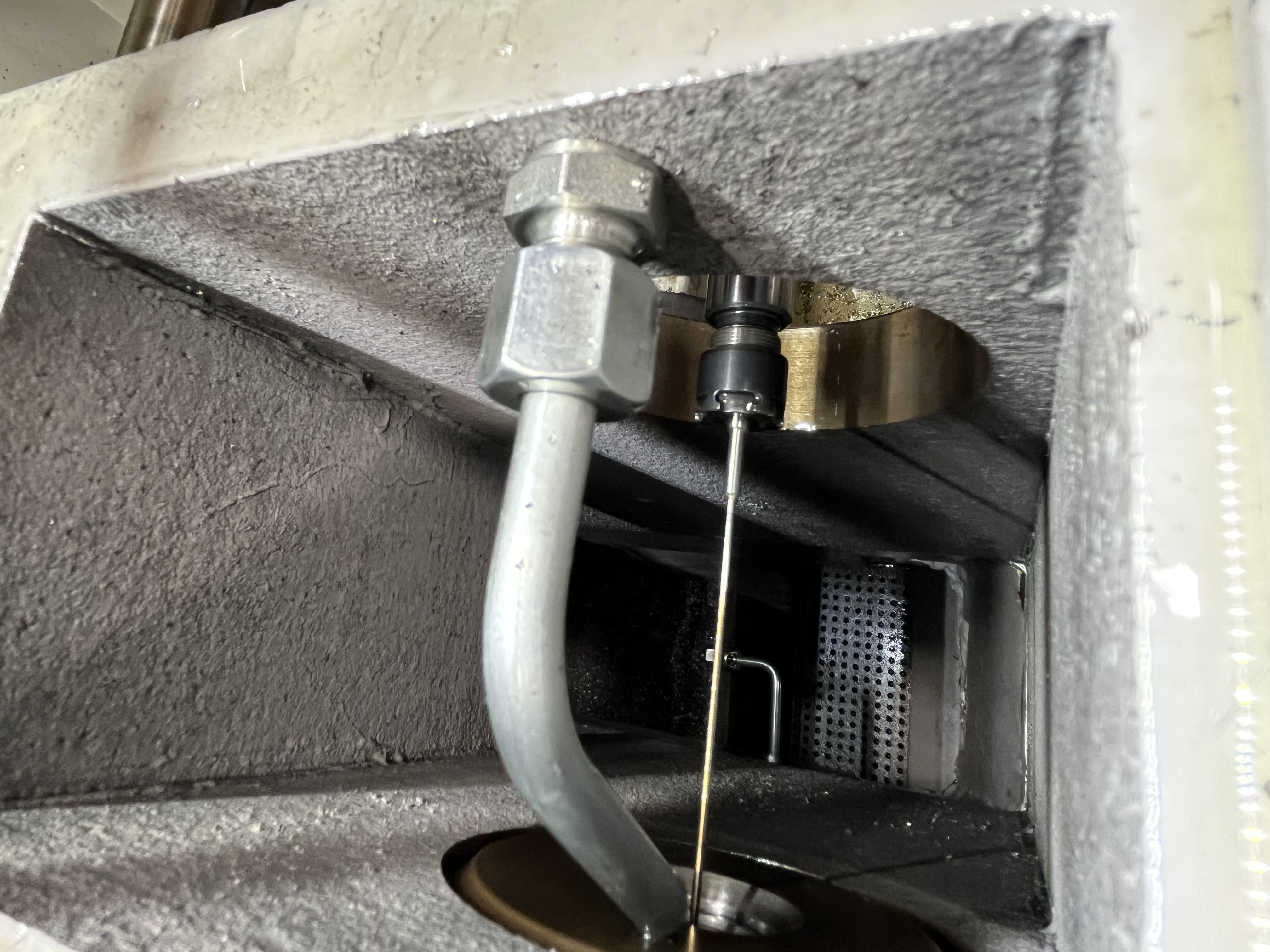
I use a gun drilling attachment that mounts in the turret and connects to the machine’s coolant-through system. The attachment holds both the drill shank and the guide bushing. Installation takes about an hour, including aligning the bushing to the spindle centerline.
For machines without through-coolant turret stations, I have used a rotating coolant union mounted on the turret face. This works but adds another potential leak point.
Coolant Pressure Limitations
I have tested several setups and found that coolant pressure below 800 psi causes problems at diameters under 6mm. The smaller the drill, the less room for chip evacuation, and the more pressure I need to push chips out.
| Drill Diameter | Min Coolant Pressure | Max L/D Ratio | Typical Surface Finish |
|---|---|---|---|
| 4-6mm | 1200 psi | 8:1 | Ra 0.8 |
| 6-10mm | 1000 psi | 10:1 | Ra 0.6 |
| 10-15mm | 800 psi | 12:1 | Ra 0.4 |
| 15-20mm | 600 psi | 15:1 | Ra 0.4 |
I have found that retrofitting a high-pressure coolant system to a lathe costs between $8,000 and $15,000 for a 1500 psi system with a proper filter package. That is worth it if I run gun drilling jobs regularly.
Alignment and Setup Procedure
Alignment between the turret and the spindle is critical. I check it before every gun drilling setup.
First, I indicate the guide bushing bore to within 0.02mm of the spindle centerline. I rotate the spindle by hand and check the runout at the bushing face. Total indicated runout should be under 0.05mm.
Second, I check the turret alignment along the Z axis. The gun drill axis must be parallel to the spindle axis within 0.01mm over 100mm. I use a test bar in the bushing and indicate both ends.
Third, I set the drill stickout so the tip is just inside the guide bushing face when the turret is at the home position. This prevents the operator from crashing the drill into the chuck.
Programming Considerations
I use a peck cycle with a 2mm retract every 10mm of depth. This clears chips from the flute and helps coolant reach the cutting tip.
I also program a dwell of 0.5 seconds at the bottom of each peck before retracting. This lets the coolant pressure build behind the cutting tip and flush any packed chips.
The spindle speed matters too. For a 10mm drill in steel, I run 2500-3000 RPM and feed at 0.03-0.05 mm/rev. I start at the low end of the feed range and increase until the chips break cleanly.
Workholding on the Lathe
Workholding for gun drilling on a lathe needs to resist both the cutting torque and the axial thrust. The axial thrust from gun drilling is higher than from a twist drill of the same diameter because of the single cutting edge geometry.
For a 10mm gun drill at 0.04 mm/rev in 4140, the axial thrust is roughly 1500-2000 N. A standard 3-jaw chuck at 600 psi hydraulic pressure provides adequate grip for diameters over 50mm. For smaller parts, I use a collet chuck or a custom soft jaw with serrations.
I check the part for slippage after the first hole. I mark a witness line across the chuck jaw and the part with a marker. If the line is offset after drilling, the clamping force or jaw surface needs improvement.
| Workholding Method | Grip Force | Max Recommended Drill Dia | Best For |
|---|---|---|---|
| 3-jaw hydraulic chuck | 8000-15000 N | 20mm | Round parts over 50mm dia |
| Collet chuck | 6000-10000 N | 16mm | Round parts under 50mm dia |
| Soft jaws (custom) | 10000-20000 N | 25mm | Irregular shapes, thin-wall parts |
| Face plate + clamps | Varies | 30mm | Large or irregular parts |
Tolerances I Can Hold
The tolerances from a lathe-based gun drilling setup are not as tight as a dedicated gun drilling machine, but they are adequate for many applications.
| Parameter | Lathe Setup | Dedicated Machine |
|---|---|---|
| Hole straightness | 0.05-0.10mm per 100mm | 0.01-0.05mm per 100mm |
| Diameter tolerance | +/- 0.02mm | +/- 0.005mm |
| Surface finish (Ra) | 0.6-1.0 microns | 0.2-0.6 microns |
| Positional accuracy | +/- 0.05mm | +/- 0.01mm |
| Max L/D ratio | 10:1 | 50:1+ |
I have held 0.05mm straightness on a 10mm x 80mm hole in 4140 using a CNC lathe setup. The same part on a dedicated gun drilling machine would hold 0.02mm. For most hydraulic and pneumatic applications, the lathe accuracy is sufficient.
The limitation becomes apparent at L/D ratios above 8:1. The lack of a steady rest along the part length allows the workpiece to deflect under the cutting forces, and the hole wanders.
Key Takeaways
A CNC lathe can handle gun drilling for short runs and moderate L/D ratios. The critical items are coolant pressure above 1000 psi, proper alignment of the guide bushing to the spindle, and a peck cycle that clears chips effectively. I have run hundreds of parts this way with good results, but I know when to send the work to a dedicated machine.