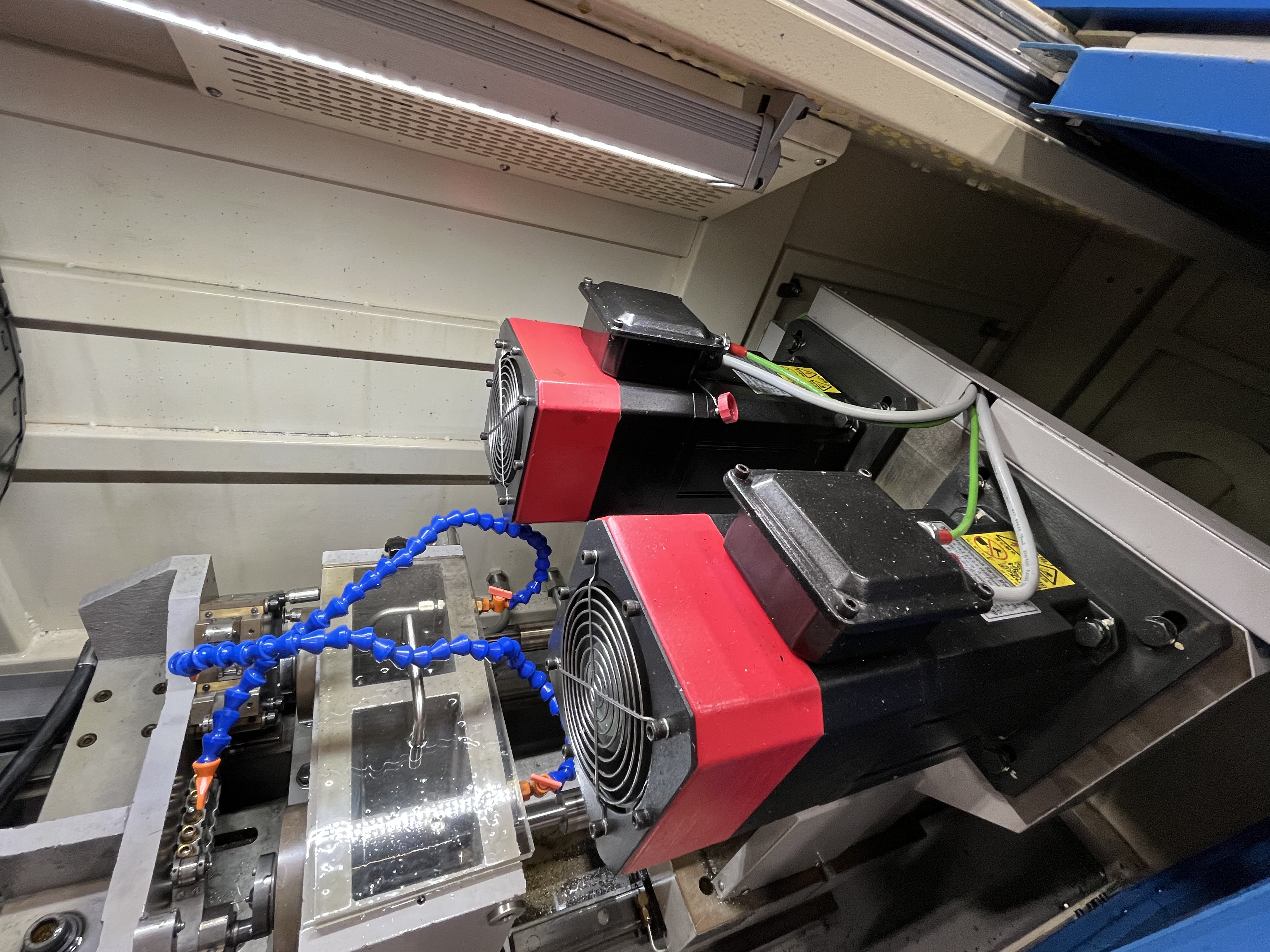
I choose between gun drilling, BTA, and ejector based on hole diameter, production volume, and surface finish requirements. Each process exploits a different chip evacuation mechanism, and that single design decision ripples through every performance metric — penetration rate, surface quality, tooling cost, and machine requirements.
Gun drilling uses a V-shaped carbide tip with a single cutting edge and a high-pressure coolant port behind the cutting face. BTA drilling pushes coolant through the annulus between the drill tube and the hole wall; chips travel back through the tube’s hollow center. Ejector drilling splits coolant flow: most goes to the cutting zone, a smaller portion diverts through annular nozzles inside the head to create a Venturi effect that pulls chips back out.
Here is how they stack up side by side, followed by the engineering rationale for every number in this table.
Full Comparison Table
| Factor | Gun Drilling | BTA Drilling | Ejector Drilling |
|---|---|---|---|
| Diameter range | 0.5–50 mm | 8–300 mm | 18–200 mm |
| Max L/D ratio | 400:1 | 100:1 | 100:1 |
| Surface finish (Ra) | 0.1–0.8 μm | 0.4–3.2 μm | 0.8–3.2 μm |
| Straightness (mm/m) | 0.05–0.3 | 0.1–0.5 | 0.2–0.6 |
| Penetration rate | Baseline | 5–10× faster | 3–5× faster |
| Chip evacuation area | 22–26 % of bore | 60–70 % of bore | 60–70 % of bore |
| Coolant pressure | 1,000–3,000 psi | 200–500 psi | 200–400 psi |
| Tool cost | Moderate | Higher (multi-tube) | Moderate |
| Machine cost premium | — | +25–35 % | +10–15 % |
| Typical hole size tolerance | IT6–IT8 | IT8–IT10 | IT9–IT11 |
Why Gun Drilling Achieves Better Surface Finish
The surface finish gap is not incidental — it is mechanical. A gun drill head carries two carbide guide pads positioned roughly 90° and 180° behind the cutting edge. As the drill rotates and advances, those pads ride against the freshly cut bore wall under hydrostatic pressure from the coolant film. This burnishing action plastically deforms surface peaks into valleys, producing a mirror-like finish in the Ra 0.1–0.8 μm range.
I have held Ra 0.15 μm on 4140 steel at 8 mm diameter with a single-pass gun drill, which is essentially a honed finish straight off the machine. BTA heads lack these burnishing pads — they rely on three or four support pads that guide rather than burnish. The result is a visibly coarser surface that often requires a follow-up skive or roller burnish pass if the print calls for sub-micron finish.
Tolerance follows the same pattern. Gun drilling’s guide pads stabilize the head against radial deflection, which is why I can hold IT6 on a 12 mm hole consistently. BTA’s larger tool body and interrupted cutting edges introduce more vibration, pushing tolerance out to IT8–IT10.
Why BTA Is 5–10× Faster
The speed advantage comes down to one number: chip evacuation cross-section.
In gun drilling, the chip exits through a V-shaped flute that occupies roughly 22–26 % of the bore area. That narrow channel limits how much material you can remove per revolution — pack the flute and the chips jam, pressure spikes, and the tool fractures. I run gun drills at feed rates of 0.005–0.025 mm/rev specifically to keep chip volume manageable.
BTA reverses the flow path. Coolant pumps down the annulus between the drill tube and the bore wall (the gap is typically 1–2 mm on radius), and chips flush back through the hollow interior of the tube. That interior area is 60–70 % of the bore cross-section — roughly three times the evacuation capacity of a gun drill flute. With that much room, chip jamming is almost eliminated, and I can run feed rates of 0.03–0.12 mm/rev.
The penetration rate scales accordingly. On a 40 mm hole in medium-carbon steel, a gun drill typically pushes 15–25 mm/min. A BTA head on the same setup runs 100–200 mm/min. That 5–10× gap holds across most materials.
There is a catch: BTA requires a starter bushing, a pressure head seal at the workpiece face, and a high-volume coolant system (150–300 GPM versus 5–20 GPM for gun drilling). Setup time runs about double. The machine itself costs 25–35 % more than an equivalent gun drilling machine because of the larger coolant pump, rotary coolant union, and chip-handling system.
Why Ejector Needs Lower Coolant Pressure
Ejector drilling (also called STS drilling outside Europe) works with standard machine coolant systems. The key is the Venturi effect built into the drill head.
The ejector head splits incoming coolant into two paths. About two-thirds flows to the cutting edges for cooling and lubrication. The remaining one-third passes through angled annular nozzles inside the head, which accelerate the flow and create a low-pressure zone that sucks chips and coolant back through the inner tube. This self-pumping action means the machine does not need a high-pressure coolant pump — 200–400 psi is typical, and I have run ejector drills at 250 psi on machines that could not push a gun drill past 100 psi.
The trade-off is surface finish and straightness. Ejector heads do not use guide pads — the head is supported by the inner tube bore and the coolant flow itself. Without rigid burnishing contact, finish lands at Ra 0.8–3.2 μm, and straightness drifts to 0.2–0.6 mm/m. I treat ejector as a roughing process for diameters over 18 mm where the machine cannot supply high-pressure coolant.
Straightness Comparison
Straightness follows the number of contact points between the tool and the bore wall.
| Process | Achievable Straightness | Key Factor |
|---|---|---|
| Gun drilling (counter-rotation) | 0.05–0.10 mm/m | Guide pads + opposing rotation cancels drift |
| Gun drilling (standard) | 0.10–0.30 mm/m | Guide pads self-pilot |
| BTA | 0.10–0.50 mm/m | Multi-support pads, larger body resists deflection |
| Ejector | 0.20–0.60 mm/m | No rigid pads, fluid-film support only |
Counter-rotation — where the workpiece and tool spin in opposite directions — zeroes out the resultant radial force vector and is how I hit 0.05 mm/m on aircraft landing-gear components. Without counter-rotation, gun drilling still leads because the guide pads act as steady-rests spaced along the bore.
Selection Decision Framework
I apply these diameter and production thresholds when choosing between the three processes:
Under 12 mm → Gun drilling only. BTA and ejector tools are not available at these diameters. Gun drilling covers the full range down to 0.5 mm.
12–30 mm → Depends on volume and tolerance. If the print calls for IT7 or better, or the hole is deeper than 100× diameter, I stay with gun drilling regardless of volume. For IT8–IT9 holes in production runs above 500 pieces per year, BTA becomes economical — the faster penetration rate offsets the longer setup and higher tooling cost.
Over 30 mm → BTA. At diameters above 30 mm, BTA’s chip evacuation advantage is decisive. A 40 mm gun drill removes roughly 5 cm³ of steel per minute. A 40 mm BTA head removes 30–60 cm³ per minute on the same machine. The cost per hole drops by 40–60 % even after accounting for the more expensive tooling.
Low coolant pressure machine → Ejector. If the machine tops out at 400 psi and the hole diameter is above 18 mm, ejector is the only viable deep hole process. I have retrofitted ejector systems onto standard CNC lathes with no plumbing changes beyond a coolant filter upgrade.
Mixed-diameter work → Gun drilling. Job shops that see a different hole size every setup benefit from gun drilling’s fast tool-change and minimal fixturing. BTA’s pressure-head seals and starter bushings are dimension-specific, so changeover takes 30–60 minutes versus 5–10 minutes for a gun drill bushing.
Production Volume Cost Comparison
For a 25 mm diameter, 500 mm deep hole in 4140 steel, annealed:
| Factor | Gun Drilling | BTA Drilling | Ejector Drilling |
|---|---|---|---|
| Penetration rate | 25 mm/min | 150 mm/min | 80 mm/min |
| Cycle time per hole | 20 min | 3.3 min | 6.3 min |
| Machine cost (typical) | $180,000 | $235,000 | $200,000 |
| Tool cost per hole | $2.50 | $4.50 | $3.00 |
| Annual holes at 1 shift | 4,800 | 22,000 | 13,000 |
| Cost per hole (machine + tool amortized over 3 years) | $14.00 | $6.50 | $9.20 |
The numbers shift with diameter. At 10 mm, gun drilling wins on cost. At 80 mm, BTA is the only practical option. The crossover point for most shops is 20–30 mm.
Key Takeaways
- Surface finish and tolerance hinge on guide pads. Gun drilling has them; BTA and ejector do not. If your print calls for Ra 0.2 μm or IT7, pick gun drilling.
- Speed is about chip room. BTA’s 60–70 % evacuation cross-section enables 5–10× the penetration rate of gun drilling. The trade-off is more expensive tooling and 25–35 % higher machine cost.
- Ejector fills a niche. It works on standard-pressure coolant systems and requires no pressure head, but finish and straightness are the worst of the three. Use it only when machine pressure is the constraint.
- Straightness leader is counter-rotated gun drilling at 0.05 mm/m. Standard gun drilling still beats both BTA and ejector by a factor of 2–3×.
- The 20–30 mm diameter band is the decision zone. Below 20 mm, gun drilling dominates. Above 30 mm, BTA dominates. In between, evaluate production volume and tolerance requirements.