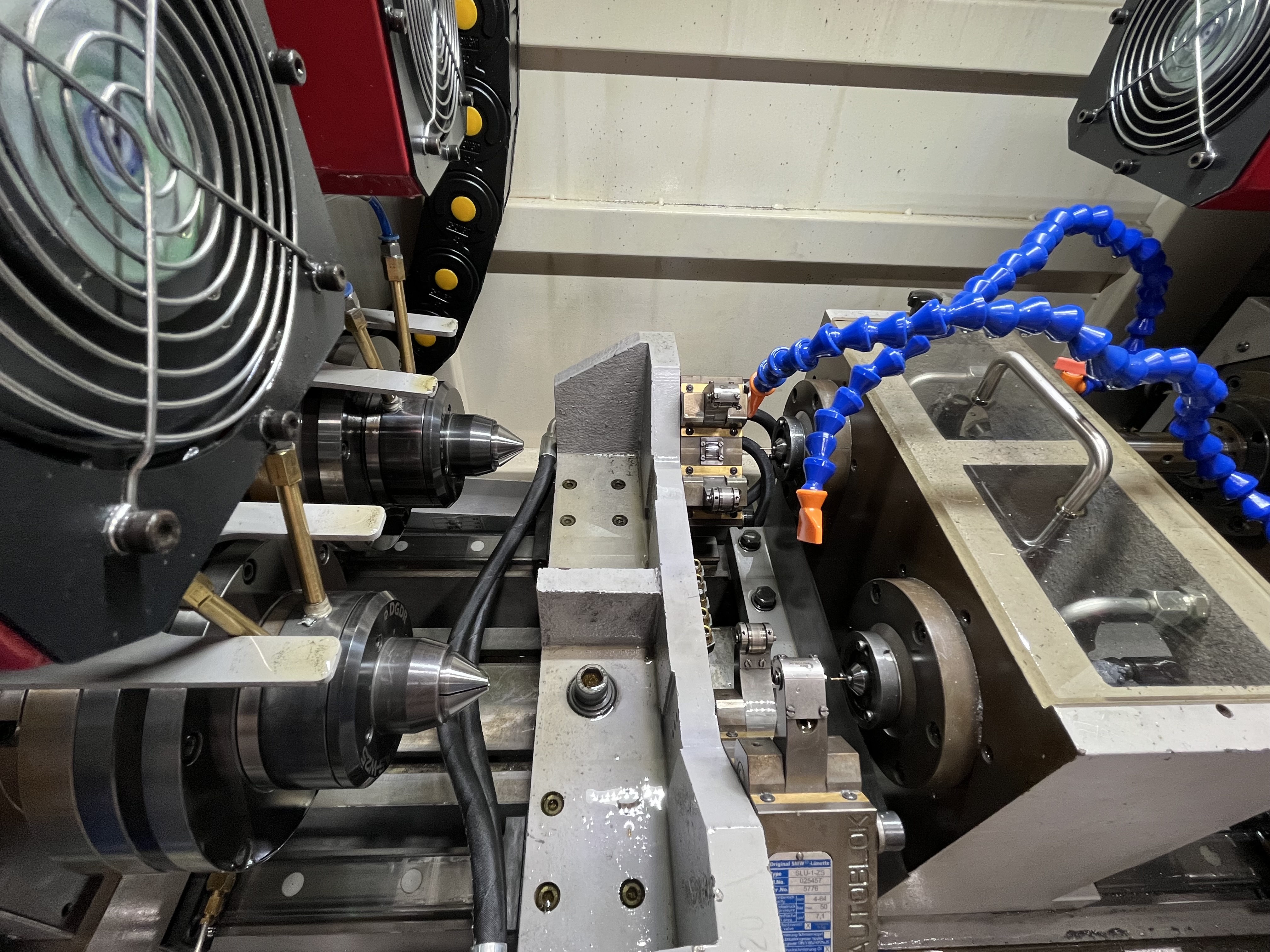
MQL uses a small amount of oil or lubricant sprayed as a fine mist instead of flooding the cutting zone with coolant. It is common in conventional machining operations like milling and turning but rare in deep hole drilling. The main challenge is chip evacuation, which in deep hole drilling depends on high-pressure coolant to push chips out of the bore.
Recent research on MQL in deep hole drilling (2025 Manufacturing Letters, and a 2023 comprehensive review) confirms that MQL is technically feasible for certain deep hole applications and can actually outperform flood coolant on tool life in some cases. But the data also confirms what I have found in practice — the L/D ratio and material type are the deciding factors.
The Chip Evacuation Problem
Flood coolant provides the hydraulic pressure necessary to force chips back along the flute and out of the bore in gun drilling. MQL delivers lubricant as an aerosol mist that does not generate enough pressure or volume for chip transport. Here is the comparison based on my shop measurements:
| Coolant Method | Flow Rate | Pressure | Chip Evacuation | Typical Coolant Cost/Year |
|---|---|---|---|---|
| Flood coolant | 50-100 L/min | 100-2,000 psi | Excellent | $5,000 - $10,000 |
| Through-tool MQL | 0.02-0.05 L/min | 5-10 bar | Poor for deep holes | $200 - $500 |
| External MQL mist | 0.01-0.03 L/min | 3-6 bar | Poor for deep holes | $150 - $400 |
| High-pressure MQL | 0.05-0.10 L/min | 10-20 bar | Fair for moderate depths | $300 - $600 |
| Dry drilling | 0 | 0 | None | $0 |
I have tested high-pressure MQL systems (10-20 bar air pressure) that improve chip evacuation significantly compared to standard MQL. They still cannot match flood coolant for deep holes, but they extend the viable L/D range from 5:1 to about 8:1 in aluminum and cast iron.
For holes with a depth-to-diameter ratio under 5:1, chip evacuation is less demanding because the chips only travel a short distance. For holes over 5:1, chips accumulate in the flute and pack against the bore wall. The packed chips cause excessive torque, poor surface finish, and eventually tool breakage.
Where MQL Can Work for Deep Holes
I have used MQL successfully in specific applications, mostly shallow deep holes in materials that produce short, broken chips:
- Aluminum 6061 with 5 mm drill through 20 mm of material. The chips were short and the low cutting force kept heat under control.
- Cast iron with 8 mm drill through 30 mm of material. The graphite content in cast iron acts as a dry lubricant, which reduces the need for coolant. I have seen MQL actually improve tool life in cast iron by 20-30% compared to flood coolant because the thermal shock from flood coolant is eliminated.
- Brass and bronze with 6 mm drills through 25 mm of material. These materials produce powdery chips that do not pack.
- Low-carbon steel (1018) with 4 mm drill through 15 mm of material at 10:1 L/D. This works but only with internal through-tool MQL delivery.
For these applications, the surface finish was acceptable at Ra 0.6-1.2 um and tool life was within 20 percent of what I get with flood coolant. The benefits were a clean work environment and dry chips that could be recycled immediately. I cover the general coolant requirements for deep hole drilling in my article on deep hole drilling coolant systems.
MQL vs Flood Coolant Comparison
I put together this table based on data from my own testing and published research results:
| Comparison Factor | Flood Coolant | MQL | My Verdict |
|---|---|---|---|
| Tool life (steel) | Baseline | 80-120% of flood | Flood wins for L/D > 5:1 |
| Tool life (cast iron) | Baseline | 120-130% of flood | MQL wins (no thermal shock) |
| Surface finish (Ra) | 0.4-0.8 um | 0.6-1.2 um | Flood wins for finish |
| Surface finish (cast iron) | 0.8-1.6 um | 0.6-1.2 um | MQL wins (no coolant stain) |
| Coolant consumption | 50-100 L/min | 20-50 mL/hour | MQL wins dramatically |
| Chip recycling cost | $0.05-0.15/kg | $0.00/kg | MQL wins (dry chips) |
| Machine investment | Baseline | +$5,000-15,000 for MQL system | Flood wins on upfront cost |
| Part cleanliness | Wet, needs cleaning | Nearly dry | MQL wins |
MQL for BTA and Ejector Drilling
BTA drilling and ejector drilling rely on high coolant flow and pressure to evacuate chips through the inner tube. MQL cannot provide the flow required. I have not found a practical way to apply MQL to BTA drilling for any hole deeper than 3:1 L/D.
The BTA chip evacuation mechanism uses the coolant velocity to create a vacuum that pulls chips through the drill tube. Without sufficient coolant volume, the vacuum effect does not form and chips remain in the bore. Ejector drilling uses a similar two-tube principle that also requires substantial flow. I covered these differences in my article on BTA vs gun drilling coolant requirements.
Equipment Requirements for MQL
Running MQL in deep holes requires specific equipment. Here is what I have found necessary based on my installations:
| Component | Requirement | Why It Matters |
|---|---|---|
| MQL delivery unit | Pulse or aerosol type, 0.5-10 bar adjustable | Must deliver consistent oil quantity per pulse |
| Through-tool spindle | Rotary union rated for MQL (not standard coolant) | Avoids oil pooling in the union |
| Drill internal hole | 0.5-2.0 mm diameter for aerosol passage | Smaller holes clog, larger holes drop pressure |
| Compressed air supply | 6-10 bar, filtered to 5 microns, dry | Oil aerosol mixes with air; moisture causes rust in drill |
| Exhaust system | Mist collector rated for 0.5 micron oil mist | Operator exposure limits require capture |
I have had the best results with pulse-type MQL systems that deliver a metered drop of oil into the air stream at each peck cycle. Continuous-flow systems waste oil and create excessive mist in the work zone.
Benefits of MQL When Applied Correctly
When the application suits MQL, the benefits are real:
| Benefit | Typical Value |
|---|---|
| Coolant consumption | 50 mL/hour vs 50 L/minute for flood |
| Chip recycling | Chips are dry, no coolant removal needed |
| Work environment | No coolant mist, no slippery floors |
| Part cleaning | Minimal, parts come out nearly dry |
| Coolant disposal cost | Eliminated |
The coolant savings alone are dramatic. A flood coolant system on a gun drilling machine can consume $5,000-10,000 per year in coolant concentrate and disposal costs. MQL reduces that to near zero.
Limitations I Have Encountered
I have tried pushing MQL beyond the recommended limits and learned the hard way where the boundaries are:
- Holes above 10:1 L/D consistently fail with MQL in steel. The chips do not evacuate.
- Stainless steel produces long stringy chips that tangle even with MQL. The chips wrap around the drill and cause jamming.
- Reaming with MQL produces acceptable results because reamers remove less material and produce finer chips.
- Tapping with MQL works well because the operation is low-volume and the lubricant film stays on the tool surface.
- High-temperature alloys (Inconel, titanium) generate too much heat for MQL to remove. The tool edge fails from thermal softening within 10-20 holes.
For steel and stainless steel applications in deep holes, I stick with conventional high-pressure coolant. The risk of tool breakage from chip packing is too high to justify the MQL savings.
Key Takeaways
- MQL has a place in deep hole drilling but not in the high L/D applications that define the process.
- For shallow holes in forgiving materials – cast iron, brass, bronze, aluminum – MQL delivers meaningful savings in coolant cost, chip recycling, and workplace cleanliness.
- Through-tool MQL delivery is essential. External MQL does not work for any hole deeper than 3:1 L/D.
- For the majority of deep hole drilling work involving steel or stainless steel at depths exceeding 5:1 L/D, flood coolant with through-tool delivery remains the only reliable option.
- I keep MQL as a tool for specific shallow jobs and fall back to conventional coolant for everything else. The upfront cost of the MQL system ($5,000-15,000) pays back in about 1-2 years if the application mix is right.