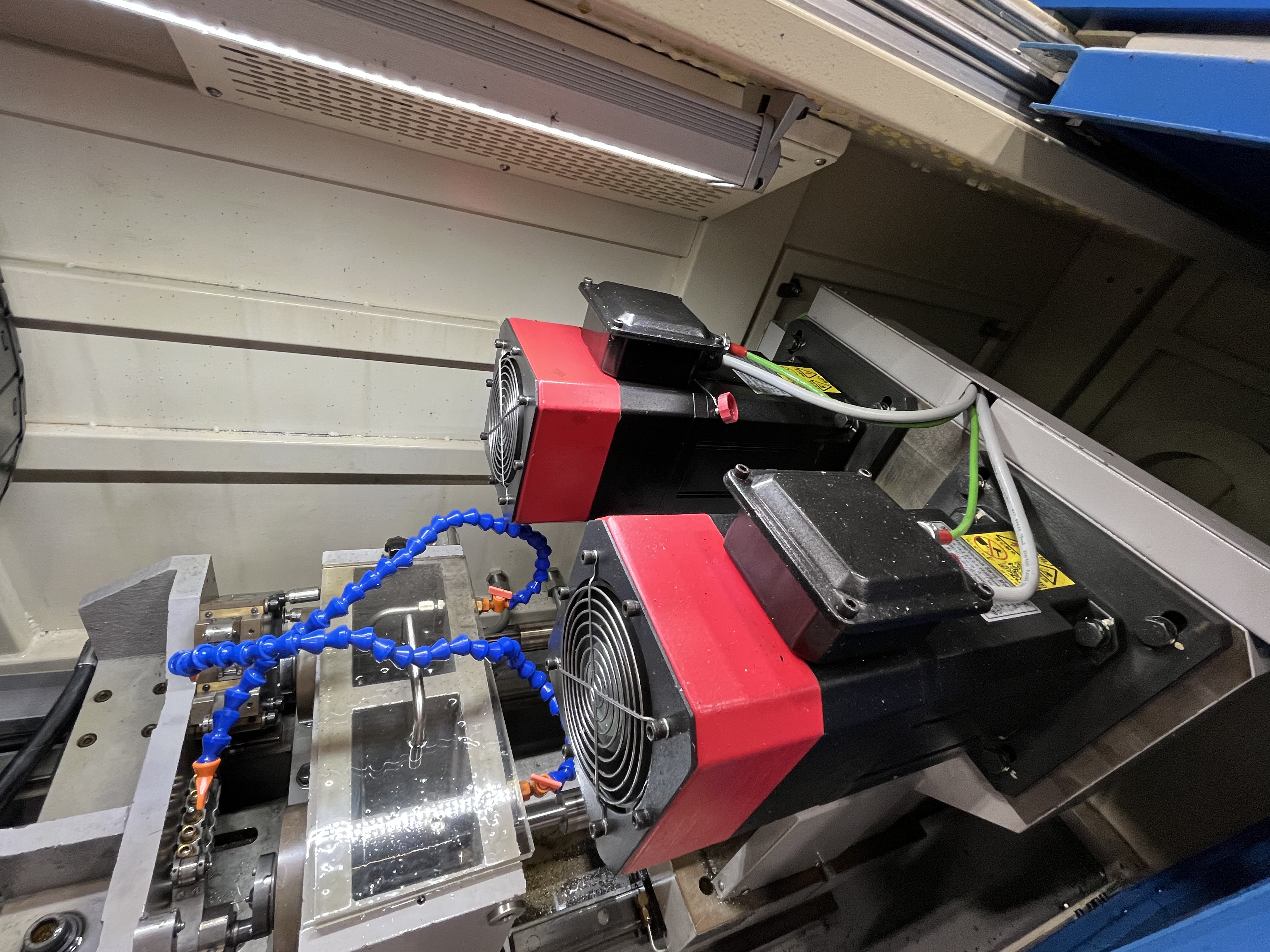
Gun drilling is a machining process for drilling deep holes with high straightness and good surface finish. It’s the method of choice when a hole needs to be deeper than a conventional twist drill can reach.
The process gets its name from its original application: drilling gun barrels. The same principles used to drill a 5mm hole through 2 meters of steel for a rifle barrel are used today to drill cooling channels in injection molds, oil passages in crankshafts, and bores in hydraulic cylinders.
How a Gun Drill Works
A gun drill is a single-lip cutting tool with a internal coolant hole and an external chip flute. The tool rotates while coolant is pumped through the center of the drill. The coolant exits at the cutting tip, cools the cutting edge, and flushes chips back along the external flute.
The key components of a gun drill:
- Carbide tip. The cutting edge is a carbide insert brazed to a steel shank. The tip geometry determines the cutting performance and chip formation.
- Steel shank. The long body of the drill that connects the tip to the machine spindle. The shank is smaller in diameter than the tip, creating clearance between the drill body and the bore wall.
- Coolant hole. A small-diameter hole through the center of the drill that delivers coolant to the cutting tip.
- Chip flute. A V-shaped groove along the length of the drill that carries chips back out of the hole.
The drill is supported by a guide bushing at the entry point. The bushing prevents the drill from whipping or deflecting during the first few millimeters of engagement.
What Gun Drilling Can Do
| Capability | Typical Range |
|---|---|
| Diameter | 0.5mm to 50mm |
| Depth-to-diameter ratio | Up to 400:1 |
| Surface finish | Ra 0.1-0.8μm |
| Diameter tolerance | IT7-IT10 |
| Straightness | 0.05-0.5mm per meter |
These are general ranges. I’ve seen gun drilling exceed these numbers on specialized machines, and I’ve seen it fall short when the setup wasn’t right. I tell customers looking at gun drilling for the first time: expect Ra 0.4μm and 0.1mm/m straightness on a good day with a proper setup.
When to Use Gun Drilling
Gun drilling is the right choice when:
- The hole is deeper than 10x the diameter. Below 10:1 L/D, a conventional twist drill can handle the job.
- Straightness matters. Gun drilling produces straighter holes than any other drilling method.
- Surface finish matters. A gun drilled hole typically doesn’t need reaming or honing.
- The hole needs to be a consistent diameter over the full length. Gun drilling produces a uniform bore from entry to exit.
Gun drilling is not the right choice when:
- The diameter is over 50mm. BTA drilling is faster and more economical at larger diameters.
- The volume is very low and the hole is short. A conventional drill is faster to set up and run.
- The hole has interrupted cuts or cross holes. These conditions can break a gun drill if not handled carefully.
How It Compares to Other Methods
| Process | Diameter Range | L/D Ratio | Surface Finish | Relative Speed |
|---|---|---|---|---|
| Twist drilling | 1-80mm | Up to 10:1 | Ra 1.6-6.3μm | Fast |
| Gun drilling | 0.5-50mm | Up to 400:1 | Ra 0.1-0.8μm | Moderate |
| BTA drilling | 8-300mm | Up to 100:1 | Ra 0.4-3.2μm | Fast |
| Ejector drilling | 18-200mm | Up to 100:1 | Ra 0.8-3.2μm | Fast |
| Reaming | 3-100mm | Up to 20:1 | Ra 0.4-1.6μm | Slow (finishing only) |
I’ve never seen another drilling method match gun drilling for surface finish on holes under 20mm.
What You Need to Run It
To run gun drilling successfully, you need:
- A machine with sufficient spindle speed. 3000-8000 RPM depending on diameter.
- High-pressure coolant. 1000-2000 psi typical, delivered through the tool.
- Coolant filtration. 20 micron or better. Chips recirculating in the coolant will damage the drill edge.
- A guide bushing. To support the drill at entry.
- Rigid setup. The workpiece and machine need to be stable.
Key Takeaways
Gun drilling is not difficult once you understand the fundamentals. The two things that cause most of the problems I’ve seen are:
- Insufficient coolant pressure. The most common cause of gun drill failure. If the chips aren’t clearing, the drill will break.
- Poor alignment. The second most common cause. If the drill doesn’t start straight, it won’t get straight.
Get those two right, and gun drilling is a reliable, repeatable process.