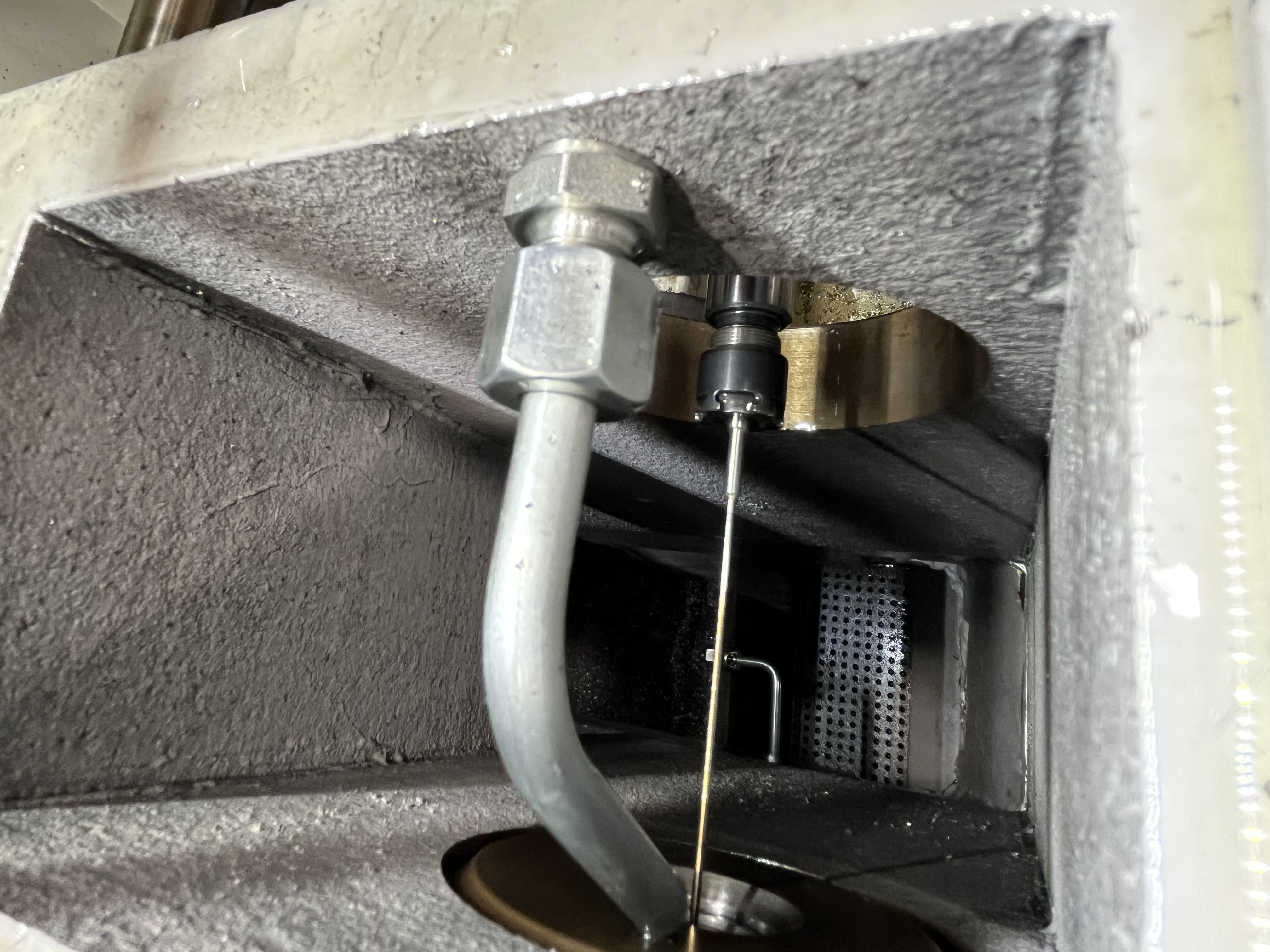
Early in my career, a senior engineer watched me setting up a gun drilling job. I was fussing with the cutting parameters. Should the feed be 0.04 or 0.05 mm/rev? Should the speed be 3000 or 3500 RPM?
He watched for a minute and said: “You are worrying about the wrong things. Check the coolant pressure first. If the pressure is not right, nothing else matters.”
He was right. I have seen more deep hole drilling problems caused by coolant pressure than by any other single factor. Worn tools, misalignment, and wrong parameters are easier to fix than chip packing from low coolant pressure.
Who the Senior Engineer Was
His name was Ray. He had been on the shop floor for thirty-seven years when I met him. He started as a machine operator in the 1970s, worked his way through every role in the shop, and ended up as the senior applications engineer. He had a habit of leaning on a broom handle while watching you work, and he would not say a word until he saw something worth commenting on. That made his advice stick. When Ray spoke, you listened, because he had been watching for ten minutes before he said anything.
Ray had seen the shift from low-pressure coolant systems to the high-pressure systems we use today. He told me stories about drilling with 20 bar coolant and wondering why drills lasted fifty holes instead of five hundred. He understood the physics of chip evacuation better than anyone I have ever met because he learned it through trial and error, not from a textbook.
Why Coolant Pressure Matters More Than Parameters
In deep hole drilling, the cutting edge is buried in the bore. There is no way for chips to escape except through the drill flute, pushed by the coolant flow. The coolant has two jobs: lubricate the cutting zone and flush the chips out of the hole. If the pressure is too low, the chips stay in the flute and pack together. Packed chips block the coolant flow completely, which raises the temperature at the cutting edge and accelerates tool wear exponentially.
I have seen a parameter-obsessed operator spend an entire shift optimizing feeds and speeds while the coolant pressure was ten bar below the minimum for that drill diameter. He was trying to solve a chip evacuation problem with cutting parameters. You cannot fix a coolant problem with a feed rate adjustment. The chips will not flush any better at 0.03 mm/rev than at 0.06 mm/rev if the coolant does not have enough pressure to push them out of the flute.
Ray taught me to set the coolant pressure first, then adjust the coolant flow rate, and only then touch the feeds and speeds. That order matters. The coolant system is the foundation. Everything else is built on top of it.
Coolant Pressure Guidelines I Use
Some materials and drill sizes need more pressure than others. I have compiled a reference table based on my own experience across different jobs:
| Drill Diameter | Material | Minimum Pressure | Recommended Pressure | Expected Flow Rate |
|---|---|---|---|---|
| 4 to 8 mm | Low-carbon steel | 60 bar | 80-100 bar | 15-25 L/min |
| 4 to 8 mm | Stainless steel | 80 bar | 100-120 bar | 20-30 L/min |
| 10 to 16 mm | Low-carbon steel | 50 bar | 70-90 bar | 30-50 L/min |
| 10 to 16 mm | Stainless steel | 70 bar | 90-110 bar | 40-60 L/min |
| 18 to 25 mm | Low-carbon steel | 40 bar | 60-80 bar | 50-80 L/min |
| 18 to 25 mm | High-alloy tool steel | 60 bar | 80-100 bar | 60-90 L/min |
| Over 25 mm | Any steel | 30 bar | 50-70 bar | 80-120 L/min |
I check the pressure at the rotating union, not at the pump. The pressure at the pump can read 80 bar while the pressure at the tool is 50 bar if there are leaks in the lines, restrictions in the filter, or wear in the rotating union seals. Ray taught me that trick. He said: “The pump does not cut the hole. The drill cuts the hole. Check the pressure where the drill is.”
Common Coolant Pressure Problems I Have Troubleshot
Low pressure at the tool almost always comes from one of four sources. Filter clogging is the most common. I have seen operators go weeks without checking the coolant filter elements, and by the time they notice the pressure drop, the filter is packed solid with fine chips and swarf. I now replace filter elements on a fixed schedule — every 200 hours of pump runtime for the primary filter, and every 400 hours for the secondary.
Rotating union wear is the second most common cause. The seals inside the union degrade over time, and the pressure drop across the union increases slowly. The operator does not notice because the drop happens over months. I measure the pressure at the union inlet and outlet during every scheduled maintenance. If the drop exceeds 10 bar across the union, I replace the seal kit.
External hose leaks are the third cause and the easiest to find. I run my hand along every high-pressure hose during the weekly machine inspection. A pinhole leak at 80 bar will atomize the coolant into a fine mist that is hard to see but easy to feel.
The fourth cause is pump cavitation. If the coolant level in the tank is low or the intake strainer is clogged, the pump cannot maintain pressure. I check the tank level before every job and clean the intake strainer during every filter change.
Passing the Advice On
I have repeated Ray’s advice to every operator I have trained. I say the same words he said to me: “Check the coolant pressure first. If the pressure is not right, nothing else matters.” I watch them go through the same phase I went through — skeptical at first, then converted after the first time coolant pressure saved them a scrapped part.
I have a coolant pressure gauge installed at every machine in our shop, and I added a second gauge at the rotating union on machines where the original gauge was mounted near the pump. The cost of a gauge and a tee fitting is about forty dollars. The cost of a scrapped bore from chip packing is usually several hundred dollars. That is an easy trade.
Ray retired five years ago. I still call him occasionally when I run into a problem I cannot solve. The last time I called, he said: “Did you check the coolant pressure?” I had not. That was the problem.
The Pressure vs. Flow Rate Distinction
One thing Ray clarified for me that I had not understood was the difference between coolant pressure and coolant flow rate. Early in my career, I thought high pressure automatically meant high flow. Ray explained that pressure is the force pushing the coolant through the flute, and flow rate is the volume of coolant moving through the system. They are related but not the same.
A system with a clogged filter will show high pressure at the pump because the pump is working against a restriction, but the flow rate at the tool will be low because the coolant cannot pass through the blockage. A system with a worn rotating union will show normal pressure at the pump but reduced pressure at the tool, and the flow rate will be low across the entire system. A system with a partially blocked drill flute will show normal pressure at the pump, normal pressure at the union, but almost no flow through the drill because the chips inside the flute are blocking the passage.
Ray drilled this distinction into me by making me install flow meters on every machine in the shop. The flow meter reads in liters per minute and is installed on the return line from the chip separator. Now I check both pressure and flow on every setup. If the flow rate drops below the minimum for the drill diameter, I stop and investigate even if the pressure gauge reads normal. That flow meter has caught three filter blockages that the pressure gauge alone would have missed.
A Specific Problem Ray Helped Me Solve
About five years after Ray gave me that advice, I ran into a problem that seemed to contradict everything he had taught me. A 20 mm gun drilling job in 4340 steel was producing poor surface finish despite the coolant pressure reading 85 bar at the union, well above the minimum. I checked the flow rate and it was within spec. I checked the drill condition and it was new. I checked the alignment and it was within tolerance. I was stuck.
I called Ray. He asked two questions. First: “What is the coolant temperature?” I had not checked. I walked over to the tank and measured it with an infrared thermometer: 52 degrees Celsius. Normal operating temperature for that machine was 35 degrees. The coolant had been circulating through a machine running three shifts for four days without a break, and the heat exchanger was undersized for the cycle time. The hot coolant could not remove heat from the cutting zone fast enough, so the surface finish degraded despite everything else being correct.
Ray’s second question: “Did you check the temperature at the exit of the bore, not the tank?” I measured the coolant temperature at the return line near the drill exit. It was 58 degrees. The coolant absorbed heat as it traveled through the bore, and by the time it reached the cutting zone, it was too hot to provide effective cooling.
I added a secondary heat exchanger and the problem disappeared. The surface finish returned to 0.3 Ra. The lesson was an extension of Ray’s original advice: coolant parameters include temperature, not just pressure and flow. Hot coolant at the right pressure is still ineffective coolant.
Key Takeaways
- Coolant pressure is the single most important parameter in deep hole drilling. Set it before you adjust anything else.
- Measure pressure at the rotating union, not at the pump. The pressure drop between the pump and the tool can be significant.
- Filter changes are not optional. Schedule them by pump runtime, not by calendar date.
- Rotating union seals wear slowly. Track the pressure drop across the union during maintenance to catch wear early.
- A coolant pressure gauge at every machine costs forty dollars. A scrapped bore costs hundreds. Install the gauge.
- If you are troubleshooting a deep hole drilling problem and you have not checked the coolant pressure, start there. Ray was right every time.
- Pass specific advice to new operators with the exact words that worked for you. A memorable phrase sticks better than a paragraph.
- Pressure and flow rate are different measurements. Install a flow meter on the return line to catch blockages that pressure gauges miss.
- Coolant temperature matters as much as pressure. Check the temperature at the bore exit, not just the tank.