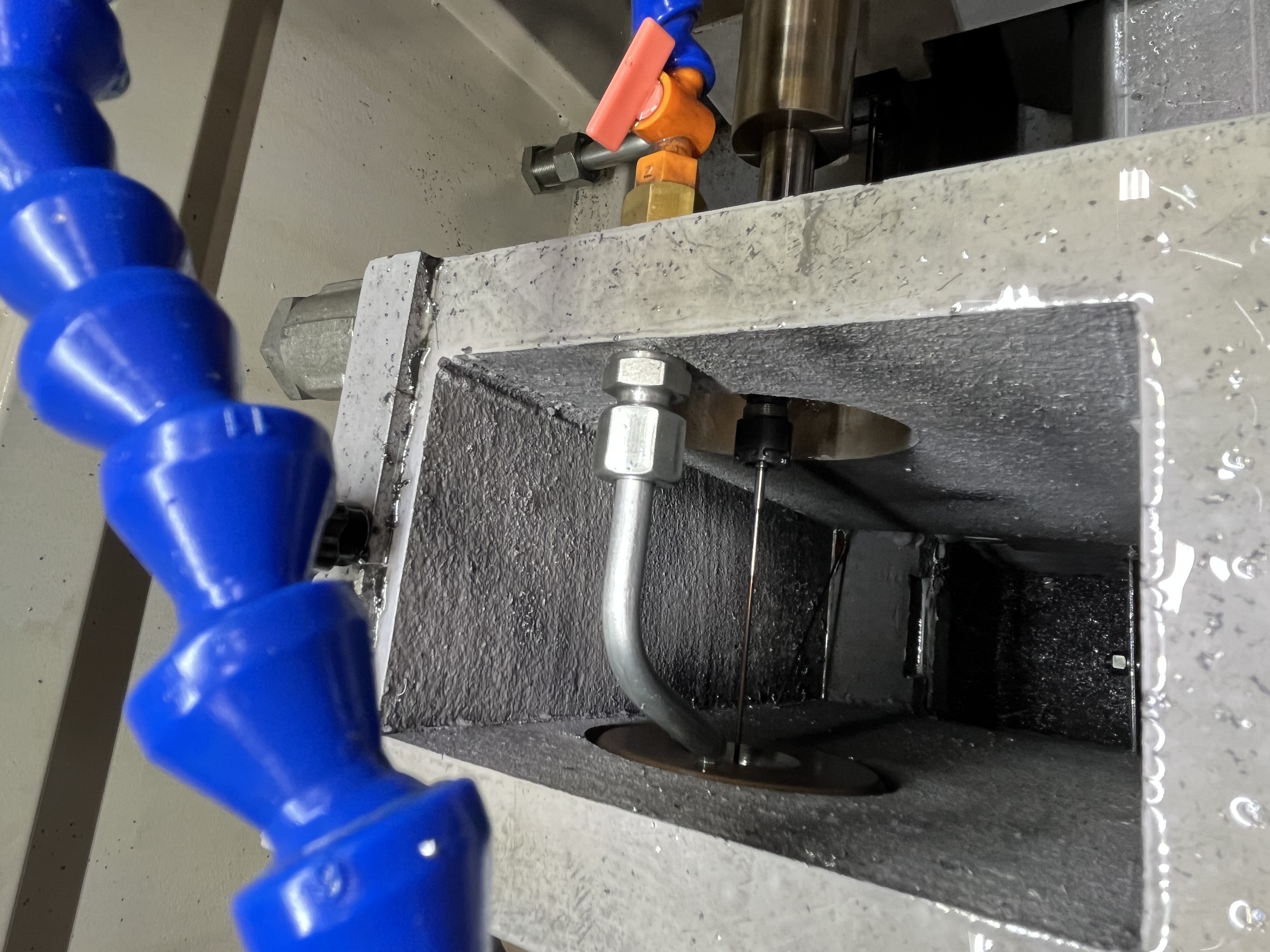
A customer called me on a Tuesday afternoon. They had a part redesign on their hands and needed a 1mm diameter hole drilled through 400mm of Inconel 718. I asked them to repeat those numbers because I thought I had misheard. They had not misheard. A 1mm hole through 400mm of material gives a length-to-diameter ratio of 400 to 1. For context, a standard gun drill with a 1mm diameter has a flute length of roughly 150mm before the brazed joint at the shank. Going 400mm deep means the drill would need to cut 250mm past the end of its own flute support.
Understanding the Problem
I pulled out my gun drilling reference charts and ran through the calculations. The first problem was tool wander. A 1mm diameter drill has a cross section of 0.785 square millimeters. The bending stiffness of that drill is roughly proportional to the fourth power of the diameter. Compared to a 10mm drill, a 1mm drill is ten thousand times less rigid. At 400mm depth, even a 0.1 degree deviation at the entry would translate to 0.7mm of positional error at the exit. The part tolerance was 0.1mm on position.
The second problem was coolant delivery. Gun drills rely on high-pressure coolant injected through the drill shank to flush chips out through the V-flute. A 1mm drill has an internal coolant hole of about 0.3 to 0.4mm diameter. The pressure drop across a 400mm length of a 0.4mm hole is extreme. I calculated the required coolant pressure at roughly 180 bar minimum, and most of the machines on my floor maxed out at 100 bar.
| Parameter | Required | Available | Gap |
|---|---|---|---|
| Drill diameter | 1.0 mm | 1.5 mm (smallest in stock) | 0.5 mm |
| L/D ratio | 400:1 | Practical max 200:1 in Inconel | 200:1 |
| Coolant pressure needed | 180 bar | 100 bar | 80 bar |
| Expected tool life at depth | 0 parts | 100+ parts typical | N/A |
| Positional tolerance | 0.1 mm | Estimated 0.7+ mm at exit | 0.6 mm |
The third problem was chip evacuation. Inconel 718 produces stringy, abrasive chips that do not break cleanly even at the best of times. In a 1mm hole, the chip clearance in the flute is less than 0.3mm. Any chip that does not flush immediately will pack, seize the drill, and cause a twist-off failure. I have seen this happen in 3mm holes in Inconel with plenty of coolant pressure. A 1mm hole would be exponentially worse.
I also considered the heat generation. At 8000 RPM with a 1mm drill, the cutting speed is only about 25 meters per minute, which is low for Inconel. The friction between the drill margin and the bore wall generates significant heat. Without enough coolant flow to carry that heat away, the cutting edge temperature can exceed 800 degrees Celsius, which softens the carbide and accelerates wear. I calculated the expected temperature at the cutting edge and estimated it would reach 900 degrees within thirty seconds of continuous cutting at 400mm depth.
The Coolant Pressure Math
I spent an evening working through the coolant pressure calculations in detail. The hydraulic resistance of a 0.4mm diameter hole through 400mm of steel follows the Hagen-Poiseuille equation for laminar flow. The pressure drop is proportional to the length of the hole divided by the fourth power of the diameter. Reducing the coolant hole diameter from 1mm to 0.4mm increases the pressure drop by a factor of about 39. At the flow rate needed to clear chips from a 1mm bore, roughly 2 liters per minute, the required inlet pressure would be about 180 bar.
The rotary union on my gun drilling machine was rated for 100 bar continuous operation. Running at 180 bar would have blown the seals within minutes. Even if I had a machine with higher pressure capability, the coolant pump power requirement at 180 bar and 2 liters per minute would be about 6 kilowatts. My pump was rated at 7.5 kilowatts, so it could theoretically supply the pressure, but the piping between the pump and the spindle was rated for 120 bar maximum. The fittings would have leaked or burst.
I also considered using through-tool coolant with a mist system instead of flood coolant. Mist systems use compressed air mixed with a small amount of oil to lubricate the cutting edge. They work well for small diameter drills in shallow holes but they cannot flush chips effectively at 400mm depth because the air pressure drops too quickly over that length. The mist would reach the cutting edge but the chips would stay in the flute.
The Test Runs
The customer asked if I could try anyway. They had engineering management pressure to keep the design and they needed someone to at least attempt it before they could justify a redesign. I agreed to run a test on a scrap piece of Inconel 718 they provided.
I set up the test using the smallest gun drill I had in stock, which was 1.5mm diameter. I know that is 50 percent larger than the required hole, but I figured the test would show us what kind of depth we could achieve and where the failures would happen. I used a 1.5mm guide bushing, set the spindle speed at 8000 RPM, which was the maximum for that machine, and set the feed rate at 0.005mm per revolution. That gave me a material removal rate of roughly 0.04 cubic centimeters per minute.
The first drill made it to 200mm depth before it snapped. I heard the noise change about three seconds before the break. The spindle load climbed from 15 percent to 60 percent in under a second, and then the drill let go. I extracted the broken tool with a set of carbide pick tools. It took about forty-five minutes to clear the piece.
I tried again with a different drill geometry. The second drill had a thicker web and a more aggressive point angle, 140 degrees instead of 120. I dropped the feed to 0.003mm per rev. That drill made it to 180mm before it twisted off at the shank. The failure mode was identical to the first attempt: chip packing in the flute, loss of coolant flow, thermal overload, seizure, and fracture.
The third attempt used a two-step pecking cycle with a 2mm retract every 10mm of depth. I thought giving the chips more room to clear might help. The pecking cycle added about three hours to the drilling time. The drill made it to 165mm before breaking. The pecking did not help because the chips were packing in the flute within the first 50mm and the retracts could not clear them.
The Right Call
After three broken drills, roughly eight hours of machine time, and a scrap coupon worth about $200, I called the customer back. I walked them through the test results and told them that the job was not feasible with any tooling I had or could reasonably source. I explained that even if I could get a custom drill made with a 400mm flute length, the coolant pressure and chip evacuation problems would remain unsolvable with standard gun drilling equipment.
The customer’s design team redesigned the part with a 3mm hole through 400mm, which gave them a 133 to 1 ratio. I ran that job without any issues. The 3mm hole cost less to drill than the test program had cost to fail, and the customer got their parts on schedule.
I think about that job often when I am quoting new work. The technical limits of deep hole drilling are not flexible. No amount of persistence or careful setup can change the physics of chip evacuation in a 1mm hole at 400mm depth. Recognizing those limits early saved the customer time and money.
Alternative Processes I Considered
After the test runs failed, I looked into whether any alternative process could make the hole. Electrical discharge machining, or EDM, can drill small holes in Inconel without the chip evacuation problem because the process erodes material with electrical sparks rather than cutting it. A small hole EDM machine can drill holes down to 0.3mm diameter through 200mm of material. The limitation is the electrode wear. For a 400mm deep hole, the electrode would need to be replaced multiple times, and each electrode change risks misalignment.
I called a local EDM shop and asked if they had experience with 400mm deep small holes. The shop manager said they had done EDM drilling up to 300mm deep in Inconel but the cycle time was about four hours per millimeter of depth. A 400mm hole would take roughly 1,600 hours of machine time, or about sixty-six days running nonstop. The quoted price was $18,000 per hole, compared to the $85 per hole for the gun drilled 3mm redesign.
Laser drilling was another possibility. Pulsed laser drilling can create small diameter holes in superalloys at high speed, but the maximum depth for laser drilling in Inconel is typically around 50mm before the laser beam diverges too much to maintain the diameter. Laser drilling through 400mm would require stepping the beam down the hole, which is not practical with current commercial laser systems.
The comparison made the decision easy. The 3mm gun drilled hole at $85 each was the only viable option.
| Process | Max Depth at 1mm Dia | Cycle Time | Cost per Hole | Feasible? |
|---|---|---|---|---|
| Gun drilling | Not feasible in Inconel | N/A | N/A | No |
| EDM drilling | 200mm typical | 1,600 hours | $18,000 | Technically yes, but impractical |
| Laser drilling | 50mm typical | N/A | N/A | No |
| Redesign to 3mm gun drill | 400mm feasible | 8 minutes | $85 | Yes |
Why I Document Every Impossible Request
I keep a log of every job I turn down as technically infeasible. Each entry includes the date, the customer name, the required geometry, the material, and the reason I could not do it. I also include the alternative I offered and whether the customer took it. Since that Inconel job, I have logged seven impossible requests. Two of them led to redesigns that I quoted and ran successfully. Three went to other shops. Two were abandoned by the customer.
The log serves two purposes. First, it gives me a data set to reference when a customer pushes back on a feasibility assessment. I can point to similar jobs and show the same failure patterns. Second, it helps me spot trends in what customers are asking for. I have noticed an increase in requests for very small diameter holes in difficult materials over the past two years, probably driven by weight reduction requirements in aerospace and medical device designs.
I shared my log with a tooling supplier a few months ago. They used the data to develop a new drill geometry specifically for small diameter deep holes in nickel alloys. The new geometry has a 140-degree point angle with a notched web design that improves chip breaking in Inconel. I tested the prototype and it increased the maximum depth in Inconel from 200mm to about 280mm at 2mm diameter. It still would not reach 400mm at 1mm, but it was a real improvement.
Key Takeaways
- A 400 to 1 length-to-diameter ratio in Inconel 718 is not a challenge to overcome. It is a physical impossibility with conventional gun drilling.
- Running a small test program is often cheaper than arguing with a customer about feasibility. Three broken drills and a scrap coupon cost far less than the reputation damage of taking an impossible job and failing publicly.
- Pecking cycles do not solve fundamental chip evacuation problems in very small diameter deep holes. Once the chips pack, they stay packed.
- The minimum feasible hole diameter for deep hole drilling in nickel-based superalloys is roughly 3mm, assuming standard equipment and coolant pressures up to 100 bar.
- I now keep a reference chart on my wall that shows practical L/D limits by material. I pull it out during every quoting call that involves small diameters or exotic alloys. It saves me from having to learn the same lesson twice.
- When I tell a customer a job is impossible, I always offer an alternative. In this case, the 3mm redesign worked. A customer who hears “no” without a solution will call someone else. A customer who hears “no, but here is what will work” comes back for the next job.