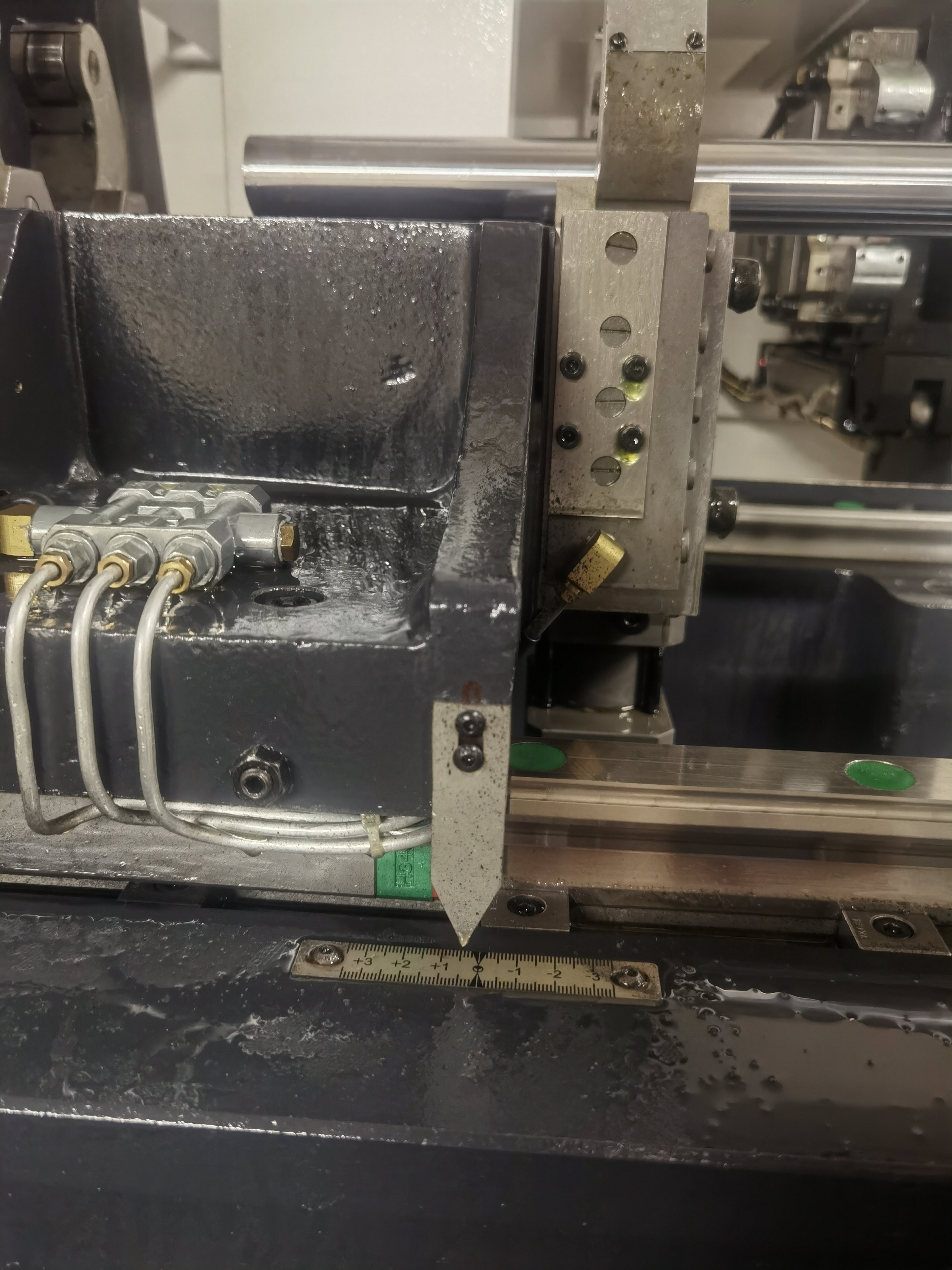
I got the call on a Tuesday afternoon. Tom from purchasing — I could tell by his voice he was already fed up. “These new gun drills you sent us are garbage,” he said. “We’re barely getting thirty holes per tool. The old ones did sixty easy. I want a refund.”
Now, I’ve been around gun drills long enough to know that when someone blames the tool first, the problem is usually somewhere else. A gun drill is a simple thing — a carbide tip brazed to a steel tube with a coolant hole running through the center. When it fails, it’s almost always because something in the system made it fail. But you don’t say that to a customer on the first call. You listen, you apologize, and you offer to come take a look. The customer is never wrong in the first conversation. They’re just describing a symptom.
I told Tom I’d be there the next morning. “Don’t send replacement drills,” I said. “Let me look at your setup first. Might save you the shipping cost.” He grunted something that could have been agreement and hung up.
I drove out to their shop the next morning. It was early March, still cold outside, but that shop was humid and warm when I walked through the roll-up door. They’re a medium-sized job shop about forty minutes from us, mostly oilfield work. They’d just landed a big contract for valve bodies — 4140 steel, 18mm holes about 400mm deep. Good, steady work. The kind of job that should be eating up gun drills at a predictable rate.
The shop floor was busy when I arrived. Three CNC lathes running, a couple of vertical mills, and their Mori Seiki deep hole machine humming in the corner. It was a well-organized shop — tools on the walls, shadow boards for every workbench, a clean floor. The kind of shop that looks like they know what they’re doing. Which made the coolant problem even more surprising.
Tom met me at the front office and walked me straight to the machine. A Mori Seiki NH6300 with a chip conveyor running full tilt — capable setup. The operator, a guy named Mike in his early thirties with a neatly trimmed beard and safety glasses pushed up on his forehead, was pulling a freshly dulled drill out of a valve body. The cutting edges were chipped and worn, like the drill had been through a rock tumbler instead of annealed steel.
“See?” Tom said, pointing. “Thirty-two holes. That’s it. We’re burning through drills faster than we can regrind them. The old supplier’s drills got sixty-five easy. I don’t know what you guys changed, but something is wrong.”
I didn’t say anything yet. I took the drill from Mike and walked it over to the bench where they had a shop microscope. I pulled the gooseneck lamp closer and took a good look. The wear pattern told me everything I needed to know. There was heat discoloration at the carbide tip — that telltale blueish tint that says you’re cooking the edge. The carbide was breaking down from thermal shock, micro-chipping along the cutting edge in a way that only happens when the heat isn’t being carried away fast enough.
Textbook signs of insufficient coolant.
I stood up and wiped my hands on a rag. “Mind if I check the coolant?” I asked.
Tom shrugged. Mike handed me a refractometer from the toolbox — it was dusty, like it hadn’t been used in a while. I wiped the prism clean with a shop rag and walked over to the machine’s coolant tank.
I cracked the lid and dipped a sample. The coolant smelled off — that sour, rancid odor you get when the concentration is too low and bacteria start growing. That was a bad sign right there. A healthy coolant mix at the right concentration shouldn’t smell like anything more than slightly oily water.
I put a drop on the refractometer prism and held it up to the light.
The reading came back at 3.2 percent.
“Your coolant concentration is at three percent,” I said. “You want it between eight and ten for gun drilling in 4140. Gun drilling generates a lot of heat at the cutting zone — the friction between the carbide and the steel creates temperatures that can exceed six hundred degrees Celsius. The coolant has to both lubricate the cutting edge and carry that heat away. At three percent, there’s not enough lubricity to keep the edge cool or carry the chips out.”
Tom looked at Mike. Mike looked at the floor.
“There’s your problem,” I said. “The coolant is too thin. It can’t lubricate or cool effectively. The drill heats up, the carbide breaks down, and you get exactly that wear pattern. It’s not the tool. It’s the coolant.”
Mike spoke up, scratching the back of his head. “We top off with water every morning. The coolant concentrate barrel was empty last week, so I’ve just been adding water to keep the tank full. I didn’t think it would matter that much.”
“Exactly,” I said. “Every time you add water without adding concentrate, the percentage drops. You probably started at eight percent when you charged the system last month. Now it’s three. That means every time you added a gallon of water, you diluted the mix. The drill runs hot, the edge goes, and the tool gets blamed for something the coolant should have been doing.”
We spent the next hour draining about a third of the tank and adding fresh concentrate to bring the concentration back up to nine percent. I showed Mike how to use the refractometer properly — not just a quick splash, but a clean sample from the tank, not the return line, because return line samples are diluted by the cutting process. Check it every morning before the first part, I told him. Write it down on the whiteboard next to the machine. Treat coolant concentration like spindle speed — it’s a critical parameter, not a nice-to-have.
The first part after the adjustment ran smooth as glass. I stood there watching the chip formation through the polycarbonate window. The chips came out tight and curled — the kind of tight figure-eight chips that tell you everything is right. We ran it for ten holes straight and pulled the drill. The cutting edges looked like they’d just been ground. No discoloration, no chipping, just a clean wear land with a uniform appearance across the entire cutting edge.
Tom called me a week later. They were getting sixty-five holes per drill and climbing. He apologized for the attitude on the phone. I told him not to worry about it — happens to everyone when the pressure is on. He ordered a fifty-gallon drum of coolant concentrate and put Mike in charge of weekly concentration checks.
For the next year, Mike sent me a photo of his refractometer reading every Monday morning. The first few months it bounced around — seven percent one week, eleven the next. But eventually he got consistent. Nine percent, every time, like clockwork. He turned his mistake into a system, and the system worked.
That call taught me something I’ve carried through my whole career. When someone blames the tool, they’re almost always trying to solve the wrong problem. The tool is the easiest thing to point at. It’s physical, it’s visible, it’s the thing that’s broken. But the real issue — bad coolant, wrong parameters, worn guide bushing — takes more work to find. It’s a lot easier to yell at the tool supplier than to admit your coolant is out of spec.
So now, when a customer calls angry, I don’t argue. I grab my refractometer and my micrometers and I go see for myself. Nine times out of ten, the tool is fine. The system around it isn’t.
I ran into Mike about a year later at a supplier trade show. He came up to me and shook my hand. “I still check the coolant every morning,” he said. “And I told the new guy the story about the guy who drove forty minutes to tell me my coolant was too thin. He checks his now too.”
I asked him how the job was going. “Better than ever,” he said. “We’re getting seventy holes per drill now. The boss buys coolant concentrate by the pallet and I check the concentration every Monday. We’ve got a log book on the wall with every reading for the past year.”
He also told me that Tom from purchasing had been promoted. “He still talks about the day you showed up with a refractometer and solved our problem in an hour,” Mike said. “Claims it was the best service call he’d ever seen from a tool supplier.”
That’s the thing about these lessons. They spread. One bad experience, one person who takes the time to explain instead of just selling a replacement tool — it ripples through the whole shop. Mike trained three operators after me, and every one of them learned to check the coolant first.
That refractometer I used that day is still in my car, twelve years later. It sits in the center console, wrapped in a shop rag, ready for the next time a customer calls angry about tool life. I’ve used it at least twenty times since then, at shops all over the state. It’s never let me down.
A refractometer costs about fifty dollars at any tool supply house. Fifty dollars. That’s less than the cost of a single gun drill. And it can save you thousands in tooling and downtime. It’s the best investment a deep hole shop can make, and most of them don’t own one.
I make sure every shop I work with has a refractometer within arm’s reach of their deep hole machines. I’ve bought three of them with my own money and given them to customers. That’s cheaper than dealing with the angry phone calls.
The day I drove out to Tom and Mike’s shop changed how I sell gun drills. I don’t just sell the tool anymore. I sell the whole system. Coolant, parameters, setup, maintenance. Because the tool is only as good as everything around it. And a happy customer doesn’t call you angry about tool life.
Check the coolant first. Trust me on that. And pass it on. The refractometer in my car has paid for itself a hundred times over. Every time I hand it to a skeptical customer and watch them read 3% on the prism, I know that’s one more shop that’s about to start checking their coolant.
Tom and I are still in touch. He calls me whenever they start a new material or a new job. “Just checking,” he says. “You told me to check the coolant first.” And I laugh every time, because he’s proving my point. The simple things are the ones that matter most.
I think about that Tuesday phone call every time a customer complains about tool life. It’s never the tool. It’s almost never the tool. It’s the coolant, the parameters, the bushing, the material, the setup. But people blame the tool because it’s the only thing they can see. My job is to look past it.
I still carry a refractometer in my car. It’s been there for twelve years, wrapped in a shop rag, ready to go. It has saved me more money than I can count. Not because it’s expensive. Because it’s simple.