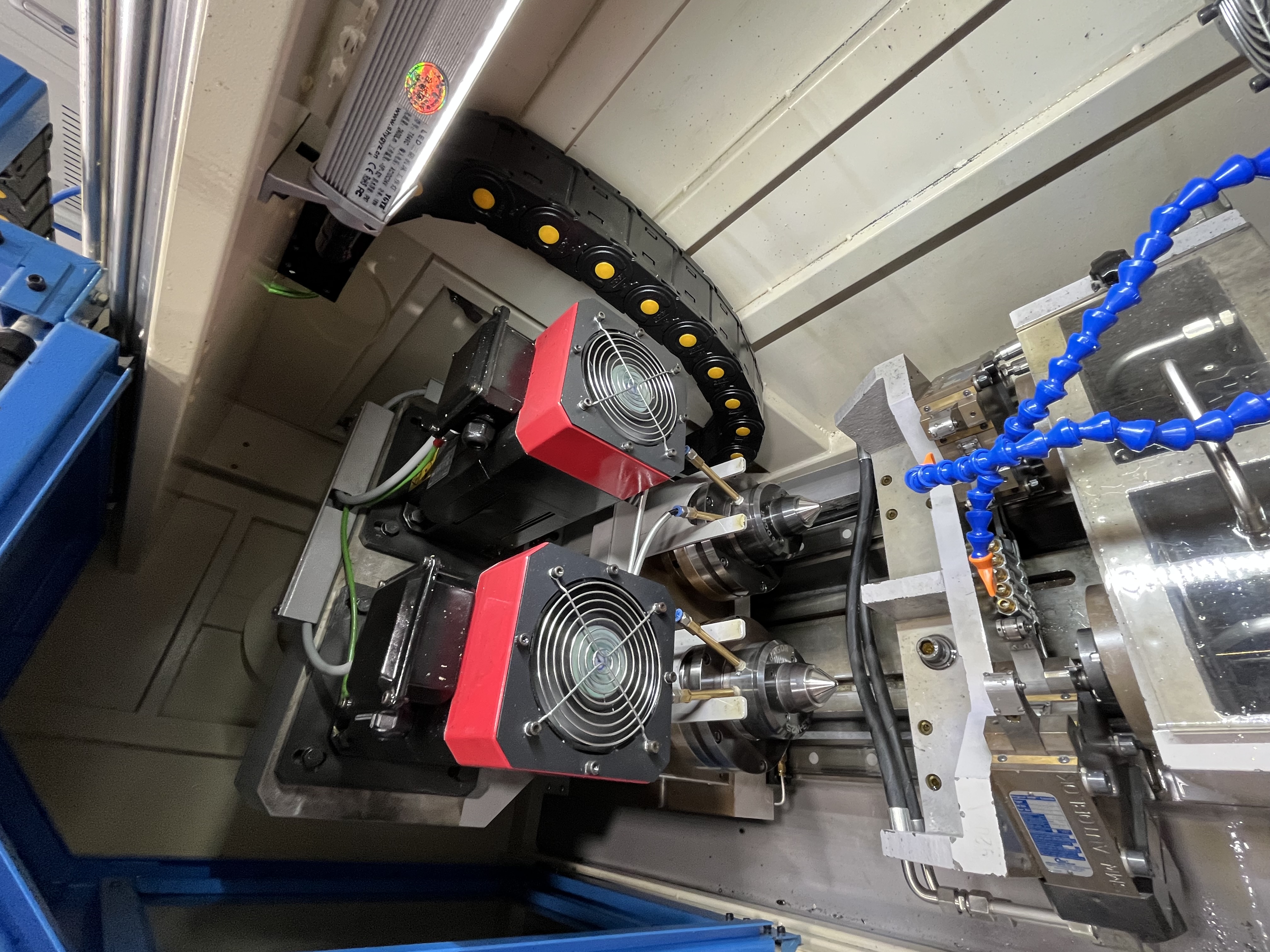
I’ve drilled a lot of deep holes in my career. Hundreds of them, in every material you can imagine. But there’s one that stands above the rest — a job that pushed me, the machine, and the tool to the absolute limit, and taught me more about preparation than any other job before or since.
I should start by explaining what makes a hole “deep.” In gun drilling terms, deep means any hole where the depth is more than ten times the diameter. A 20mm hole drilled 200mm deep — that’s 10:1. Easy. A 20mm hole drilled 600mm deep — 30:1. Getting interesting. A 20mm hole drilled 2000mm deep — 100:1. That’s where most gun drilling applications top out. Past that, you’re in special territory.
Six thousand millimeters at 20mm diameter is 300:1. That’s not deep. That’s extreme.
It was a cold week in February, and the job came in through a customer we’d never worked with before. A manufacturer of large hydraulic cylinders needed a 20mm diameter gun-drilled hole through a 6000mm long shaft — that’s nearly twenty feet, or six meters for the metric folks. The shaft was for a massive hydraulic press that would be used to form automotive body panels. The material was 4140 steel, heat-treated to about 32 Rockwell C.
The length-to-diameter ratio was over 300:1. For context, most gun drilling applications top out around 100:1 with standard equipment. Past that, you need specialized whip guides, precise alignment, and extremely careful parameter control. Three hundred to one was three times the normal limit.
I looked at the drawing and my first thought was that there was no way. Our biggest machine could handle 3500mm in a single pass with the standard setup. And that was with the full set of whip guides installed and the steady rest positioned perfectly. Six thousand millimeters meant we had to drill from both ends and meet in the middle — a technique called “double-end drilling” that I’d done before on smaller parts but never on something this long. The margin for error was microscopic.
I called the customer’s engineer and asked if they really needed a gun-drilled hole through the full length. Could they bore it from one end and leave the other end solid? No, he said. The shaft needed to be a continuous oil passage. It had to be gun-drilled end to end. I asked if we could increase the diameter to make the aspect ratio more manageable. No, he said. The shaft diameter was fixed by the press design. 20mm. Six meters. Non-negotiable.
The shop foreman, a guy named Doug who’d been there since the 1970s and had seen everything, looked at the drawing and let out a low whistle. “You ever done a three-hundred-to-one before?”
“No,” I said.
“Neither have I. Let’s figure it out.”
The customer wanted a delivery date. I told them we needed two weeks from receipt of material. They said they needed it in one. I said two or we wouldn’t take the job. They came back with ten days. We settled on twelve. That bought us enough time to prepare properly.
We spent a week preparing for that job. The first thing we did was design a custom set of whip guides — machined from Delrin plastic on our CNC lathe to fit the shaft diameter exactly, with spiral oil grooves cut into the bore to keep them lubricated as the shaft rotated. We needed seven whip guides spaced evenly along the 6000mm length to prevent the drill from deflecting as it progressed. Each one had to be positioned within a few millimeters of its calculated location.
I spent an entire afternoon just positioning the whip guides. Each one had to be locked onto the shaft at exactly the right spot, with the bore aligned perfectly to the shaft axis. If one was off by even half a millimeter, it would create a leverage point that could bend the drill. I checked each one three times before locking it down.
The second challenge was alignment. When you’re drilling a 20mm hole through six meters of steel, the drill has to enter the shaft perfectly concentric. A misalignment of even 0.1mm at the entry point would result in a wandering hole that could miss the meeting point entirely, or worse, break through the side wall of the shaft. We spent an entire day dialing in the alignment — using a precision machinist’s level, a test bar, and a dial indicator with a magnetic base that we moved along the entire length of the shaft, checking runout at every whip guide position.
Doug and I took turns on the alignment. He’d check the level, I’d adjust the steady rests. Then I’d check and he’d adjust. We went back and forth like that for hours, each of us catching things the other missed. By the end of the day, the shaft was within 0.02mm of true over its full length. That’s the kind of alignment you need for a 300:1 ratio.
The third challenge was the meeting point. Drilling from both ends means you have to calculate exactly where the two holes will meet, and you have to stop each pass at exactly the right depth. We decided to drill the first side to 3000mm — measured carefully with a depth gauge after every hundred millimeters of progress. Then we would flip the shaft one hundred and eighty degrees, realign everything from scratch, and start drilling from the other side.
The first side took most of a day. The gun drill advanced slowly, steadily, with me watching the coolant return like a hawk. Every hundred millimeters, I stopped the feed, backed the drill out to clear chips, and measured the depth. The chips were consistent, which was a good sign. The coolant pressure held steady at eighty bar.
The first side took most of a day. The gun drill advanced slowly, steadily, with me watching the coolant return like a hawk. Every hundred millimeters, I stopped the feed, backed the drill out to clear chips, and measured the depth with a rod. I wrote every depth in a notebook. The chips were consistent, which was a good sign. The coolant pressure held steady at eighty bar. By the end of my shift, I had drilled 3000mm straight and true.
On the second side, about 2800mm in — after two days of setup and drilling — I heard the sound change. The steady, high-pitched whine of the gun drill suddenly dropped in pitch and became a lower, hollow tone. The machine vibrated slightly — a harmonic shudder that traveled through the floor and up through my boots. I knew immediately what it meant. The drill had just broken through to the other side.
I stopped the feed immediately and checked the coolant return at the far end of the hole. A steady stream of coolant was flowing out of the opening, carrying fine chips with it. The two holes had met.
I called Doug over. He walked the length of the shaft, put his hand on the far end, and felt the coolant flow. Then he grinned — a rare sight from a guy who’d seen it all. “You just drilled the longest hole this shop has ever made. Probably the longest hole anyone in this city has ever made today.”
We checked the hole with a bore gauge. The total runout at the meeting point was 0.15mm — well within the customer’s spec of 0.25mm maximum. The surface finish was good enough that the customer could hone it to final size without any issues. We shipped the shaft the next day.
The customer was thrilled. They sent us a photo of the shaft installed in their hydraulic press, with a handwritten note that said “This cylinder moves a hundred-ton die every three seconds. Thanks for making it work.”
I still think about that job when I’m setting up something routine — a simple 100mm-deep hole in mild steel, the kind of thing I can do in my sleep. It reminds me that deep hole drilling is mostly about preparation. The actual drilling is the easy part. The hard part is everything that comes before — the alignment, the whip guide placement, the parameter selection, the contingency planning. If you spend a week getting ready and the drilling takes a day, you’ve done it right.
After that job, the customer started sending us all their long-hole work. We became their go-to shop for anything over two meters. Over the next three years, we drilled probably fifty more shafts for them — some longer, some shorter, but all requiring the same level of precision and preparation.
Doug retired about a year after that job. At his retirement party, he gave me a small box wrapped in oily shop paper. Inside was a piece of the test bar we’d used to align the setup for that first six-meter shaft — about 100mm of hardened steel, engraved with the date and the job number. “In case you ever forget what we did,” he said.
I still have that piece of test bar on my desk at home. It’s a reminder that the hard jobs are what make this trade worth doing. Anybody can drill a hole. But it takes a real deep hole driller to drill a six-meter hole through 4140 and meet in the middle within fifteen hundredths.
In the years since, I’ve done other long holes — six-foot gun drill penetrations in oilfield equipment, deep coolant passages in mold components for the plastics industry — but nothing has matched that six-meter shaft for pure technical challenge. Every time I see a long hole job come across my desk, I think about whether we can do it. And then I think about February of 2012, when Doug and I proved that with enough preparation, there isn’t a hole that can’t be drilled.
The piece of test bar that Doug gave me sits on my desk to this day. It’s got the job number scratched into it — 2012-017. I look at it whenever I’m facing a job that seems impossible. It reminds me that impossible is just another word for “nobody’s done it yet.” And then I get to work.
Doug passed away a few years ago. I still think about him whenever I’m setting up a long hole job. I think about the day we spent aligning that six-meter shaft, checking and rechecking every whip guide, every steady rest, every indicator reading. We didn’t know if it would work, but we prepared like it had to. And it did.
I have a photo of that shaft on the wall above my desk at work. It’s a picture of the part sitting on the truck, ready to ship, with a sticky note that says “300:1 — We did it.” Every time I look at it, I remember that deep hole drilling isn’t about the machine. It’s about the preparation. And the people who do the preparing.
The customer still sends us work, twelve years later. Not just long holes — all their deep hole work. They trust us because we took the time to get it right when it mattered most. And that trust is worth more than any single job.
I still have the original drawing for that shaft somewhere in my files, marked up with notes about whip guide positions and alignment data. I pull it out sometimes when I’m feeling overwhelmed by a tough job. It reminds me that if we could drill a 300:1 hole with a 1980s machine and a week of preparation, we can handle anything that comes through the door.
That drawing is dog-eared and stained with coolant, but it’s one of my most prized possessions. It represents the week when Doug and I proved that deep hole drilling is mostly about willpower and preparation. The machine does the work. But the people do the thinking.
I showed that drawing to a young operator last month who was struggling with a long hole job. He looked at the numbers and said, “Six meters? With a 20mm drill?” I nodded. “And we did it on a machine that was older than you.” He went back to his machine with a different attitude. Sometimes perspective is all you need.
I think about that job every time I face something that seems impossible. The drawing is still in my files. The test bar is still on my desk. And the memory of that sound — the moment the coolant broke through — is still in my ears. It’s the sound of preparation paying off. And it’s the best sound I know. It never gets old, no matter how many holes I drill.
If there’s one thing I want every deep hole driller to know, it’s this: the hardest hole you’ll ever drill is the one you didn’t prepare for. The one you did prepare for — that one’s just practice.