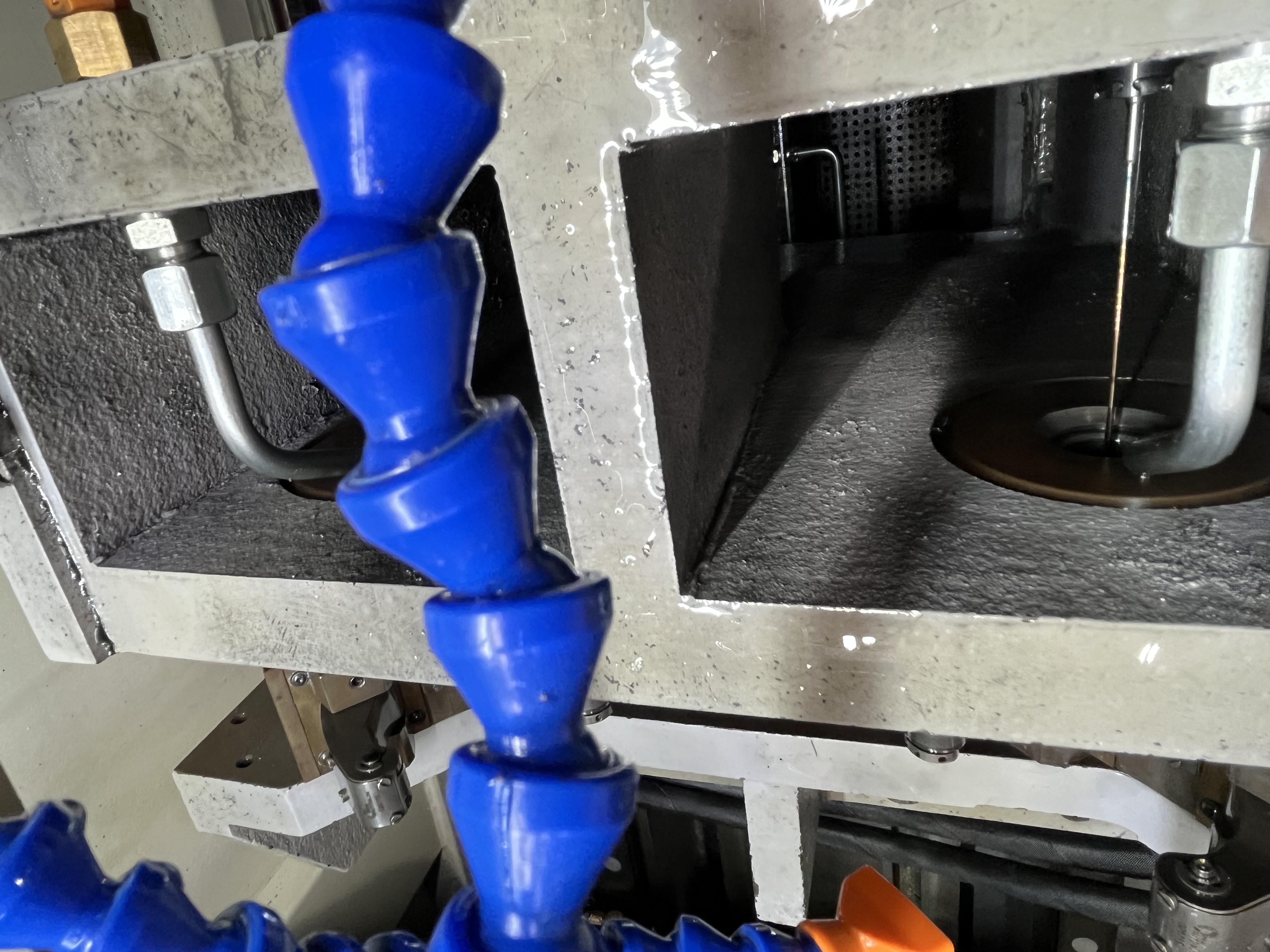
We had a machine that had been losing coolant pressure for about three months. Not dramatically, but steadily. The pressure at the tool had gone from 1200 psi down to about 900 psi, and it kept dropping a little more every week. I had changed the filter elements. I had checked the pump motor current. I had inspected the pressure relief valve. Nothing helped.
The machine was still making good parts, so the slow pressure loss got treated as a low priority. The operators adjusted their peck cycles to compensate for the reduced chip clearing. The production schedules got padded to account for the longer cycle times. Everybody just worked around it.
Eventually the pressure dropped below 700 psi and the machine started having trouble clearing chips from deep holes. We started getting scrapped parts from chip re- cutting, which is when the chips get trapped in the hole and get chewed up by the drill, ruining the surface finish. That got management’s attention.
I pulled the pump off the machine on a Thursday afternoon. It was a Viking internal gear pump, about the size of a car battery, rated for 2000 psi and 40 gallons per minute. The pump had been on the machine for about four years and had never been opened.
Getting the pump apart was a job. The bolts were rusted in place and I had to use penetrating oil and an impact gun to break them loose. Once I got the cover off, I could see the gears and they looked fine. No scoring, no wear, no signs of cavitation. But the inlet port was partially blocked by something dark and fuzzy.
I reached in with a pair of tweezers and pulled out a shop rag.
A blue cotton shop rag, about the size of a dish towel, had been sucked into the pump inlet at some point. It had been wrapped around the inlet port, partially blocking the flow for months. The pump had been running with a rag wrapped around its intake, slowly starving itself of coolant.
The rag was so degraded that it fell apart when I pulled it out. It had been in there long enough that the fibers had started to break down and the dye had leached out. There was no telling how long it had been there. Could have been three months, could have been a year.
I cleaned out the pump housing, replaced the inlet gasket, and bolted it back onto the machine. The pressure at the tool went back to 1200 psi on the first test cycle. The next part came out with perfect chip formation and a beautiful surface finish.
The question was, how did a rag get into the coolant system in the first place? The coolant tank had a screen over the return port. The pump inlet had a strainer. There was no way a rag that size should have been able to get through.
I traced the coolant path from the machine back to the tank and found the problem. The return line screen had a hole in it, about 25mm across, where someone had pushed a pipe through to drain the tank at some point. The hole was big enough for a rag to pass through if it got folded up. The pump inlet strainer was missing. It had probably been removed during a previous repair and never replaced.
I spent the next week inspecting every coolant system in the shop. I found two more missing strainers, three damaged return screens, and one machine that had no screen at all on the return port. I ordered replacement screens and strainers for every machine and installed them myself.
The rag incident cost us months of reduced productivity, a handful of scrapped parts, and a day of labor to diagnose and repair. All because someone had not replaced a strainer after a repair. Now I check the coolant system screens and strainers as part of the monthly preventive maintenance. It takes ten minutes per machine. And if I ever find a missing strainer, I stop everything and track down where it went before I start the machine again.
I also banned loose rags from the area around coolant tanks. If there is a rag near an open coolant port, it is going to end up inside the pump sooner or later. Gravity and curiosity see to that.