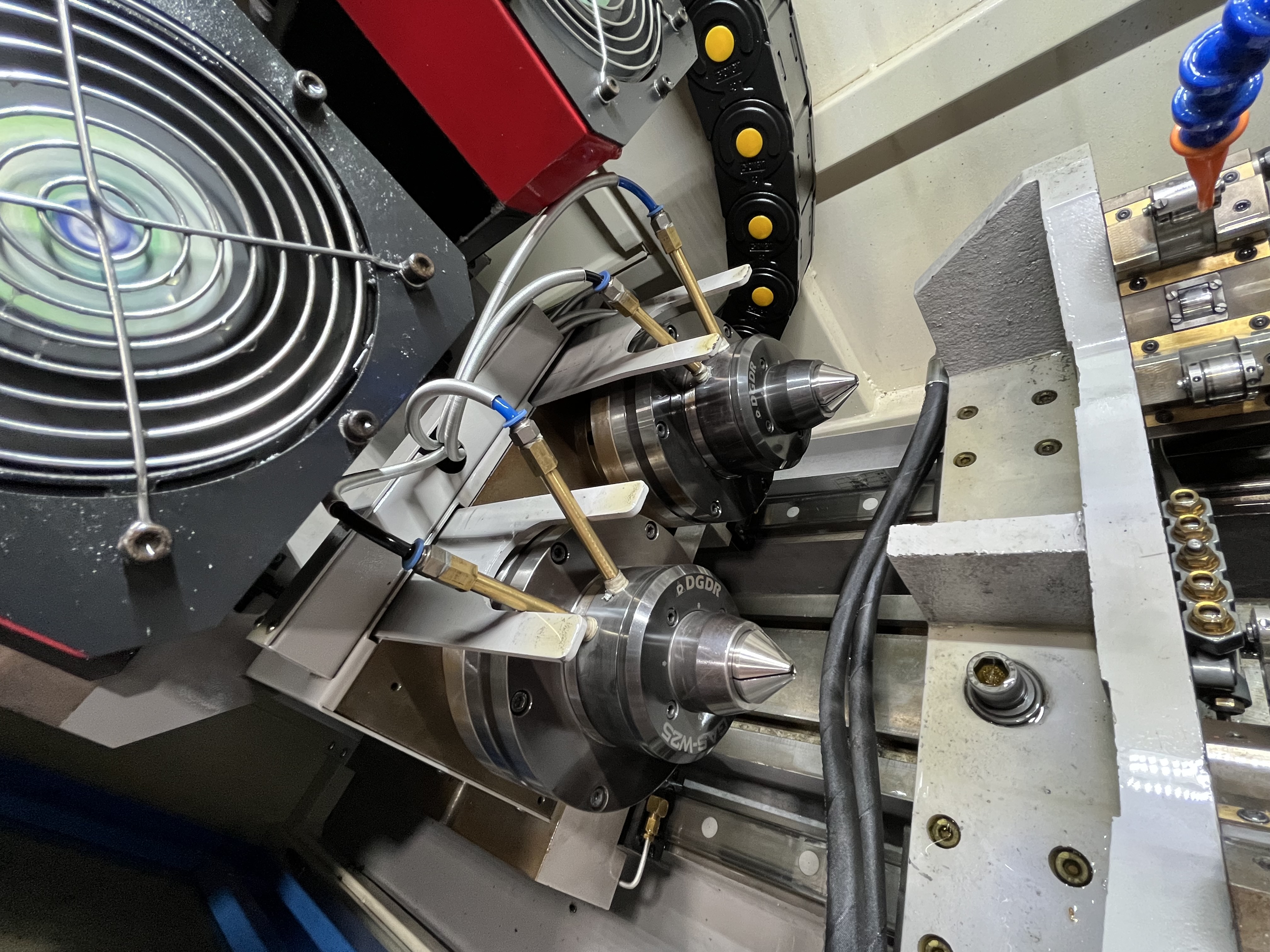
Tool holder runout directly affects hole quality in deep hole drilling. I have measured the runout difference between collet holders and side-lock holders on dozens of gun drill setups, and the gap is significant enough to dictate which holder I use for each job. A difference of 0.01mm in runout at the holder can become 0.05mm or more at the drill tip.
Problem Description
Runout at the cutting edge causes the drill to cut unevenly. One side of the drill takes more material than the other, producing an oversized hole and accelerated tool wear. On gun drills, which rely on a single cutting edge and two guide pads, runout pushes one guide pad against the bore wall harder than the other, causing rapid pad wear and poor surface finish.
| Parameter | Collet Holder | Side-Lock Holder |
|---|---|---|
| Typical runout range | 0.005-0.010mm | 0.010-0.025mm |
| Grip mechanism | Circumferential clamping | Single-point set screw |
| Repeatability | +/-0.003mm | +/-0.010mm |
| Best application | Precision gun drilling | General purpose drilling |
| Cost (relative) | Higher | Lower |
I check runout with a dial indicator on every new tool setup. The measurement is taken at the holder nose and again 100mm from the holder face to detect any tilt. A holder that measures 0.008mm at the nose but 0.030mm at 100mm has angular runout, which is worse than concentric runout alone.
Root Causes of Runout
Side-lock holders produce more runout because of their design. The set screw pushes the tool shank against the opposite wall of the holder bore. This single-point contact forces the shank off-center. The amount of offset depends on how hard the screw is tightened. A 0.020mm offset at the holder becomes 0.080mm at a 400mm-long gun drill tip because of lever arm amplification.
Collet holders clamp the shank evenly around the full circumference. A precision ER collet holder compresses the collet evenly and centers the shank within 0.005mm in most cases. Hydraulic chucks take this further by using oil pressure to apply uniform radial force, achieving 0.003mm or better.
Dirt on the holder taper is the most common cause of runout that I see in practice. A single chip or piece of debris on the spindle taper face can tilt the holder by 0.010-0.020mm. I clean both the spindle bore and the holder taper with a lint-free cloth before every tool change.
| Runout Cause | Typical Contribution | Fix |
|---|---|---|
| Dirty taper | 0.010-0.020mm | Clean with lint-free cloth |
| Side-lock offset | 0.010-0.025mm | Switch to collet holder |
| Worn collet | 0.005-0.015mm | Replace collet |
| Defective holder | 0.010-0.050mm | Replace holder |
| Spindle bearing wear | 0.005-0.030mm | Repair spindle |
Selection Guidelines
I use collet holders for all gun drilling work where hole tolerance is under H8. The hydraulic collet holder is my first choice for drills over 6mm diameter. The hydraulic grip provides 0.003mm runout and excellent damping. ER collet holders are my second choice for drills under 6mm where hydraulic chucks are not available in the right size.
Side-lock holders work for roughing operations and for drills larger than 25mm where collet holders are not available in the size range. I accept the 0.015-0.025mm runout on these jobs because the hole tolerance is usually H10 or looser.
I apply a simple rule: if the hole tolerance is within 0.05mm of the nominal diameter, I use a collet holder. If the tolerance is 0.1mm or wider, a side-lock holder is adequate. This rule has served me well across hundreds of jobs.
Material and Coating Effects
The tool shank material and finish affect how well each holder type grips. Hardened shanks above 55 HRC provide better grip in collet holders because the collet fingers do not dig into the shank surface. Soft shanks below 40 HRC can deform under collet pressure and change the runout after the first few holes.
| Shank Condition | Collet Holder Grip | Side-Lock Holder Grip |
|---|---|---|
| Hardened (>55 HRC) | Excellent, consistent | Good, set screw marks shank |
| Ground finish | Excellent | Good |
| Unhardened (<40 HRC) | Good, may mark shank | Poor, set screw deforms shank |
| Worn or undersized | Poor, runout increases | Poor, screw cannot center |
Tool coatings also interact with the holder. TiN and TiAlN coatings on the shank reduce friction and can cause the drill to slip in a side-lock holder under heavy feed. I use collet holders for coated drills to avoid slippage.
I have also found that side-lock holders work better with carbide shanks than with steel shanks. Carbide is stiffer and resists the deformation caused by the set screw. For drills with carbide shanks, side-lock holders can achieve 0.015-0.020mm runout, which is acceptable for many jobs.
Measurement and Correction
I measure runout with a dial indicator graduated in 0.001mm. The indicator tip contacts the holder OD near the nose. I rotate the spindle by hand and record the total indicator reading. The TIR should not exceed 0.010mm for a collet holder or 0.025mm for a side-lock holder.
When runout exceeds these limits, I check the holder taper for debris first. If the taper is clean, I mark the high spot on the holder and rotate it 180 degrees in the spindle. If the TIR stays in the same spindle orientation, the holder is defective. If the TIR follows the holder, the spindle taper needs inspection.
I replace collets when they show visible wear or when the TIR exceeds 0.015mm with a known-good holder. Collets wear at the fingers and the clamping surface. A worn collet cannot center the tool even if the holder body is perfect.
Cost Considerations
Collet holders cost more initially than side-lock holders. A precision ER collet holder runs $80-150. A hydraulic chuck costs $300-600. A side-lock holder costs $40-80. The higher cost of collet holders is justified when the hole tolerance requires it.
| Holder Type | Typical Cost | Runout | Best For |
|---|---|---|---|
| Side-lock | $40-80 | 0.010-0.025mm | General drilling, roughing |
| ER collet | $80-150 | 0.005-0.010mm | Precision gun drilling |
| Hydraulic chuck | $300-600 | 0.003-0.005mm | Highest precision jobs |
| Shrink fit | $150-300 | 0.003-0.005mm | High-speed applications |
The cost of the holder is small compared to the cost of scrapped parts from runout. A single scrapped part on a high-value deep hole job can cost more than a full set of hydraulic chucks. I choose the holder based on the job requirements, not the upfront cost.
Key Takeaways
- Collet holders provide 0.005-0.010mm runout versus 0.010-0.025mm for side-lock holders.
- Dirt on the holder taper is the number one cause of excessive runout in practice.
- Hydraulic chucks provide the best runout at 0.003mm for precision gun drilling jobs.
- Use collet holders for tolerances under H8 and side-lock holders for H10 and looser.
- Check runout at the holder nose and at 100mm extension to detect angular runout.